Nord Stream Pipeline
The Nord Stream pipeline is back in the news following the renewed tensions between the West and Russia over Ukraine.
- Owned by the Russian energy giant, Gazprom, Nord Stream Pipeline is the longest subsea pipeline.
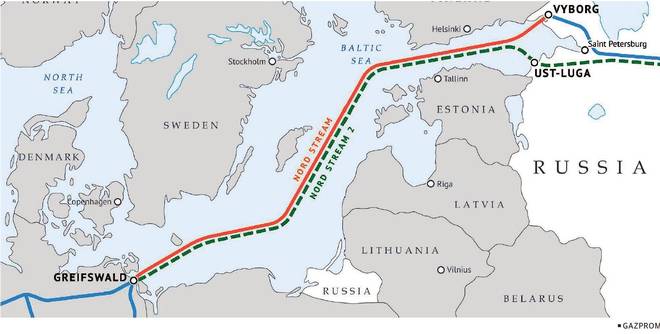
- It is an export gas pipeline that runs under the Baltic Sea carrying gas from Russia to Europe.
- The gas for Nord Steam comes mainly from the Bovanenkovo oil and gas condensate deposit in Western Siberia.
- Nord Stream consists of two pipelines, which have two lines each.
- Nord Stream 1 which runs from Vyborg in Leningrad (Russia) to Lubmin near Greifswald, Germany was completed in 2011.
- Nord Stream 2 which runs from Ust-Luga in Leningrad to Lubmin was completed in 2021.
- Twin pipelines of the Nordstream together can transport a combined total of 110 billion cubic metres (bcm) of gas a year to Europe for at least 50 years.
- The pipeline’s significance comes from the fact that it bypasses transit countries, making it highly reliable for European customers.
- The Nord Stream crosses the Exclusive Economic Zones (EEZs) of several countries including Russia, Finland, Sweden, Denmark and Germany, and the territorial waters of Russia, Denmark, and Germany.
- In Germany, the pipeline connects to the OPAL (Baltic Sea Pipeline) and NEL (North European Pipeline) which further connects to the European grid.
Reference
https://www.thehindu.com/news/international/explained-the-importance-of-the-nord-stream-pipeline/article38352754.ece
Pradhan Mantri Kisan Mandhan Yojana
Union Minister for Agriculture and Farmers Welfare said that a total of 21,86,918 farmers are enrolled in the Pradhan Mantri Kisan Mandhan Yojana.
- Pradhan Mantri Kisan Maan Dhan Yojna (PMKMY) is a voluntary and contributory pension scheme for the Small & Marginal Farmers (SMFs).
- It is being implemented in order to provide old age protection and social security net to the SMFs by way of pension.
- Under this scheme, provision has been made for payment of a minimum fixed pension of Rs. 3,000/- to the eligible SMFs, subject to certain exclusion clauses, on attaining the age of 60 years.
- Eligibility - The beneficiary should be a Small and Marginal Farmer.
- They must have cultivable landholding up to 2 hectares.
- The entry age of the scheme is 18 to 40 years.
- The beneficiary should not be SMFs covered under any other statuary social security schemes such as NPS, Employees’ State Insurance Corporation scheme, Employees’ Fund Organization Scheme etc.
- They should not have opted for Pradhan Mantri Shram Yogi Maandhan Yojana and National Pension Scheme for Traders and Self Employed Persons administered by the Ministry of Labour & Employment.
- Should not be from categories of beneficiaries of higher economic status.
- Contribution - The eligible beneficiary can opt to become member of the Scheme by subscribing to a Pension Fund.
- The beneficiary is required to contribute Rs 100/ - per month at median entry age of 29 years.
- The Central Government also contributes to the Pension Fund in equal amount, managed by the Life Insurance Corporation, which is also responsible for pension pay out.
- Status - As the Scheme has an entry age of 18 to 40 years, no beneficiary has yet attained the age of 60 to be eligible for payment.
Reference
- https://pib.gov.in/PressReleasePage.aspx?PRID=1795456
- https://maandhan.in/scheme/pmkmy
Pandit Bhimsen Joshi
The Prime Minister has remembered Pandit Bhimsen Joshi on his 100th birth anniversary.
- Born in 1922 at Ron, Gadag district, Karnataka, Bhimsen Joshi was the eldest among 16 children born to Gururaj Joshi and Godavaribai.
- He left home at a young age in pursuit of music and a suitable guru.
- He found his guru Pandit Sawai Gandharva at Kundagol, Dharwad district.
- There he met Gangubai Hangal, another disciple of Sawai Gandharva, whom he fondly called ‘akka’ (elder sister).
- Gangubai went on to become a doyenne of Hindustani classical music and settled down in Hubballi.
- After the training, the ‘Ganda Bandhan’ (ritual that creates a bond between guru & disciple) took place in Dharwad, where Bhimsen Joshi chose to settle down.
- When All India Radio opened a station in Dharwad in 1950, the inaugural song Vande Mataram was sung by Pandit Bhimsen Joshi, Gangubai Hangal, Mallikarjun Mansur and Basavaraj Rajguru.
- He organised the Sawai Gandharva Music festival in Pune.
Reference
- https://pib.gov.in/PressReleasePage.aspx?PRID=1795594
- https://www.thehindu.com/news/national/karnataka/pandit-bhimsen-joshi-from-a-small-town-boy-to-bharat-ratna/article38370340.ece
Saint Ramanujacharya
Prime Minister will inaugurate the Statue of Equality, a gigantic statue of Ramanujacharya, on the outskirts of Hyderabad.
- Born in 1017 in Sriperumbudur in Tamil Nadu, Ramanujacharya is revered as a Vedic philosopher and social reformer.
- Ramanuja travelled across India, advocating equality and social justice.
- He revived the Bhakti movement, and his preachings inspired other Bhakti schools of thought.
- He is considered to be the inspiration for poets like Annamacharya, Bhakt Ramdas, Thyagaraja, Kabir, and Meerabai.
- From the time he was a young budding philosopher, Ramanuja appealed for the protection of nature and its resources like air, water, and soil.
- He went on to write nine scriptures known as the navaratnas, and composed numerous commentaries on Vedic scriptures.
- Ramanuja is credited with establishing the correct procedures for rituals performed in temples throughout India, the most famous being Tirumala and Srirangam.
- Reason to build the Statue of Equality - Ramanuja was an advocate of social equality among all sections of people centuries ago.
- He encouraged temples to open their doors to everyone irrespective of caste or position in society at a time when people of many castes were forbidden from entering them.
- He took education to those who were deprived of it.
- His greatest contribution is the propagation of the concept of “vasudhaiva kutumbakam”, which translates as all the universe is one family.
- He travelled across India for several decades, propagating his ideas of social equality and universal brotherhood from temple podiums.
- He embraced the socially marginalised and condemned, and asked royal courts to treat them as equals.
- He spoke of universal salvation through devotion to God, compassion, humility, equality, and mutual respect, which is known as Sri Vaishnavam Sampradaya.
- The Vaishnava seer behind the Statue of Equality, Ramanujacharya’s social philosophy was designed to cross the boundaries of the caste system and to embrace the whole of humanity.
- Ramanujacharya liberated millions from social, cultural, gender, educational, and economic discrimination with the foundational conviction that every human is equal regardless of nationality, gender, race, caste, or creed.
Reference
https://indianexpress.com/article/explained/ramanujacharya-statue-of-equality-explained-7754236/
Moons Make Planets Habitable
A new study has examined the moon formations and concluded that only certain types of planets can form moons that are large in respect to their host planets.
- Earth's moon is vitally important in making Earth the planet we know today - The moon controls the length of the day and ocean tides, which affect the biological cycles of life forms on our planet.
- The moon also contributes to Earth's climate by stabilizing Earth's spin axis, offering an ideal environment for life to develop and evolve.
- Because the moon is so important to life on Earth, scientists conjecture that a moon may be a potentially beneficial feature in harboring life on other planets.
- Most planets have moons, but Earth's moon is distinct in that it is large compared to the size of Earth.
- The moon's radius is larger than a quarter of Earth's radius, a much larger ratio than most moons to their planets.
- By understanding moon formations, we have a better constraint on what to look for when searching for Earth-like planets.
- It is expected that the exomoons [moons orbiting planets outside our solar system] should be everywhere, but so far we haven't confirmed any.
- These constraints will be helpful for future observations.
Origin of Earth's Moon
- Many scientists have historically believed Earth's large moon was generated by a collision between proto-Earth and a large, Mars-sized impactor, approximately 4.5 billion years ago.
- [Proto-Earth is the Earth at its early stages of development.]
- The collision resulted in the formation of a partially vaporized disk around Earth, which eventually formed into the moon.
- In order to find out whether other planets can form similarly large moons, the study conducted impact computer simulations, with a number of hypothetical Earth-like rocky planets and icy planets.
- They hoped to identify whether the simulated impacts would result in partially vaporized disks, like the disk that formed Earth's moon.
- The researchers found that rocky planets larger than six times the mass of Earth (6M) and icy planets larger than one Earth mass (1M) produce fully -- rather than partially -- vaporized disks, and these fully-vaporized disks are not capable of forming fractionally large moons.
- We found that if the planet is too massive, these impacts produce completely vapor disks because impacts between massive planets are generally more energetic than those between small planets.
- After an impact that results in a vaporized disk, over time, the disk cools and liquid moonlets -- a moon's building blocks -- emerge.
- In a fully-vaporized disk, the growing moonlets in the disk experience strong gas drag from vapor, falling onto the planet very quickly.
- In contrast, if the disk is only partially vaporized, moonlets do not feel such strong gas drag.
- As a result, we conclude that a completely vapor disk is not capable of forming fractionally large moons.
- Planetary masses need to be smaller than those thresholds we identified in order to produce such moons.
Reference
https://www.sciencedaily.com/releases/2022/02/220201144027.htm



