Environmental Information, Awareness, Capacity Building and Livelihood Programme (EIACP)
The Ministry of Environment, Forest and Climate Change (MoEF&CC), envisages to celebrate the World Environment Day 2023 with a thrust on the Mission LiFE.
EIACP
- The Environmental Information System (ENVIS) came into existence as a plan programme in 1983.
- ENVIS has been subsumed within the revamped scheme of Environment Education, Awareness, Research and Skill Development.
- ENVIS is renamed as EIACP (Environmental Information, Awareness, Capacity Building and Livelihood Programme).
- EIACP serves as a one stop platform for dissemination of environmental information, policy formulation on environment and facilitation of alternate livelihoods through green skilling.
- The programme is one of the Central Sector sub-scheme being implemented in alignment with Mission LiFE.
- EIACP Hub on Status of Environment Related Issues is hosted by the Indian State Level Basic Environmental Information Database (ISBEID).
- The ISBEID is a centralised database maintained by the Ministry of Environment, Forest and Climate Change, Government of India for all the States.
- EIACP conducts Environmental Awareness Programs to School Children, Colleges and Universities on Environmental Important Days like, World Environment Day, World Earth Day, etc.
Reference
- PIB │EIACP
- EPTRI │EIACP
Himalayan Brown Bear (Ursus arctos isabellinus)
Encroachment pushes Himalayan brown bears into Kashmir’s villages.
- Description – The Himalayan brown bear is the largest mammal found in Kashmir.
- It is considerably smaller than the Grizzly and the Kodiak bears.
- Behaviour – This is the least arboreal (living in trees) bear and is largely terrestrial as an adaptation to life in the rolling uplands above the tree line.
- It hibernates (Meaning) in winter.
- Hibernation is the condition or period of an animal or plant spending the winter in a dormant state.
- Distribution – Through the Western Himalayan states of Jammu & Kashmir Himachal Pradesh and Uttarakhand (3000-5000 m).
- It is found from northern Afghanistan, northern Pakistan, northern India, west China and Nepal.
- Populations are present in the Great Himalayan National Park (Himachal Pradesh) and the Deosai National Park, Pakistan.
- They may also be present in south and western Ladakh, in the upper Suru and Zanskar valleys.
- Habitat – It is not primarily a forest animal and inhibits alpine scrub and meadows above the tree line although it is occasionally found in subalpine forests.
- Threats – They are threatened by habitat destruction due to various anthropogenic pressures such as habitat encroachment, tourism, and grazing pressure.
- The Himalayan brown bear population has been steadily declining in the past century with only an estimated 500-750 bears left in India.
|
Protection Status
|
|
IUCN Status
|
Critically Endangered
|
|
Wildlife (Protection) Act of 1972
|
Schedule I
|
|
CITES
|
Appendix I
|
Brown bears are distributed worldwide and include the famous Grizzly of North America.

Reference
- Down To Earth │Himalayan Brown Bear
Petroleum Coke (Pet Coke)
Government permits import of pet coke as raw material for lithium-ion batteries.
- Petcoke is a by-product created when bitumen found in tar sands, is refined into crude oil.
- Bitumen is a sticky, black, highly viscous liquid or semi-solid form of petroleum.
- It is a carbon-rich solid material derived from a thermo-based chemical engineering process.
- It is a spongy, solid residue from oil distillation that can be burned for fuel similar to coal.
- The process splits long chain hydrocarbons of petroleum into shorter chains that takes place in coker units.
- There are two distinctive grades of Petroleum Coke viz. Calcinable or Green Petcoke and Fuel Grade Petcoke.
- Production – Calcinable grade coke or Green Petcoke, also referred as RPC is produced at Koyali, Barauni, Bongaigaon, Digboi and Guwahati refineries of IndianOil.
- Fuel Grade Petcoke is produced at Panipat, Paradip, Koyali and Haldia refineries of IndianOil.
- Petcoke, a by-product from oil refining and a substitute for coal is referred by India due to the surge in the global prices of coal.
- The ongoing Russia-Ukraine war resulted in a hike in the price of commodities such as coal, and crude oil.
- Indian firms are also buying Petcoke from Venezuela because the country is offering the same at a discounted rate of 5-10% lower than the US.
- The world’s biggest consumer of Petcoke, India imports over half of its annual Petcoke from the US which is around 27 million tonnes.
- Applications – It is used as a feed stock or for fuels and is used in making cement, lime kilns, gasification units, and industrial boilers.
- It is used as a carbon source in Electrodes for electrometallurgical industries, Synthetic Graphite, Aluminium Anodes, TiO2 pigments, Carbon Raiser.
- Difference between Coke and Coal:
|
Coke
|
Coal
|
- Charcoal is a type of fuel created when the wood is burned incompletely.
|
- When burned, coal is a glossy, black fossil fuel that contains impurities, produces smoke, and produces less heat than coke.
|
- Coke is a carbon-based fuel manufactured from calcined or dry-distilled mineral coal.
|
- Coal is a soiled, black coal waste that burns hotter and cleaner than regular coal.
|
- It is carbon-based and has a high calorific value.
|
- Coal is not a renewable resource.
|
- It is used as a fuel in steel foundries' blast furnaces.
|
- It is commonly used to generate electricity.
|
Reference
- Business Standard │ Pet coke as raw material for lithium-ion batteries
Myristica swamps
Climate change and human intervention threaten the Myristica swamps of Kerala.
- Myristica swamps are freshwater swamps predominated by members of the Myristicaceae family.
- The evergreen trees have evolved to live in the waterlogged conditions of the swamps.
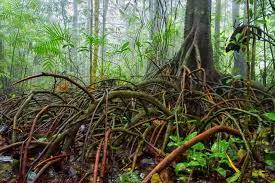
- They have two types of roots, knee roots (pneumatophores) and stilt root.
- They have evolved over millions of years and are comprised of old-growth trees.
- Location – In India, these unique habitats occur in the Western Ghats and a smaller distribution exists in the Andaman and Nicobar Islands.
- Myristica swamps are seen next to rivers and help in retaining water and act as a sponge, ensuring perennial water availability.
- Important Species – Gymnocranthera canarica and Myristica fatua — belonging to the primitive Myristicaceae family.
References
- The Hindu │ Climate change threaten the Myristica swamps
- Conservation India │ Conserving Threatened Myristica Swamps
Smart Bandage
A new ‘smart bandage’ raises the bar for treating chronic wounds.
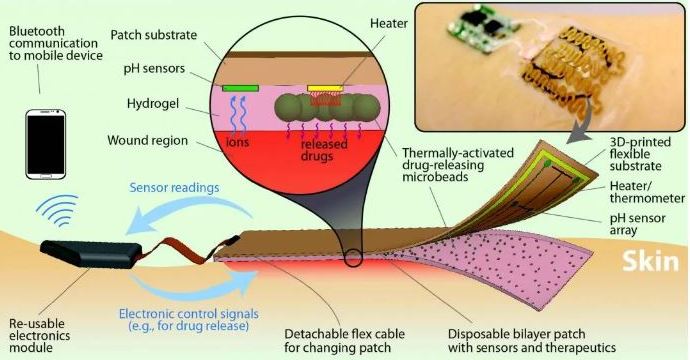
- The smart bandage is a soft stretchable polymer that helps the bandage maintain contact with and stick to the skin.
- The bioelectronics system consists of biosensors that monitor biomarkers in the wound exudate.
- Data collected by the bandage is passed to a flexible printed circuit board, which relays it wirelessly to a smartphone or tablet for review by a physician.
- A pair of electrodes control drug release from a hydrogel layer as well as stimulate the wound to encourage tissue regrowth.
- Working of smart bandages - Biosensors determine the wound status by tracking the chemical composition of the exudates, which changes as the wound heals.
- Additional sensors monitor the pH and temperature for real-time information about the infection and inflammation.
- A pair of electrodes, the same electrodes that stimulate the tissue, control the release of drugs from a hydrogel layer.
- The wireless nature of the device sidesteps the problems of existing electrical stimulation devices, which usually require bulky equipment and wired connections, limiting their clinical use.
Reference
- The Hindu │ Smart Bandage



