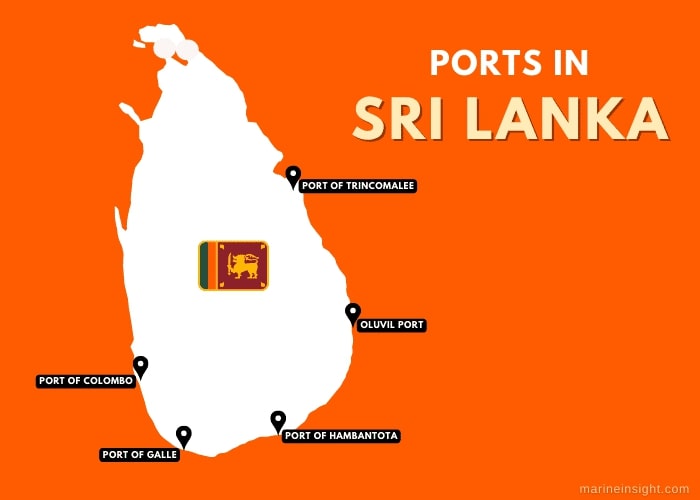
Hambantota Port
India has raised its concern about the scheduled visit of a Chinese satellite vessel to the Hambantota port, Sri Lanka to the Sri Lankan President.
- Hambantota port is also known as the Magampura Mahinda Rajapaksha port.
- It is a deep-water port situated in the southern part of Sri Lanka.
- It is close to the Asian and European maritime trade routes, the Suez Canal and Malacca Strait.
- It was constructed in 2008 with Chinese financial aid, and given to China on a 99-year lease.
- The growing congestion at Colombo port was the primary reason for constructing Hambantota.
- It was also envisaged to solve the country’s logistical problems and offer quick access to the international shipping lanes.
- The port has led to the emergence of conflict between the Asian powers, India and China since,
- China seeks to establish its paramountcy in the Indian Ocean and,
- India strives to maintain a natural defence area.
Disadvantages to India
- India is apprehensive that the port is part of Chinese ‘string of pearls’ with an objective to surround India and dock its military vessels.
- The String of pearls is a geopolitical theory on potential Chinese intentions in the Indian Ocean region.
- It refers to the network of Chinese military and commercial facilities and relationships along its sea lines of communication extending from the Chinese mainland to Port Sudan.
- These sea lines run through several major maritime choke points such as
- The Strait of Mandeb,
- The Strait of Hormuz,
- The Strait of Malacca,
- The Lombok Strait, and
- Other strategic maritime centres in Pakistan, Maldives, Sri Lanka, Bangladesh, and Somalia.
Reference
- https://www.thehindu.com/todays-paper/tp-national/india-shares-concern-over-chinese-ship/article65713779.ece
- https://www.marineinsight.com/know-more/5-major-ports-of-sri-lanka/#2_Port_of_Hambantota
- http://www.hipg.lk/about-us/hipg
Odesa Port
The first shipment of Ukrainian grain since the Russian invasion in February 2022 left the port of Odesa under a landmark deal to lift Moscow’s naval blockade in the Black Sea.
The milestone comes after the United Nations and Turkey signed agreements with Russia and Ukraine to re-open Ukraine's Black Sea ports and resume exports of grain, cooking oil and fertilizer.
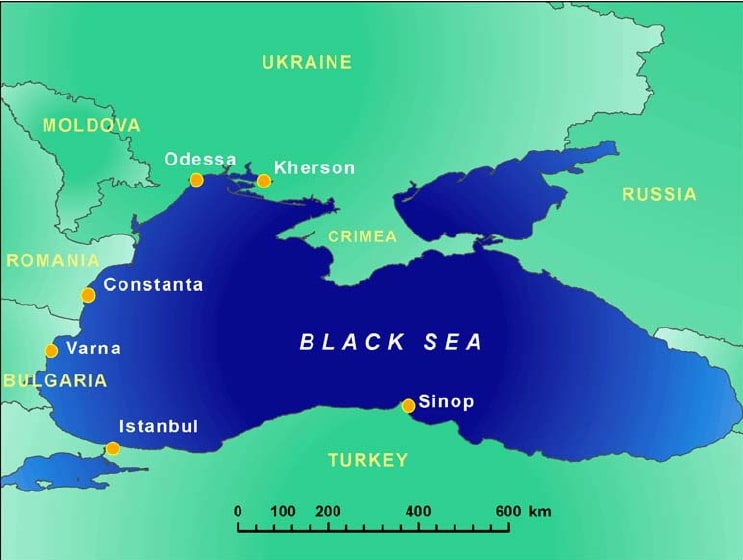
- Odessa Sea Port (UAODS Port) is the largest Ukrainian seaport and one of the largest ports in the Black Sea basin.
- Its total annual traffic capacity is 40 million tonnes.
- The types of vessels regularly calling at Odessa are Bulk Carrier (100%).
- Along with its younger satellite ports of Chornomorsk (1958) and Yuzhne (1973), port of Odessa is a major freight and passenger transportation hub of Ukraine.
- Odesa is the base of a fishing fleet as well as the chief operational hub of the Ukrainian Navy. Odesa is also an important cultural and educational centre.
Reference
- https://www.thehindu.com/todays-paper/tp-international/first-ship-of-ukrainian-grain-leaves-odesa-port/article65714379.ece
- https://www.npr.org/2022/08/01/1114819095/first-grain-ship-leaves-ukraine-odesa
- https://www.britannica.com/place/Odessa-Ukraine
- https://www.searates.com/port/odessa_ua
- https://www.marinetraffic.com/en/ais/details/ports/124?name=ODESSA&country=Ukraine
School Innovation Council
The School Innovation Council was launched and has been introduced to all schools of all the states.
- The School Innovation Council (SIC) is an initiative taken by
- The Ministry of Education’s Innovation Cell (MIC) and
- The All India Council for Technical Education (AICTE).
- SIC is a council of teachers, students, and experts from industry and academia to conduct year-round activities for students and teachers on Innovation and Entrepreneurship.
- SIC will enable mindset change, awareness, and training on Ideation, Innovation and Entrepreneurship, design thinking, Intellectual Property Rights, start-up finance, and HR among School teachers and students.
- SIC will promote out of box thinking in school education as envisioned in National Innovation and National Education Policy 2020.
- It will also enable the ranking system for schools on the level of innovation-oriented activities.
- To implement the SIC council in all schools across the nation, SIC portal has been developed where schools can register themselves.
- SIC will link schools with Innovation Councils established by MIC at Higher Education Level to further provide exposure to school students.
School Innovation Ambassador Training Program
- School Innovation Ambassador Training program (SIATP) was launched to strengthen the mentoring capacity of teachers for cultivating and handholding innovative and ingenious ideas from students.
- The SIATP program has been conceptualised by MIC and AICTE to train the school teachers across country.
- Under SIATP, teachers undergo 72 hours of training, and those who qualify all the following five modules with a minimum 50% as passing marks are recognized as “Innovation Ambassadors”.
- Design Thinking & Innovation;
- Idea generation & Idea hand-holding;
- Finance/Sales/HR;
- Intellectual Property Rights (IPR);
- Entrepreneurship and Prototype/ Product Development.
- The “Innovation Ambassadors” are competent to nurture the young school students on Ideation, IPR, product development, design thinking, problem-solving, critical thinking and skills of entrepreneurship.
Reference
- https://pib.gov.in/PressReleasePage.aspx?PRID=1847064
- https://sic.mic.gov.in/
- https://sia.mic.gov.in/
Pyrene Remediation
Researchers at the Council of Scientific & Industrial Research-Indian Institute of Petroleum (CSIR-IIP), Dehradun have identified white-rot fungus Trametes maxima IIPLC-32 to be capable of pyrene remediation.
- Pyrene, possessing four fused benzene rings, is a parent class of Polycyclic Aromatic Hydrocarbons (PAHs).
- Pyrene is a highly toxic, recalcitrant, and carcinogenic PAHs found in the environment.
- Rapid pace of economic development and industrialisation has resulted in the release of several PAHs into the environment.
- The PAHs are ubiquitous environmental pollutants originating from multiple sources, including combustion of petrogenic fossil fuels, and incomplete incineration of municipal wastes and biomass.
- It gets lodged into the environmental matrices like soil, water and atmosphere.
- This results in widespread environmental pollution, necessitating adequate remediation of contaminated environmental matrices.
- Remediation is the action of remedying something, in particular of reversing or stopping environmental damage.
- Pyrene Remediation is the action of remedying the environment by removing pyrene from the environment.
- The fungus Trametes maxima IIPLC-32 has the potential to cause microbial degradation of pyrene using special enzymes.
- Growing on dead plants, this fungus can remove pyrene from the environment.
- This fungus acts to decrease the pollution level of the soil, thereby improving the soil quality.
- In the future, T.maxima IIPLC-32 can be tried for the bioremediation of PAH-contaminated aquatic environments.
Reference
- https://www.downtoearth.org.in/news/environment/researchers-identify-fungus-for-pyrene-remediation-84090
- https://pubchem.ncbi.nlm.nih.gov/compound/Pyrene
- https://www.sciencedirect.com/topics/agricultural-and-biological-sciences/remediation#:~:text=Physical%20remediation%20is%20the%20process,a%20number%20of%20physical%20means.
Arab Spring
- Arab Spring is a wave of pro-democracy protests and uprisings that took place in the Middle East and North Africa beginning in 2010 and 2011.
- This pro-democracy wave challenged some of the region’s entrenched authoritarian regimes.
- It began when protests in Tunisia and Egypt toppled their regimes in quick succession, inspiring similar attempts in other Arab countries.
- However, not every country saw success in the protest movement.
Jasmine Revolution of Tunisia
- In 2010, deadly protests began, and spread from the town of Sidi Bouzid across the country.
- The then President Zine el-Abidine Ben Ali fled in January 2011, inspiring revolts elsewhere.
- Tunisia held a first democratic election in October 2011, which was won by the once-banned moderate Islamist Ennahda.
- A new constitution establishing a parliamentary system was agreed in 2014, and Tunisians choose their lawmakers and president in free and fair elections, most recently in 2019.
- Issues - Economic troubles caused hardship and disillusionment.
- Illegal emigration to Europe increased.
- The economy, heavily dependent on tourism, was hit particularly hard by COVID-19.
- In 2021, President Kais Saied froze parliament and sacked the government.
- In 2022, he called a referendum on a new constitution that strengthened the presidency, capping what his opponents called a march to one-man rule.
Egypt Uprising of 2011
- President Hosni Mubarak had been in power since 1981, but massive anti-government protests began in 2011, inspired by Tunisia.
- As hundreds of thousands of protesters massed after Friday prayers, Mubarak deployed the military.
- Protests gathered momentum, police were pulled from the streets and the army stood back until Mubarak stepped down - to be tried on charges of abusing power and killing demonstrators.
- The once-banned Muslim Brotherhood won the 2012 election.
- However, a year later the military, which was encouraged by anti-Brotherhood protests toppled the new president Mohamed Mursi.
- Army chief Abdel Fattah el-Sisi replaced him as president.
- Rights groups documented abuses in a crackdown on dissent and the military faced a long-running insurgency from Islamist militants in Sinai.
Yemen Uprising of 2011-2012
- Crowds took to the streets against President Ali Abdullah Saleh in 2011, aggravating splits in the army and between political blocs.
- As Saleh was hurt in an assassination attempt, he sought treatment in Saudi Arabia.
- Gulf States brokered a transition deal including a “national dialogue” aimed at resolving Yemen’s problems, with Saleh’s old deputy Abd-Rabbu Mansour Hadi to be president until elections.
- With an al Qaeda insurgency raging in the east, Sanaa faced new problems in the north from the Iran-allied Houthi group and from a revived southern secessionist movement.
- In 2015, after the Houthis seized Sanaa, Saudi Arabia and its allies began a military campaign to keep Hadi in power.
- This war soon reached bloody stalemate, aggravating food shortages and cholera outbreaks.
- Ex-president Saleh was killed in a roadside attack in 2017 after switching sides, abandoning the Iran-aligned Houthis for the Saudi-led coalition.
- A U.N.-backed ceasefire took effect in 2022 and Hadi was replaced by a presidential council.
Libya Revolt of 2011
- In 2011, protests broke out in Benghazi and Misrata, which soon turned to armed revolt against Muammar Gaddafi’s 42-year rule.
- The UN Security Council declared a no-fly zone to protect civilians from Gaddafi’s forces and NATO started air strikes to halt their advance on Benghazi.
- Soon, the rebels had seized Tripoli, and Gaddafi was killed in his hometown of Sirte.
- Local militias seized hold of territory and, the country split in 2014 between western and eastern factions.
- The UN helped broker a political agreement in 2015, but in practice the country stayed divided and Islamic State seized control of Sirte for more than a year.
- In 2019, eastern commander Khalifa Haftar launched a new war. This war led to an international conflict involving Russia, the UAE and Egypt backing Haftar and Turkey backing the Tripoli government.
- A U.N.-backed election - part of a peace process aimed at knitting Libya back together - was cancelled in 2021.
- In 2022, the Sirte-based parliament appointed a new prime minister but the government based in Tripoli refused to step down, leaving Libya split between rival administrations.
Syrian Civil War
- When the first protests began to spread through Syria in 2011, President Bashar al-Assad sent in security forces.
- Protesters were taking up arms and army units were joining the gathering revolt, later backed by Gulf monarchies and Turkey, as Assad hit back with air strikes. Full-blown war erupted.
- In 2014, the Islamic State group seized a swathe of territory, drawing a U.S.-led coalition to back Kurdish fighters in the northeast.
- Support from Russia, Iran and Lebanon’s Shi’ite Hezbollah movement helped Assad claw back control over much of the country.
- By the end of the decade, more than half the country’s pre-war population was displaced with the country partitioned between Assad, Turkey-backed rebels and Kurdish-led groups.
Reference
- https://indianexpress.com/article/explained/explained-what-became-of-the-arab-spring-8051102/
- https://www.britannica.com/event/Arab-Spring
- https://www.cfr.org/article/arab-spring-ten-years-whats-legacy-uprisings



