Kuril Islands
The Ukraine war has given some hope to Japanese that the Kuril Islands can be wrestled out of Russia's control.
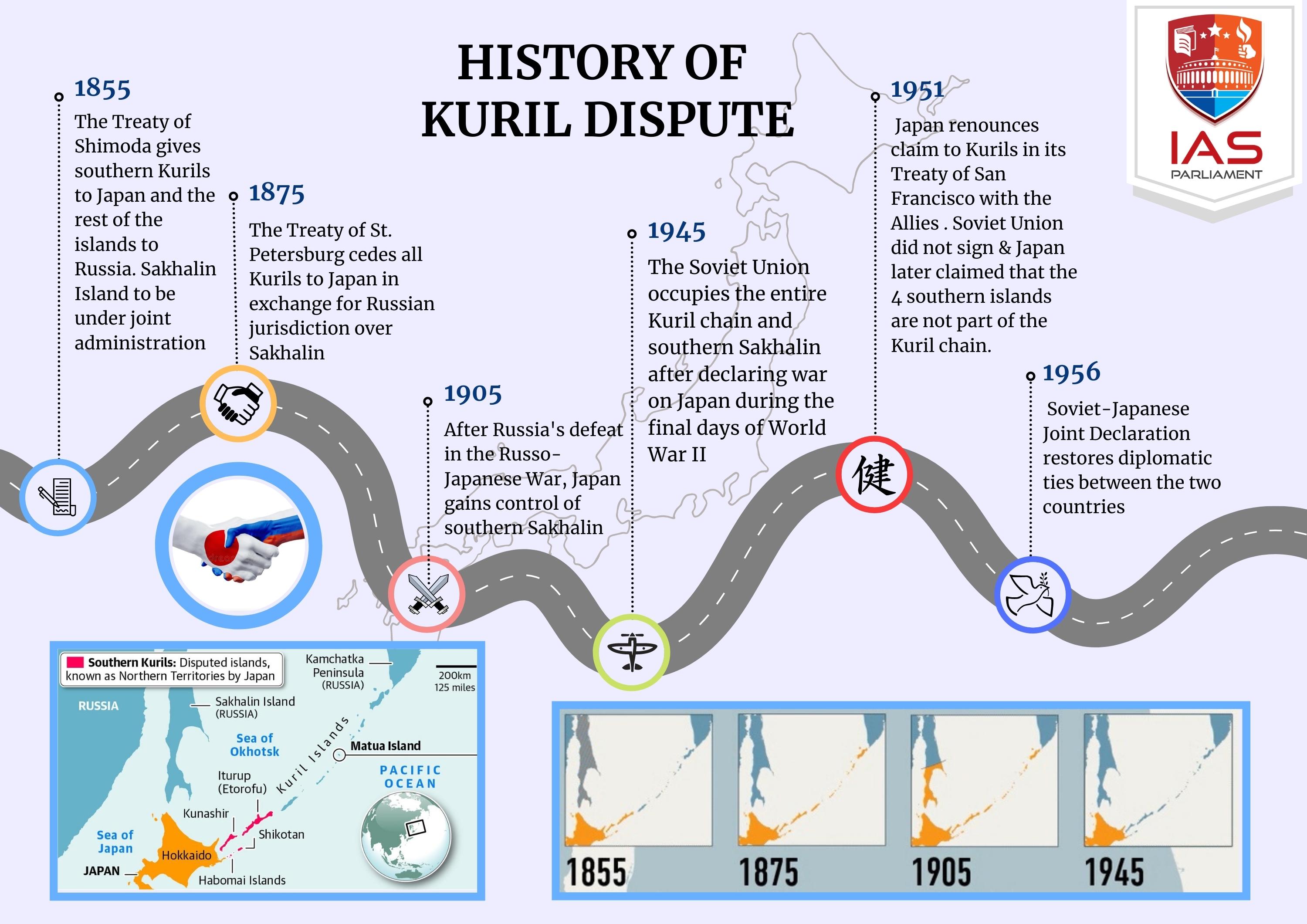
- The Kuril Islands are strategically located islands stretching between the north of Japan's Hokkaido island and the southern tip of Russia's Kamchatka Peninsula.
- These are a set of 4 islands situated between the Sea of Okhotsk and the North Pacific Ocean.
- They are - Iturup (Etorofu in Japanese), Kunashir (Kunashiri), Shikotan and Habomai Islets.
- These islands are a point of contention between Russia and Japan.
- Japan claims - The islands have been part of it since the early 19th century.
- Russia - These islands were seized by Soviet forces in the closing days of WWII.
- Japan, Russia and South Korea calls them in 3 different names.
- Japan - Northern territories
- Russia - the Kuril Islands
- South Korea - Dokdo islands
References
- IE - Could China take Kuril Islands claimed by Japan and Russia?
Paddari Tribe
The government has brought a Bill to include 4 communities in the list of Scheduled Tribes (STs) in Jammu and Kashmir: ‘Gadda Brahmin’, ‘Koli’, ‘Paddari Tribe’, and ‘Pahari Ethnic Group’ which has triggered unrest among the Gujjar-Bakerwal.
- Paddari tribes live in the remote Paddar area of the hilly Kishtwar district.
- Area - The Paddari homeland borders Zanskar (Ladakh) in the north and the east, Pangi in Himachal Pradesh in the south, and the rest of J&K in the west.
- Paddari population - 21,548 (As per 2011 census), comprising 83.6% Hindus, 9.5% Buddhists, and 6.8% Muslims.
- Language - The people of the area speak the Paddari language.
- Click here to know about - Pahari Tribes
Other Tribes in J&K
- The Gujjars and Bakerwals are the dominant ST communities in J&K.
- They are the third largest group after Kashmiris and Dogras in J&K.
- They live in the districts of Rajouri, Poonch, Reasi, Kishtwar, Anantnag, Bandipora, Ganderbal, and Kupwara.
- They are nomadic tribes.
- ST status in in J&K - Gujjars, Bakerwals, Gaddis and Sippis.
References
- IE - Who are the Paddaris proposed for ST status in J&K?
Hathnikund Barrage
The over release of water from the Hathnikund barrage is causing flooding in the national capital, New Delhi.
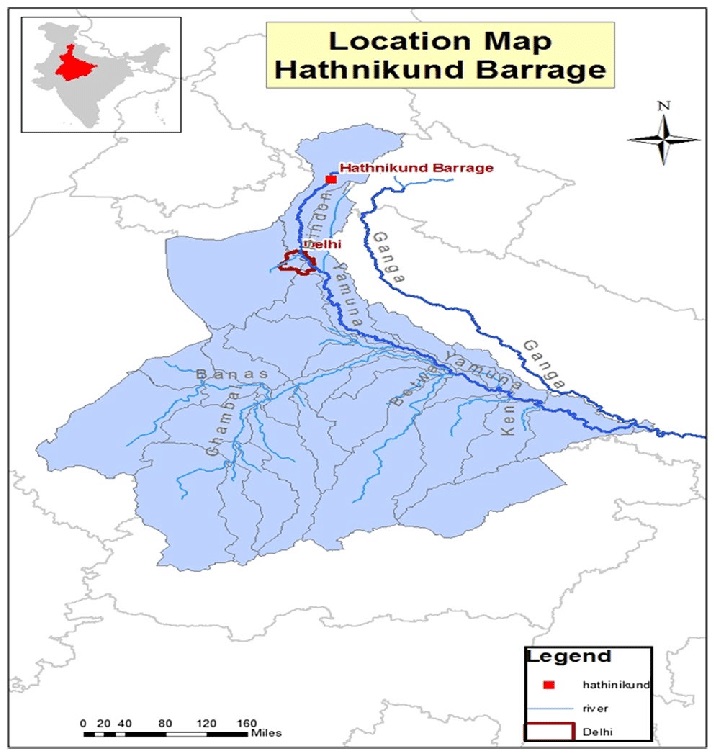
- The Hathnikund is a barrage on the river Yamuna.
- The Hathnikund barrage’s main function is to divert Yamuna’s water to the canals.
- Location - The Hathnikund barrage is located on the UP-Haryana border with the left side maintained by the UP government and the right by Haryana.
- The water management is, however, managed entirely by Haryana.
- The water from Hathnikund barrage is supplied to three channel.
- Regulating authority - Water regulation through Hathinikund barrage is regulated by the Upper Yamuna River Board.
- The board has representatives of all riparian stakeholders of the river - Himachal Pradesh, Haryana, Delhi, Uttar Pradesh, and Rajasthan.
- Every state gets the share of the water as agreed upon the agreement signed on May 12, 1994 between the states.
- Dam Vs Barrage
- A barrage regulates the diversion of river water as per demands in canals.
- A dam collects water, especially to make a reservoir.
References
- The Hindu - Hathnikund a barrage, not dam
- TOI - Hathnikund engineers say barrage of charges baseless
- Hindustan Times - Delhi flood puts Hathnikund barrage in eye of storm
Trans Lunar Injection
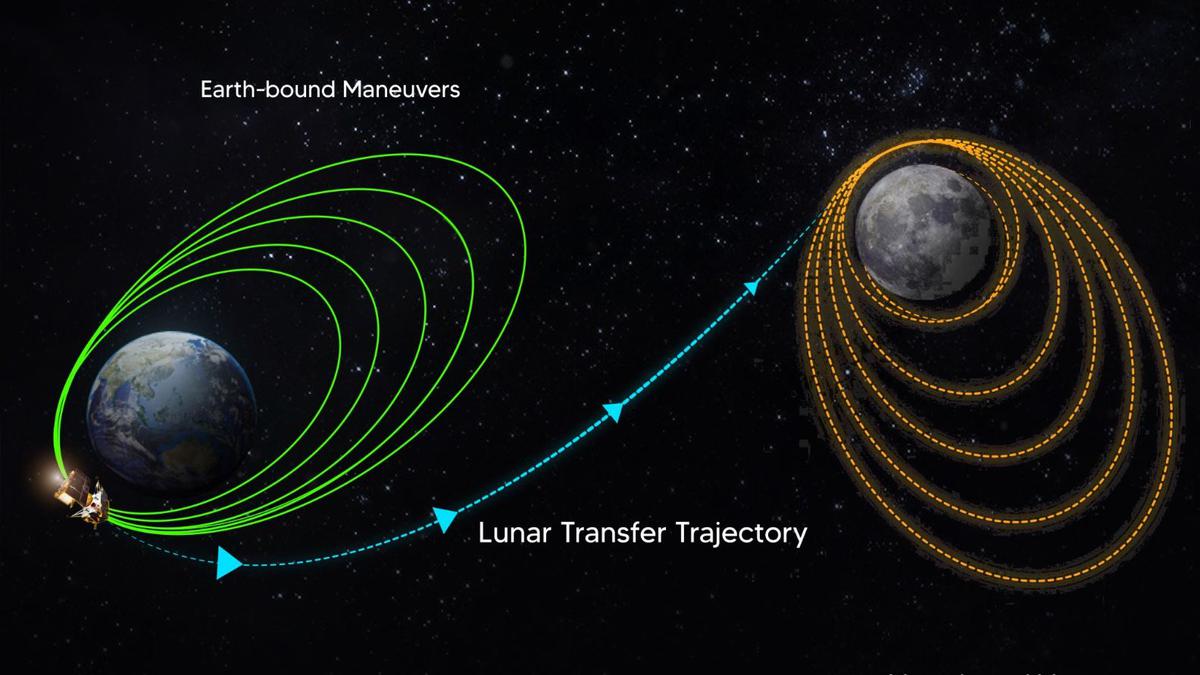
ISRO successfully conducts Trans Lunar Injection (TLI) of Chandrayaan-3 from ISRO Telemetry, Tracking and Command Network (ISTRAC) in Bengaluru.
- The Trans Lunar Injection (TLI) manoeuvre is a vital space travel technique used to launch a spacecraft from Earth's orbit and place it on a track beyond the Moon.
- Chandrayaan-3 has completed 5 orbit-raising manoeuvres around Earth and has achieved an orbit of 127,603 km x 236 km, forming an elliptical path with the farthest and closest points.
- The TLI is performed when the spacecraft is at the ‘perigee’ or the closest point to Earth.
- During this manoeuvre, its thrusters will be activated to propel the spacecraft to obtain the velocity necessary to break away from the gravitational pull of the Earth.
- The engines on the spacecraft's propulsion module will be fired to go towards the Moon.
- Lunar-Orbit Insertion (LOI) happens later once the spacecraft enter into the lunar orbit.
- The spacecraft's altitude and position is lowered into a 100 km circular orbit.
- At this point, the propulsion module will be separated from the landing module.
ISRO Telemetry, Tracking and Command Network (ISTRAC)
- ISTRAC is located in Bengaluru.
- ISTRAC holds major responsibility to provide tracking support for all the satellite and launch vehicle missions of ISRO.
- ISTRAC has a network of ground stations at Bengaluru, Lucknow, Mauritius, Sriharikota, Port Blair, Thiruvananthapuram, Brunei, Biak (Indonesia) and the Deep Space Network Stations.
References
- The Hindu - ISRO successfully conducts Trans Lunar Injection of Chandrayaan-3
- CNBC - ISRO to initiate Trans Lunar Injection for moon mission spacecraft
GI Tags from Tamil Nadu
Three famous products from Tamil Nadu - Jaderi namakatti, Kanniyakumari Matti banana, Chedibutta saree - were given the GI tag.
Jaderi namakatti
- Jaderi namakatti are white clay sticks.
- They are used to adorn the foreheads of idols, men and temple elephants.
- Composition - Rich deposit of hydrous silicate minerals that form fine grain particles of clay.
- The clay is processed and shaped in a finger like structure.
- Process - The rocks are placed in a circular pit and crushed.
- The powder is then gathered and left to soak in water in a pit for 5 days.
- It is dried, rolled into clay sticks and packed to send to temples.
- The production of namakatti depends on the climatic condition as it needs a lot of sunlight to dry.
- Place - The rock pieces are extracted at Thenpoondipatti in Tiruvannamalai district of Tamil Nadu.
- Jaderi is a small village in Cheyyar taluk in Tiruvannamalai district where around 120 families are involved in making namakatti for more than hundreds of years now.
Kanniyakumari Matti banana
- Matti banana is a traditional table banana cultivar of medicinal value.
- It is mostly grow in the Agatheeswaram, Thovalai and Thiruvattar taluks of Kanniyakumari district (Kanyakumari).
- The fruit is highly fragrant, sweet with sub-acid flavour, firm texture and powdery nature.
- The Matti banana fruit looks like mouth of a crocodile hence it is also called as ‘Crocodile Finger Banana’.
Chedibutta Saree
- The Chedibutta saree is a handloom saree which depicts the Chedibutta design in art silk and cotton mix fabric.
- The name ‘Chedibutta’ is a combination of two Tamil words- ‘Chedi’ (plant) and ‘Butta’ (repeated motif or design).
- The iconic ‘plant and flower’ motif woven on the border and pallu (edge of the saree).
- Intrinsic character - The saree is woven using art silk thread while the Chedibutta designs are made using brightly coloured cotton threads.
- Weavers - The Sowrashtra community are the primary weavers.
- Location - These sarees are woven by skilled weavers of the Veeravanallur town in the Tirunelveli.
Other GI Tags
Seven other products from across India were also given GI tags.
- Agra leather footwear
- Rajasthan’s Nathdwara Pichhwai Painting
- Kashmir’s Mushqbudji rice
- Bihar’s Marcha Rice
- Jammu Kashmir’s Rajouri Chikri Wood Craft
- Agsechi Vayingim (Agassaim Brinjal) of Goa
- Sat Shiro Bheno (Sat Shirancho Bhendo) also known as Okra, vegetable crop of Goa
References
- The Hindu - Jaderi ‘namakatti’, chedibutta saree and Matti banana get GI tag



