Mains: GS II – Polity| GS IV - Ethics
Why in News?
In recent times, public discourse in Tamil Nadu’s political arena has come under scrutiny and Concerns are being raised across sections of society about the tone, content, and quality of speeches delivered by leaders from both the ruling and Opposition parties.
What is a political speech?
- Definition – A political speech or Public speech is a formal address delivered by a politician or public figure focused on government affairs, public policies, and campaign issues.
- Objective – Its core purposes are to persuade listeners, shape public opinion, and mobilize voter support.
- Key Characteristics
- Persuasive Intent – Designed to convince an audience to accept a specific viewpoint, policy, or candidate rather than just share neutral information.
- Public Concern – Focuses heavily on societal needs, laws, governance, and community values.
- Rhetorical Style – Uses emotional appeal, storytelling, repetition, and clear framing to connect with voters.
Freedom of speech and expression is guaranteed under Article 19(1)(a) of the Constitution of India.
What is the significance of political speech in society?
- Drives Action – Encourages citizens to vote, protest, or support specific legislative goals.
- Builds Identity – Unites communities or political parties under shared national narratives and common values.
- Holds Power Accountable – Serves as a primary method for leaders to explain their actions and for opponents to challenge reigning policies.
- Protects Freedom – Recognized in many legal systems (such as under constitutional free speech laws) as vital to maintaining an informed and active democracy.
- Drives democratic culture – Political leaders significantly influence public behavior when they demonstrate civility, respect opposing viewpoints, focus on policy discussions, and uphold constitutional.
- Inspires the Next Generation – The quality of political discourse directly influences young citizens, principled political communication, encourages democratic participation.
- It also builds respect for constitutional values, promotes tolerance and critical thinking and inspires future leadership rooted in integrity and public service.
- Young citizens learn democratic behaviour not merely from textbooks but from the conduct of public leaders.
|
Political Speech: A Pillar of Democratic Governance
|
- Communicates government policies and political ideologies to citizens.
- Enables informed public debate and political participation.
- Ensures accountability by allowing leaders to justify their decisions.
- Facilitates electoral competition based on ideas and programmes.
- Constructive political discourse strengthens democratic institutions by encouraging reasoned debate rather than emotional polarisation.
|
Mark Twain once remarked, “The difference between the almost right word and the right word is really a large matter.”
This observation is particularly relevant to political communication in a democracy.
Public speech is not merely a means of political mobilisation; it reflects the quality of democratic culture and influences public behaviour.
What are the drivers of toxic rhetoric?
- Media Incentives – Platforms and conflict entrepreneurs use insults and outrage because anger drives visibility and engagement.
- Political discussions are increasingly characterised by Personal attacks instead of issue-based debates.
- Identity Politics – Divisions rely on an "us versus them" mindset, framing disagreements as existential threats rather than normal policy debates.
- Allegations and counter-allegations replacing evidence-based arguments.
- Strategic Mobilization – Parties use aggressive language to solidify base loyalty and delegitimize opponents
- Desire for attention – Legal battles and media controversies dominating public attention.
- Sensational language aimed at attracting immediate political gains.
- Such rhetoric may provide short-term electoral advantages but gradually weakens democratic norms and public trust.
What are the lessons from global experience?
- McCarthy Era in the United States – During the 1950s, Senator Joseph McCarthy employed sweeping accusations and inflammatory speeches that created an atmosphere of fear and suspicion.
- It created following Consequences:
- Damage to individual reputations and careers.
- Weakening of institutional credibility.
- Polarisation of political discourse.
- The famous question, "Have you no sense of decency, sir?" symbolised society's collective rejection of irresponsible political speech.
- However, the damage endured long after the immediate controversy ended.
- Decline of the Weimar Republic (Germany) – The final years of the Weimar Republic witnessed:
- Increasingly aggressive political rhetoric.
- Growing hostility between political opponents.
- Erosion of democratic norms and mutual respect.
- Verbal extremism eventually contributed to political instability, demonstrating that unchecked rhetoric can have consequences extending far beyond electoral politics.
Why moderation in public speech matters?
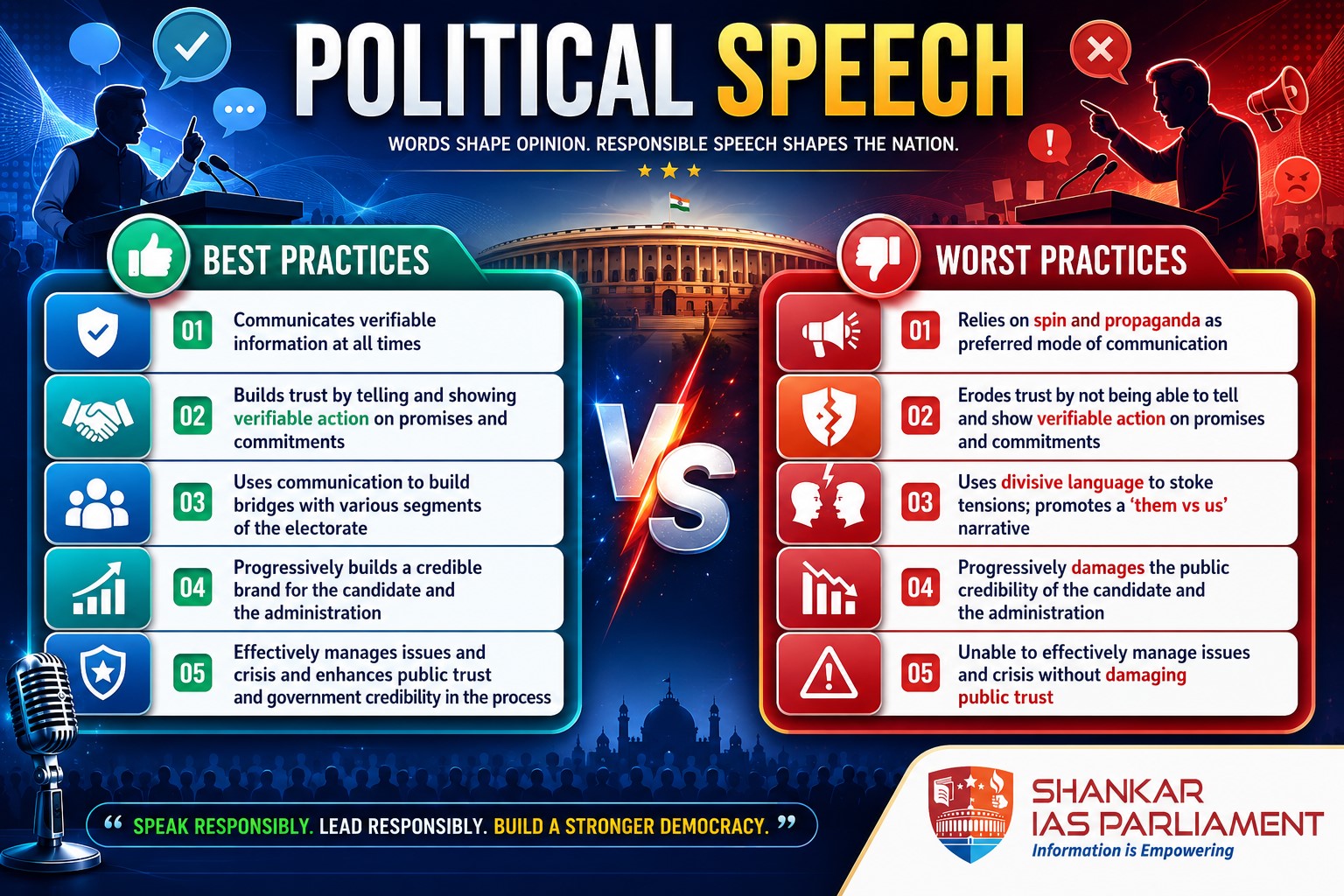
- Reflects dignity – Thoughtful speech shows respect for the audience and confidence in one's own ideas.
- Avoids fear – Harsh accusations and personal attacks create climates of mistrust and damage public institutions.
- Sets precedents – Poor communication standards established today become hard to reverse tomorrow.
- Encourages integrity – Principled discourse motivates young citizens to value substance over slogans.
- Focuses on solutions – Moderated voices prioritize the public good and meaningful problem-solving over quick applaus
- Conversely, when leaders resort to abusive language or inflammatory rhetoric, intolerance gradually becomes normalised within society.
What could be done?
- Restoring civility in political discourse requires collective responsibility.
- Political Parties
- Adopt internal codes of ethical communication.
- Promote issue-based campaigning.
- Discourage hate speech and personal attacks.
- Political Leaders
- Exercise restraint and responsibility in public speeches.
- Focus on governance, policy, and solutions.
- Lead by example in maintaining democratic decorum.
- Media
- Avoid incentivising sensationalism.
- Encourage balanced debates.
- Strengthen fact-checking mechanisms.
- Citizens
- Reward constructive political engagement.
- Reject divisive rhetoric.
- Demand accountability based on governance performance rather than inflammatory speeches.
What lies ahead?
- Democracy flourishes not merely because freedom of speech exists, but because that freedom is exercised with wisdom, restraint, and responsibility.
- Political speech should elevate public debate rather than degrade it.
- As history demonstrates—from the McCarthy era in the United States to the decline of the Weimar Republic—unchecked rhetoric can erode democratic institutions and social trust.
- The need of the hour is therefore not louder voices, but more responsible ones—grounded in dignity, guided by constitutional values, and committed to the larger public good.
- Such moderation will strengthen democratic culture and inspire future generations to uphold the ideals of respectful and constructive public discourse.
Reference
The Hindu| Political Speech



