Why in news?
The pointers are indicating that India is witnessing a K shaped recovery more than V-shaped with various groups and industries recovering much more rapidly than their counterparts.
What shapes of economic theory are in debate?
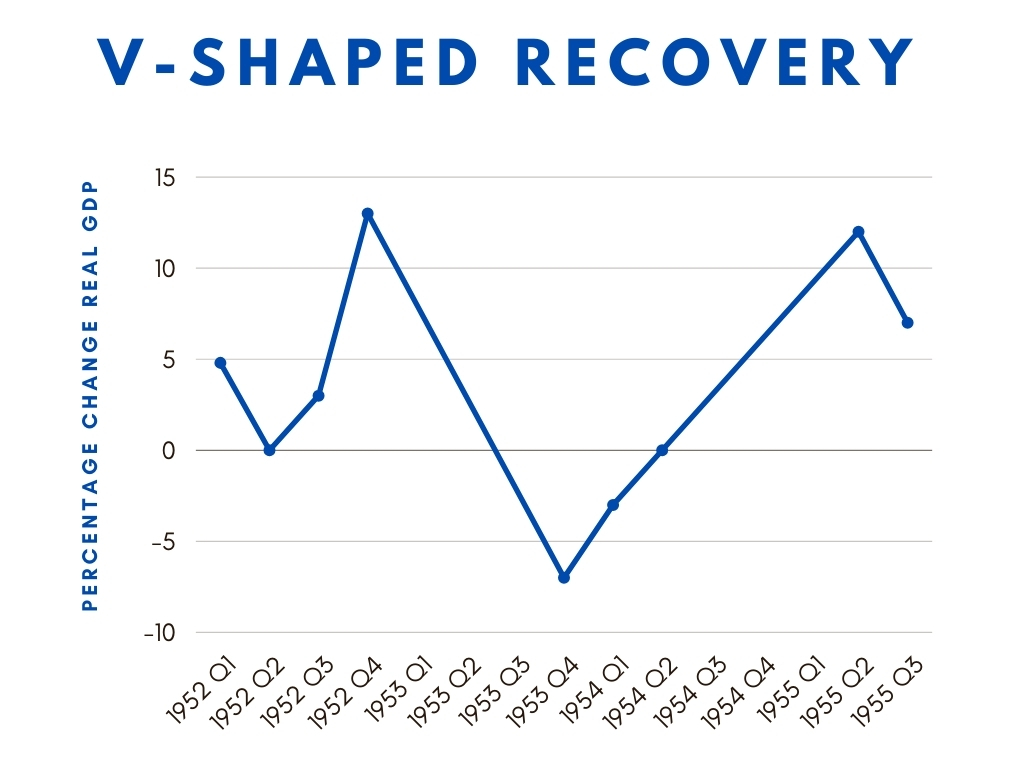
- V-shaped recovery - A V-shaped recovery is characterized by a quick and sustained recovery in measures of economic performance after a sharp economic decline.
- Such recoveries are generally spurred by rapid readjustment of consumer demand and business investment spending.
- Because of the speed of economic adjustment and recovery in macroeconomic performance, a V-shaped recovery is a best-case scenario given the recession.
- The recoveries that followed the recessions of 1920-21 and 1953 in the U.S. are examples of V-shaped recoveries.
- The Economic Survey 2021 predicted a ‘V-shaped’ post-pandemic recovery.
- The recovery in FY22 is indeed V-shaped after the first quarter because of 20 % expansion – a sharp upturn after a quick decline.
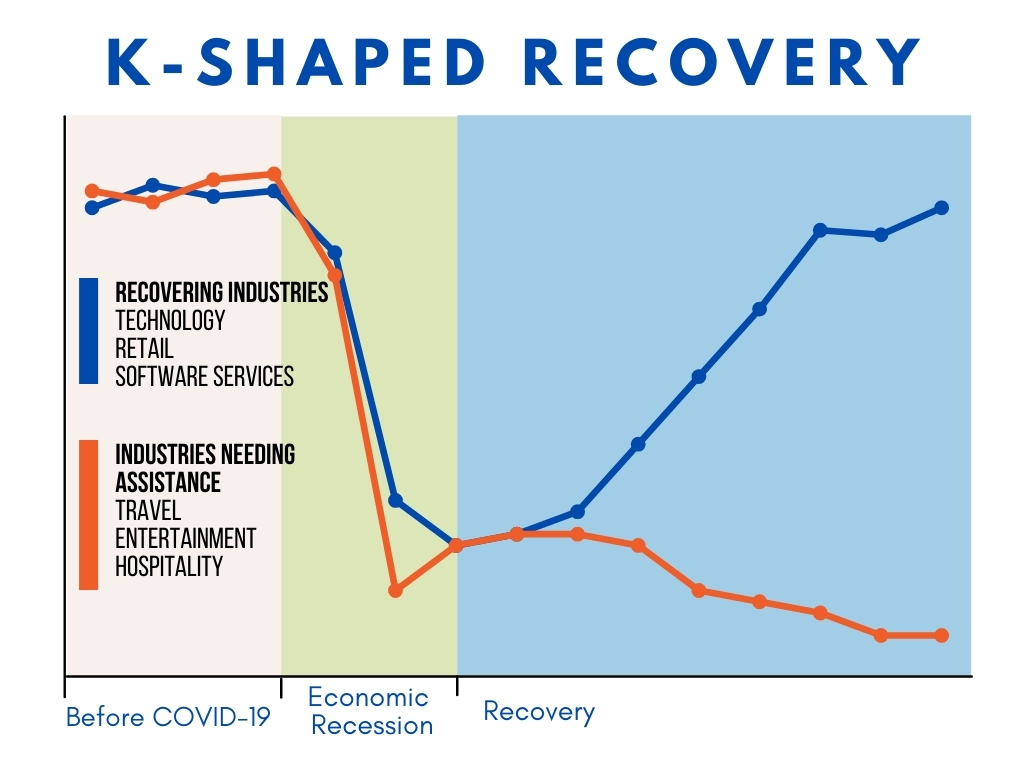
- K-shaped recovery - A K-shaped recovery is one in which the performance of different parts of the economy diverges like the arms of the letter "K"
- In a K-shaped recovery some parts of the economy may see strong growth while others continue to decline.
- Overall, the natural consequence of a pandemic is the widening of inequality and a K-shaped recovery.
- Education, for example, is inherently K-shaped in many places and this has become even more skewed due to Covid-19.
- A K-shaped recovery exhibits wealth inequality, greater corporate monopolies, a continuing racial wealth gap, long-term unemployment for low-income workers, and accelerating technological adoption.
What indicates that the economy is witnessing K shaped recovery?
- Signs from industry - The effects of this K-shaped recovery can be observed through the growth and consumption in specific industries.
- A report by CRISIL indicates that in the year 2021, two-wheeler sales are set to decline by 3%-6% year-over-year on top of a lower base in the year 2020.
- The sales of two-wheelers are the second-lowest it has been in seven years and the festival season was unable to rectify this phenomenon.
- On the other hand, premium cars and premium motorcycles have been resistant to the pandemic slowdown.
- Impact of taxation - The taxation policy of the Government insists on maintaining indirect taxes on fuel and consumer products while lowering corporate taxes.
- While inflation soars, the incomes of the middle and lower-middle-class have at best remained constant leading to a sustained loss in disposable income.
- On jobs - Over five million people lost their jobs in October, according to a Centre for Monitoring Indian Economy (CMIE) report.
- Unemployment coupled with the high food and fuel prices push families into poverty.
- On NREGA - There is a greater demand now for MGNREGA jobs than in the pre-COVID-19 era.
- But, in 2021-2022, the Government had cut its budget allocation towards MGNREGA by 34% for its inability to compensate workers in time and fairly.
- People who are looking for MGNREGA work cannot afford to be unpaid for such long durations and this again ties back to placing upward pressure on unemployment figures.
- Stimulus and growth - The recovery in the stock market and other such financial assets over the past year has been phenomenal but only less than 5% of India directly benefited from the said recovery.
- The lower middle class which does not invest in such assets has no guard against inflation and their only hedge against inflation is their income.
- The disproportional benefit of the asset price inflation favouring the upper-middle-class further displays the inherent K-shape of the recovery.
How can the Government address this phenomenon?
- The U.S. and European economies have stimulated the economy bottom-up through unemployment cheques and social welfare schemes.
- It is crucial that the Government addresses this phenomenon and works towards aiding the middle and lower-middle class.
- It is essential to prioritise those who are more likely to spend (the middle and lower-middle-class) rather than those who have a greater propensity to save.
- Social welfare schemes must be given greater importance to assist households to get through this period.
- The velocity of money which sustained a significant shock from pandemic lockdowns needs to be kickstarted.
- The Government needs to increase the progressive (direct) taxes and reduce the regressive (indirect) taxes to ease the financial pressure on lower-income households.
References
- https://www.thehindu.com/todays-paper/tp-opinion/pointers-that-india-is-witnessing-a-k-shaped-recovery/article37675507.ece
- https://www.investopedia.com/terms/v/v-shaped-recovery.asp
- https://www.investopedia.com/k-shaped-recovery-5080086



