Mains: GS I – Indian Geography
Why in News?
The Union Government notified the Legal Metrology (Indian Standard Time) Rules, 2026, on August 27, 2026, designating Indian Standard Time (IST) as the single reference for legal, administrative, commercial and other official purposes across India.
What is the Background?
- Importance of Time – Time is no longer merely a measure of hours and minutes; it has become a critical component of modern governance, digital infrastructure and national security.
- Banking transactions, digital payments, telecommunications, railways, power grids, financial markets, computer networks and government records all depend on accurate and synchronised time.
- The Rules will come into force 180 days after their publication in the Official Gazette, providing institutions and businesses time to align their systems.
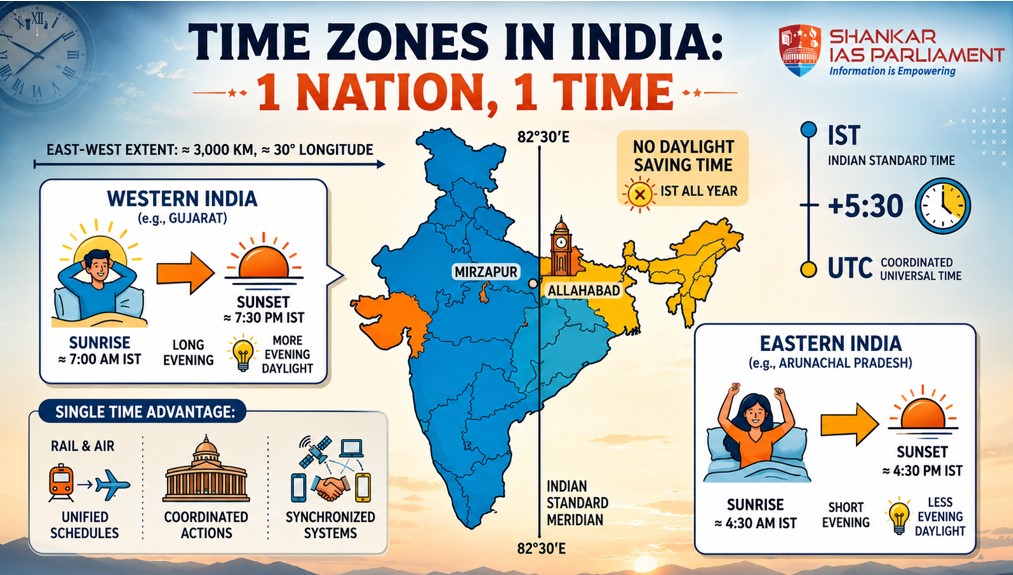
- Significance – The initiative, popularly described as “One Nation, One Time”, seeks not merely to standardise clocks but to create a secure, accurate, resilient and domestically controlled national timing infrastructure.
Why Does India Need “One Nation, One Time”?
- Concerns with different time sources – India already follows IST as its standard civil time.
- The issue addressed by the new Rules is that various digital and technological systems may obtain time from different sources, potentially resulting in inconsistencies.
- Significance of precise timestamps – Modern infrastructure relies heavily on precise timestamps for:
- Banking and digital payment transactions
- Telecommunications and internet networks
- Railway and aviation operations
- Electricity-grid synchronisation
- Stock exchanges and financial markets
- Government and legal records
- Cybersecurity and digital investigations
- Emergency and other time-critical services
- Even small differences between system clocks can create difficulties in establishing the exact sequence of events. In financial markets, for instance, transactions can occur within fractions of a second. In cybersecurity, inconsistent timestamps across servers can make it difficult to correlate logs and reconstruct an incident.
- Thus, a common and traceable time reference can improve coordination, accountability, operational efficiency and national security.
- India’s Official Time Reference – The CSIR-National Physical Laboratory (CSIR-NPL) is the custodian of India's official time reference.
- It maintains UTC(NPLI), India's realisation of Coordinated Universal Time (UTC). IST is derived from this reference with an offset of UTC +5:30 hours.
- IST is generated using advanced atomic clocks and satellite links and is traceable to UTC with an uncertainty of less than 3 nanoseconds.
- It is disseminated through Network Time Protocol (NTP) servers with millisecond-level accuracy.
- Although IST has long been India's standard time, it was not previously legally mandated as the sole reference for all relevant systems.
- The 2026 Rules seek to bridge this gap by requiring time-dependent systems in government and critical sectors to use an authorised and traceable IST reference.
What is White Rabbit Technology ?
- White Rabbit – It is an open-source technology developed initially at CERN for scientific experiments requiring extremely precise synchronisation among computers and other devices.
- Working – It uses fibre-optic networks to distribute timing signals.
- Crucially, it does not simply transmit a time signal and assume that it reaches another computer instantaneously.
- Instead, it measures the time taken by the signal to travel through the network, accounts for transmission delays and adjusts clocks accordingly.
- This allows computers located at different places to remain synchronised with very high precision.
- Advantage – Ordinary internet-based synchronisation can be affected by variable network delays.
- White Rabbit is specifically designed to compensate for such variations and therefore offers much greater precision.
- Its fibre-optic architecture also provides an important strategic advantage: time can be disseminated terrestrially without requiring every location to depend directly on a satellite signal.
What is the Role of ISRO and NavIC?
- Another important element of the initiative is reducing excessive dependence on foreign satellite-based timing sources such as GPS.
- ISRO's NavIC, India's indigenous satellite navigation system, provides positioning, navigation and timing services.
- ISRO has been provided traceability to IST with nanosecond-level accuracy through satellite links.
- NavIC can therefore serve as an indigenous source of precise timing, while terrestrial technologies such as White Rabbit can distribute IST through fibre-optic networks.
- The combination of atomic clocks, NavIC, NTP servers and fibre-optic timing networks can provide multiple pathways for disseminating India's official time.
Why Does Precise Time Matter?
- Financial Sector – Stock exchanges and financial institutions require highly accurate timestamps to establish the sequence of orders and trades.
- SEBI has required exchanges to synchronise system clocks with atomic clocks, with stringent precision and accuracy requirements.
- A common time reference can assist in detecting irregularities, resolving disputes and conducting regulatory investigations.
- Telecommunications and Cybersecurity – Modern telecom networks generate enormous volumes of server and network logs.
- If different systems operate with inconsistent clocks, correlating these records becomes difficult.
- Accurate timestamps can help investigators reconstruct cyber incidents and establish the sequence of network events.
- They can also assist in determining which system or user was associated with an activity at a particular time.
- Power Grids – Electricity grids require precise synchronisation for monitoring, control and stability.
- Accurate timing can help coordinate operations across geographically dispersed components and facilitate rapid identification of faults.
- Transport – Railways, aviation and other transport systems depend on coordinated schedules and reliable digital systems.
- A common timing reference can improve coordination and reduce ambiguity in time-sensitive operations.
- Governance and Legal Systems – Government databases, official records and legal proceedings frequently rely on timestamps.
- A uniform reference can strengthen the integrity and reliability of digital records.
- Strategic and National-Security Significance – The initiative has an important strategic dimension.
- Satellite-based timing signals can be vulnerable to jamming and spoofing, in which false signals are introduced to mislead receivers.
- Dependence on external timing sources can therefore create vulnerabilities for critical infrastructure.
- By developing indigenous sources such as NavIC and terrestrial fibre-based systems such as White Rabbit, India can build a more resilient timing architecture.
- If one timing source is disrupted, another authorised domestic source can potentially provide continuity.
- However, terrestrial systems are not invulnerable either. Fibre networks can be physically disrupted, while satellite systems can face interference.
- Hence, the objective should be redundancy, cybersecurity, independent verification and multiple backup sources, rather than dependence on any single technology.
What are the challenges ahead?
- Need for upgradation – Government departments, businesses and critical infrastructure operators will need to upgrade legacy systems and establish connectivity with authorised IST sources.
- Resource constraints – Smaller organisations may face financial and technological constraints in upgrading their infrastructure.
- Need for Safety Infrastructure – India will need strong cybersecurity safeguards around national timing infrastructure because manipulation of time can itself become a tool for cyberattacks or disruption.
- Coordination – Effective coordination among the Centre, States, regulators, critical infrastructure operators and private technology providers will be essential.
What could be done?
- India should adopt a multi-layered national timing architecture combining:
- CSIR-NPL's atomic-clock-based national reference,
- NavIC-based indigenous satellite timing,
- White Rabbit and other high-precision terrestrial networks,
- Secure and redundant time servers,
- Regular calibration, auditing and cybersecurity assessments.
- Capacity-building and financial support for institutions transitioning to compliant systems.
- The government should also encourage indigenous research and development in precision timing, atomic clocks, resilient networks and cybersecurity.
What lies ahead?
- As India becomes increasingly dependent on digital infrastructure, precise time is emerging as an element of economic security, technological sovereignty, cybersecurity and national resilience.
- By combining CSIR-NPL's national time standard, ISRO's NavIC and technologies such as White Rabbit, India can move towards a secure and resilient timing ecosystem.
- Thus, “One Nation, One Time” can be viewed as more than standardisation of clocks—it is an effort to establish sovereignty over the digital infrastructure that increasingly governs India's economy and society.
References
- The Hindu| One Nation One Time
- The Indian Express| ONOT



