Introduction
- India’s economy began 2026-27 on a strong note, with real GDP growth accelerating to 7.8% in Q1, riding on manufacturing and services, while real GVA rose 8.2%.
- Investments rose by 11.9%; household consumption grew 7.1% and exports grew by 12.0%.
- This momentum continued into July, with industrial production up 6.7%, while cumulative merchandise and services exports during April-July rose 13.16% year-on-year.
- Credit to industry and services grew 20.0% and 22.9%,respectively, in July.
India’s Macroeconomic Position
- India entered 2026-27 amid persistent geopolitical tensions and uncertainty around global trade. Despite these external pressures ,real GDP grew by 7.8% in Q1 2026-27.
- The outcome marked the highest Q1 real GDP growth during the four-year period from 2023-24 to 2026-27. This has been supported by buoyant domestic demand and gains in manufacturing and services.
- The International Monetary Fund (IMF) has also highlighted India’s role in the global economy.
- In July 2026, it described India as one of the world’s fastest-growing economies and a key engine of global growth.
- India’s sovereign credit assessment further reflects this confidence. In August 2026, S&P Global Ratings affirmed India’s ‘BBB/A-2’ sovereign ratings with a Stable Outlook.
- This followed the upgrade of its long-term rating to ‘BBB’ in 2025, after an 18-year gap.
A Stronger Start to 2026-27
Growth Accelerates in the First Quarter
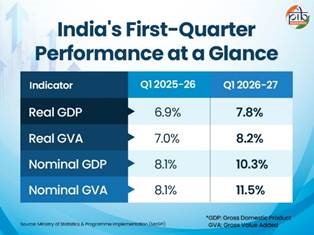
- Economic growth strengthened in the first quarter (Q1) of 2026-27. This outcome has exceeded the Reserve Bank of India’s estimate of 7.0% for the quarter.
- Real GDP, or GDP at Constant Prices, is estimated at ₹81.36 lakh crore in Q1 FY 2026-27. It recorded 7.8% rise, compared with 6.9% in Q1 FY 2025-26.
- Nominal GDP, or GDP at Current Prices, is estimated at ₹88.27 lakh crore. It recorded 10.3% rise, compared with 8.1% last year.
|
Gross Domestic Product (GDP) is the value of final goods and services produced in the domestic economy in an accounting period.
|
- Real GVA is estimated at ₹73.82 lakh crore , recording 8.2% growth, compared with 7.0% last year.
- Nominal GVA is estimated at ₹80.53 lakh crore , recording 11.5% growth, compared with 8.1% last year.
|
Gross Value Added (GVA) measures the individual contribution of producers, industries or sectors to the economy.
|
Revised Estimates Strengthen the Growth Picture
- Real GDP has been revised upwards for the previous three financial years. The revisions show that the first-quarter performance follows a stronger growth trajectory than previously estimated.
|
Revised Real GDP Growth Estimates
|
|
|
|
|
|
|
|
|
|
|
|
|
|
|
|
|
- Source: Ministry of Statistics & Programme Implementation (MoSPI)
|
|
Basis of the Revised Estimates
|
Composition of Growth Drivers
Trends Across Key Expenditure Components
- Economic activity in the first quarter was supported by a sharp rise in investment, firm household consumption and stronger exports.
|
Key Expenditure Components of Real GDP
|
|
|
|
|
|
- Gross Fixed Capital Formation (GFCF)
|
- Domestic funding of investment
|
|
|
- Private Final Consumption Expenditure (PFCE)
|
- Spending by households on goods and services
|
|
|
|
|
- Goods and services supplied to the rest of the world
|
|
|
- Source: Ministry of Statistics & Programme Implementation (MoSPI)
|
Growth Extends Across Major Sectors
- The strength in expenditure was also reflected on the production side, with the tertiary and secondary sectors expanding at a faster pace.
- In terms of Real GVA, the tertiary sector grew by 10.0% in Q1 2026-27, up from 8.0% in Q1 2025-26. Within the sector, financial, real estate, IT and professional services recorded 12.1% growth.
- The secondary sector expanded by 8.6% in Q1 2026-27, compared with 6.1% in the corresponding quarter of the previous year.
- Manufacturing recorded 9.2% growth, supported by strong output across key segments. Several manufacturing categories also performed well during the quarter:
|
Key Manufacturing Categories Record Notable Gains
(Year-on-year IIP growth (%))
|
|
|
|
|
|
|
|
|
- Other Transport Equipment
|
|
|
- Computer, electronic and optical products
|
|
|
|
|
|
|
- Source: Ministry of Statistics & Programme Implementation (MoSPI)
|
- Under the IIP, capital goods production also increased by 15.2% in Q1 2026-27, compared with 8.8% a year earlier. Infrastructure/ construction goods also recorded higher growth of 7.2%, up from 6.1%.
Recent Indicators Signal Continued Momentum
Industrial Activity Remains Firm
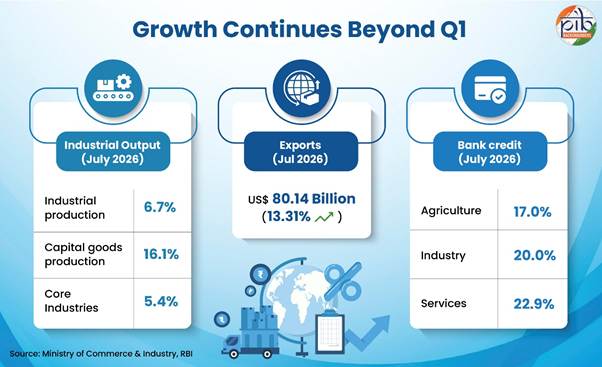
- Industrial production grew by 6.7% in July 2026, compared to 5.4% last year. It increased by 6.3% in April-July 2026-27 compared 4.0% last year same period.
- Capital goods production rose by 16.1% in July 2026 over July 2025. Intermediate goods increased by 10.0% and infrastructure and construction goods by 6.9%.
- The Index of Core Industries (ICI) recorded year-on-year growth of 5.4% in July 2026, compared with July 2025. During April-July 2026-27, the ICI grew by 4.3%, up from 1.5% in the corresponding period of the previous year.
Strong Export Performance
- India’s combined merchandise and services exports reached an estimated US$ 80.14 billion in July 2026, increasing by 13.31% over July 2025.
- During April-July 2026-27, cumulative exports were estimated at US$ 316.42 billion. This is 13.16% higher than the US$279.63 billion recorded during April-July 2025-26.
Credit Expands Across Major Sectors
- Bank credit growth strengthened across major sectors in July 2026.
- Credit to agriculture and allied activities grew by 17.0% year-on-year, compared with 7.3% in July 2025.
- Credit to industry increased by 20.0%, up from 6.5% in July 2025.
- Credit to the services sector grew by 22.9%, compared with 10.2% in July 2025.
Recent Policy Measures Supporting Growth
- Policy measures introduced during 2026 have complemented these economic trends, spanning manufacturing, energy security, trade and investment, and agriculture.
Manufacturing and Industry
- The Mobile Phone Manufacturing Scheme (July 2026) has an outlay of ₹62,500 crore through 2030-31.
- It aims to further expand production, deepen value addition and strengthen global competitiveness.
- Approved in July 2026, Semicon 2.0 has a budget outlay of ₹1,27,500 crore.
- It supports chip design and manufacturing, advanced packaging, research, materials, equipment and talent development.
- Approved in July 2026, the BHAVYA Rasayan Scheme has an outlay of ₹3,030 crore for a period of 5 years from FY 2026-27 to FY 2030-31.
- It will support the establishment of three dedicated chemical parks across the country.
- Emergency Credit Line Guarantee Scheme 5.0 (ECLGS 5.0) targets additional credit flow of ₹2.55 lakh crore in response to the West Asia situation.
- It provides 100% guarantee coverage for MSMEs and 90% for non-MSMEs.
- Passed by Parliament in August 2026, the MSME Development (Amendment) Bill, 2026 simplifies compliance and supports MSME development and competitiveness.
Energy Security
- Samudra Manthan, the National Offshore Exploration Scheme, has an outlay of ₹84,084 crore through FY 2030-31. The Scheme supports exploration to unlock India’s offshore energy potential.
- The Scheme for Promotion of Surface Coal/Lignite Gasification Projects was approved in May 2026 with an outlay of ₹37,500 crore.
- It supports the 100 MT coal gasification target by 2030 and aims to reduce import dependence.
- GOBARdhan, the National Circular Bioenergy Scheme, was approved in August 2026 with an outlay of ₹23,731 crore.
- The Scheme will be implemented from FY 2026-27 to FY 2035-36. It aims to increase compressed biogas production from agricultural, animal and municipal organic waste.
- Approved in July 2026, Pradhan Mantri Surya Sarovar Yojana (PM-SSY) has an outlay of ₹5,070 crore.
- It supports 5,000 MW of floating solar projects with co-located energy storage, with projects sanctioned during FY 2026-27 to FY 2030-31.
Trade and Investment
- The India-UK CETA and Agreement on Social Security entered into force on 15 July 2026.
- It provides zero-duty access for nearly 99% of India’s exports to the UK.
- The India-Israel Bilateral Investment Agreement (BIA) entered into force on 4 July 2026.
- It aims to strengthen bilateral economic ties and provides a more secure and predictable framework for investment.
- In June 2026, reforms were announced to expand Foreign Portfolio Investor (FPI) participation in Government Securities.
- Key measures include tax exemptions, wider coverage under the Fully Accessible Route and streamlined investment norms.
- The reforms are intended to attract long-term foreign capital and deepen India’s debt market.
- Launched in May 2026, the Bharat Maritime Insurance Pool (BMIP) carries a sovereign guarantee of ₹12,980 crore. It provides maritime risk cover while reducing dependence on foreign insurers amid global volatility.
Agriculture: Farm Income and Production Support
- The continuation of Pradhan Mantri Kisan Samman Nidhi (PM-KISAN) from FY 2026-27 to FY 2030-31 has been approved with an outlay of ₹3.15 lakh crore.
- The scheme provides eligible farmer families income support through the Direct Benefit Transfer (DBT) system.
- For Marketing Season 2026-27, the Government increased MSPs for 14 Kharif crops to ensure remunerative prices for farmers. The highest absolute increases were for sunflower seed, cotton, nigerseed and sesamum.
- Approved in May 2026, the Mission for Cotton Productivity (Kapas Kanti) has an outlay of ₹5,659.22 crore for 2026-27 to 2030-31.
- It links cotton farmers with modern research and technologies, reduces pest risks, and strengthens production systems and agricultural trade.
- The National Investment Policy for Urea-2026 (NIPU-2026) aims to promote new investment in gas-based urea manufacturing units.
- It supports higher domestic production and India’s goal of self-sufficiency in urea.
- These measures build on a decade of policy initiatives including Make in India, Production Linked Incentive (PLI) schemes, PM-KISAN, the Export Promotion Mission and others.
Conclusion
- India’s economic performance at the start of 2026-27 reflects broad-based momentum across key areas of the economy.
- Investment has accelerated, household consumption has remained firm, while manufacturing, services and exports have provided additional support.
- More recent indicators show that this strength has carried beyond the first quarter.
- Continued government support through various policy measures has also helped maintain the pace of economic activity.
Reference
PIB| India’s GDP Growth



