Prelims: Current events of National and International Importance | Science and Technology
Why is in news?
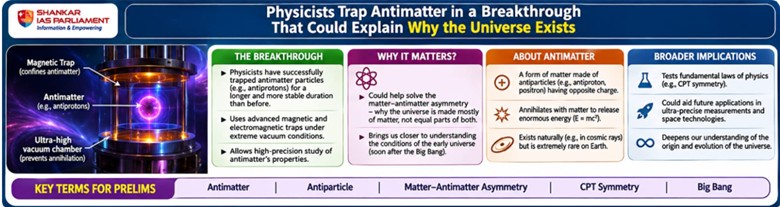
Researchers at Northwestern University achieved unprecedented quantum control over a single positron—the antimatter counterpart of an electron—by trapping and cooling it close to absolute zero.
The achievement could enable a highly precise comparison of the properties of matter and antimatter, helping investigate why the observable universe contains far more matter than antimatter.
About antimatter
- Antimatter consists of antiparticles corresponding to ordinary matter particles.
- A positron is the antiparticle of an electron; it has the same mass as an electron but a positive electric charge.
- An antiproton is the antimatter counterpart of a proton, while an antineutron is the counterpart of a neutron.
- When a particle and its corresponding antiparticle meet, they can annihilate, converting their mass into energy and other particles.
What did the researchers achieve?
- The team captured a positron produced during the radioactive decay of sodium-22, slowed it down and cooled it to approximately 300 millikelvins—about 0.3 degrees above absolute zero.
- The positron was confined in a near-perfect vacuum using carefully configured electric and magnetic fields, without touching the physical walls of a container.
- This wall-free trapping method prevents the positron from coming into contact with ordinary matter, which would cause annihilation. The particle was kept confined for months.
- The researchers created a system called a ‘one-positron quantum cyclotron’, in which the positron behaves somewhat like an artificial atom and its individual quantum energy levels can be manipulated and observed.
- Microwaves were used to induce controlled transitions between the positron’s quantum states.
Matter–antimatter asymmetry
- According to the prevailing understanding of the Big Bang, matter and antimatter should have been produced in nearly equal quantities.
- If equal quantities had remained together, widespread matter–antimatter annihilation would have occurred. However, the observable universe is dominated by matter.
- This unexplained imbalance is known as the matter–antimatter asymmetry or baryon asymmetry problem.
- Understanding the asymmetry may require physical processes beyond those fully explained by the Standard Model.
Standard Model of particle physics
- The Standard Model is the theoretical framework describing the fundamental particles and three of the four fundamental interactions: electromagnetic, strong nuclear and weak nuclear forces.
- It does not include gravity as a quantum interaction and does not fully explain several observations, including the dominance of matter over antimatter.
- It predicts that electrons and positrons should have corresponding, highly symmetrical properties.
What happens next?
- The researchers aim to measure the positron’s magnetic properties with very high precision and compare them with those of an electron.
- The magnetic moment is a measure of a particle’s magnetic properties.
- Any statistically significant difference between the electron and positron measurements could indicate physics beyond the Standard Model and offer clues to the matter–antimatter asymmetry.
- The research was published in the journal Physical Review Letters.
Key terms
- Absolute zero: The theoretical lower limit of temperature, 0 kelvin (−273.15°C), at which a system has minimum thermal energy.
- Quantum state: A mathematical description of the state of a quantum system, including its measurable properties.
- Annihilation: A process in which a particle and its antiparticle interact and their mass is converted into energy and other particles.
- Magnetic moment: A quantity that describes the strength and orientation of a particle’s magnetic properties.
Reference
The Indian Express | Antimatter trapping and matter–antimatter asymmetry



