Prelims: Current events of national and international importance | Science & Technology
Why in News?
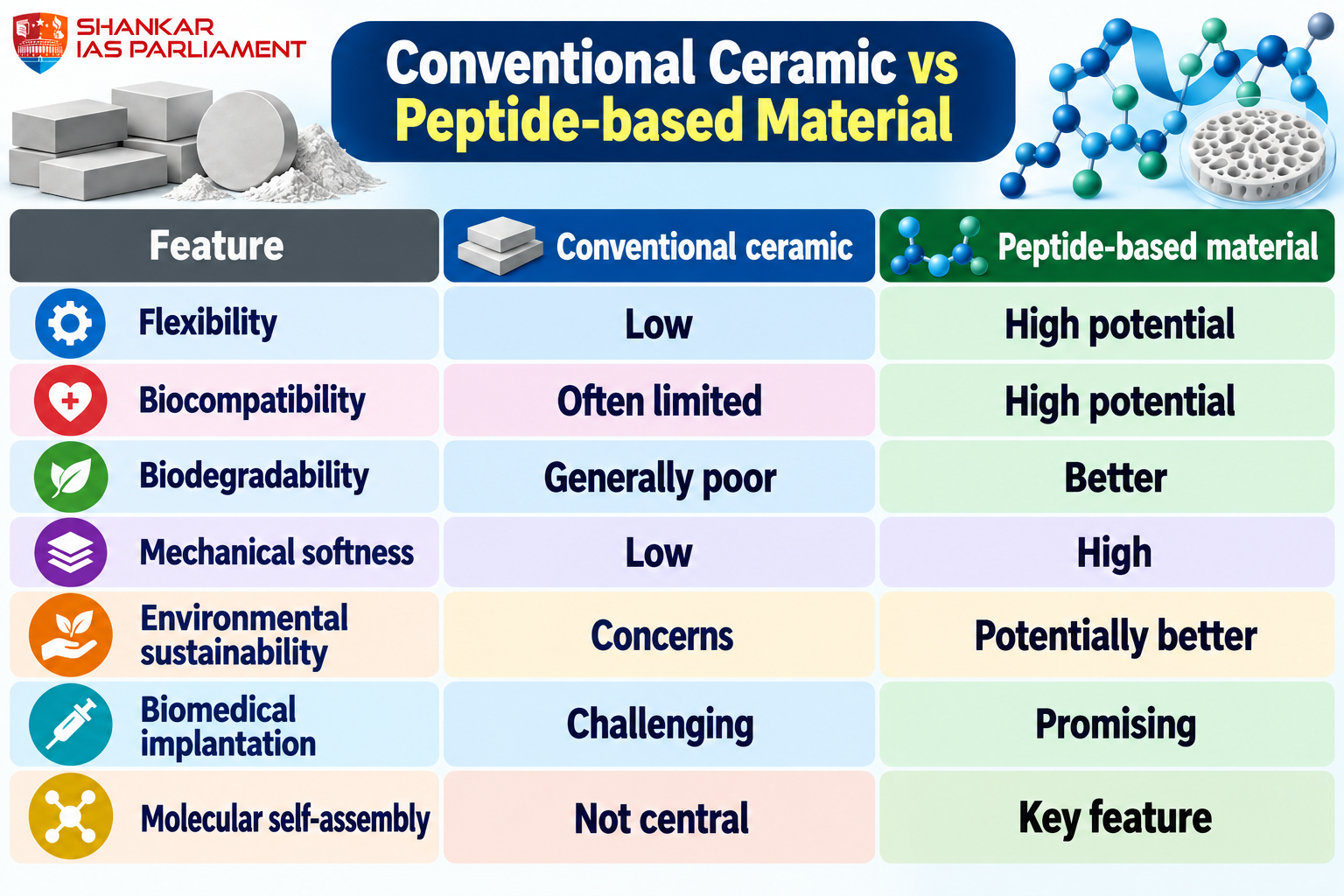
Recently, "Researchers at CeNS Bengaluru, IISER Kolkata, and JNCASR Bengaluru have developed a peptide‑based piezoelectric biomaterial with potential biomedical applications."
- Piezoelectricity – It is the phenomenon where mechanical stress generates electric charge in certain solids such as ceramics, crystals, and biological materials (DNA, bone, proteins).
- The term originates from Greek words meaning "press" and "amber," historically linked to electricity.
- New findings – While the chemical composition stays the same, differences in molecular arrangement change the material’s functionality.
- Key Observations
- When dissolved in water, peptide molecules form nanofibers and show no detectable piezoelectric response.
- With about 1% co-solvent, peptide molecules reorganise into a supramolecular structure that displays a strong piezoelectric response.
Self-assembly - Peptide molecules form ordered supramolecular structures on their own.
- The same peptide, assembled differently, exhibits distinct electrical properties.
- This finding highlights the essential relationship between structure and function in biomaterials.
- Researchers employed advanced nanoscale characterisation techniques, including the following:
- Atomic Force Microscopy (AFM) – This technique examines surface and topographical features at the nanoscale.
- Field Emission Scanning Electron Microscopy (FESEM) – It provides high-resolution imaging of nanostructures.
- Computational simulations – These simulations help elucidate molecular organisation and interactions.
- Potential Uses
- Implantable medical sensors
- Biosensors
- Electronic skin
- Wearable health‑monitoring devices
- Energy harvesting
- Mechanism – Natural body movements, such as heartbeat, breathing, and walking, cause mechanical deformation.
- Peptide piezoelectric materials convert this mechanical deformation into electrical energy.
- Thus, such materials could potentially help develop self-powered, low-energy biomedical devices.
Reference
PIB | Piezoelectricity



