Prelims: Current events of national and international importance
Why in News?
Recently, RBI drafts rules for Non-Banking Financial Company (NBFC), All-India Financial Institutions (AIFIs) participation in term money market.
Drafts rules
- Participation in term market – NBFCs and Housing finance companies (HFCs) (except base layer NBFCs) can borrow and lend in the term money market.
Base Layer NBFCs (NBFC-BL) are non-systemically important, smaller financial entities that pose minimal risk to the broader financial system.
- AIFIs may also borrow and lend, while companies are allowed to lend only.
- RBI proposes that all call, notice, and term money deals conducted outside the NDS-CALL platform must be reported there within 15 minutes.
Term money involves unsecured loans and borrowings for periods longer than 14 days, up to one year.
- Entities not yet on the platform have six months to become members.
- Trading platforms – The draft allows trades to be conducted via over-the-counter markets, including NDS-CALL and RBI-approved electronic trading platforms.
The Negotiated Dealing System - Call (NDS-CALL) is an electronic, screen-based platform introduced by the Reserve Bank of India (RBI) and developed by Clearcorp.
It enables market participants to negotiate bilaterally, borrow, and lend funds in the Call, Notice, and Term Money markets.
- Borrowing limits – NBFCs and HFCs (excluding base layer) can borrow up to 200% of their net owned funds in the term money market.
- Standalone primary dealers can borrow up to 225% of their net owned funds in call and notice money, and up to 400% in term money and inter-corporate deposits combined.
- Payments banks can borrow and lend in call and notice money markets, and are also allowed to borrow in the term money market.
Non-Banking Financial Company (NBFC)
- Registered under – The Companies Act, 1956.
- Role – Engaged in the business of loans and advances, the acquisition of shares, stocks, bonds, debentures and securities issued by the Government or local authority.
- Limitations – Not allowed to take traditional demand deposits from the public.
- They can only accept time deposits, and they do not provide savings or current account facilities.
- They cannot accept deposits for a period less than 12 months and more than 60 months.
- NBFCs do not have a banking license
- NBFCs cannot accept demand deposits
- NBFCs do not form part of the payment and settlement system and cannot issue cheques drawn on itself
- Deposit insurance facility of Deposit Insurance and Credit Guarantee Corporation is not availableto depositors of NBFCs, unlike in the case of banks.
- Unlike banks, NBFCs are not subjected to stringent and substantial regulations.
- The RBI has the authority to issue licenses to NBFCs, regulate their operations, and ensure that they adhere to the established norms and regulations.
Housing finance companies (HFCs)
- Statutory backing – They are corporate entities incorporated under Companies Act, 1956.
- Aim – Providing housing loans and finance in a streamlined manner.
- Regulation – Regulated by the RBI. (earlier regulated by National Housing Bank (NHB))
- Types – Deposit-taking HFCs and Non-deposit taking HFCs
- There are 97 HFCs in the country.
- Advantages – Flexible loan approval compared to banks, consideration of lower credit scores
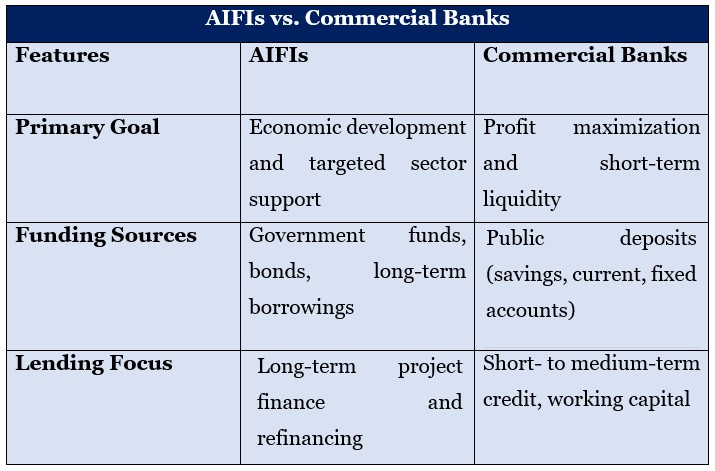
All-India Financial Institutions (AIFIs)
- Setup by – They are apex-level, specialized development banks set up by the Government of India.
- Role – They address long-term, sector-specific credit gaps—such as agriculture, infrastructure, and housing.
- Regulation and supervision – Directly by the Reserve Bank of India (RBI).
- Major AIFI – Currently, there are 5 recognized AIFIs in India:
- NABARD (National Bank for Agriculture and Rural Development.
- SIDBI (Small Industries Development Bank of India).
- NHB (National Housing Bank).
- EXIM Bank (Export-Import Bank of India).
- NaBFID (National Bank for Financing Infrastructure and Development).
Reference
Business Standards| RBI’s Rule for Term Money



