Why in News?
Recently “Animal Health Security Strengthening in India for Pandemic Preparedness & Response” initiative has been launched by the Indian government under Pandemic Fund Project.
What are the needs of animal health management?
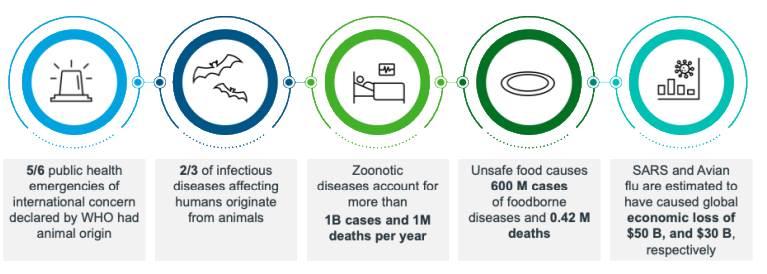
- Public Health Emergencies - In the past few decades, WHO declared 6 public health emergencies of international concern, and 5 of these have had animal origin.
- Increasing Zoonosis – About two-thirds of infectious diseases affecting humans originate from animals.
- Zoonotic Mortality – Zoonotic diseases account for more than 1Billion cases and 1Million deaths per year.
- Pandemic Preparedness - COVID-19 pandemic acknowledged that pandemic preparedness and response (PPR) needs a One Health approach and a focus on animal health security.
- Protect Livestock Wealth - 536 million livestock and other animals of India requires measures to prevent and manage infection outbreaks.
- Food Safety - Unsafe food causes 600 M cases of foodborne diseases and 0.42 M deaths.
- Prevent Economic Losses - SARS and Avian flu are estimated to have caused global economic loss of $50 Billion, and $30 Billion, respectively.
- Poverty Threats - Animal disease outbreaks also threaten to reverse the gains made in poverty reduction.
What is the Pandemic Fund Project?
- Pandemic Fund Project – The project “Animal Health Security Strengthening in India for Pandemic Preparedness & Response” is launched under the G20 Pandemic Fund .
G20 Pandemic Fund was created by G20 countries under Indonesian presidency in 2022 to assist low-and middle-income countries in strengthening their capacities to identify, report and contain future pandemics.
- Nodal Ministry - Union Ministry of Fisheries, Animal Husbandry and Dairying.
- Objective of the Project - To enhance the country's capacity to prevent, detect, and respond to animal health threats.
- Implementation - It is being implemented through three implementing entities Asian Development Bank (ADB), the World Bank, and the Food and Agriculture Organization (FAO).
What are the major interventions under the project?
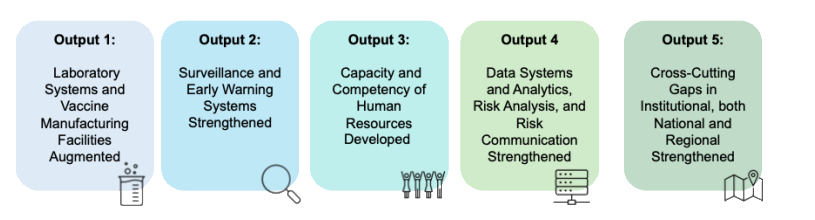
- Augmentation of Laboratory Systems - Upgrading and expanding animal health laboratories and developing laboratory networks.
- Strengthening of Surveillance and Early Warning Systems - Enhancing early warning systems and building robust sentinel and passive surveillance mechanisms to detect potential outbreaks at an early stage and facilitate timely interventions.
- Human Resources Development - Enhance the skills and capabilities of animal health human resources.
- Upgrading data management systems - Strengthening of Data Systems, Analytics, Risk Analysis for better risk assessment, improved decision-making, and more effective communication strategies related to animal health risks.
- Addressing Institutional Capacity Gaps - Strengthen institutional capacity at both national and regional levels by supporting the development of a disaster management framework for the livestock sector and AMR management.
What are the expected outcomes of the project?
- Outcome - Impact of the project would be
- To reduce the risk of pathogen emergence from animals (domesticated and wildlife)
- Prent transmission to the human population
- endangering the health, nutritional security, and livelihoods of vulnerable populations.
- The project is designed to enhance India's animal health security through the following five key outputs
 Quick facts
2019 Livestock Census
- Total livestock population of India 535.78 million.
- 192.9 million cattle
- 148.88 million goats
- 109.85 million buffaloes
- 74.26 million sheep
- 9.06 million pigs
- All other animals taken together contributed just 0.23% of the total livestock population in India.
Reference
The Indian Express | Project to monitor animal healt



