0.1106
7667766266
x

Oxyserphus Narendrani - Parasitic Wasp

iasparliament Logo
September 25, 2026

Prelims: Current events of national and international importance | Species

Why in News?

Recently, Scientists from the Zoological Survey of India (ZSI) discovered a new species of parasitic wasp in Dibru-Saikhowa National Park, Assam.

Oxyserphus Narendrani
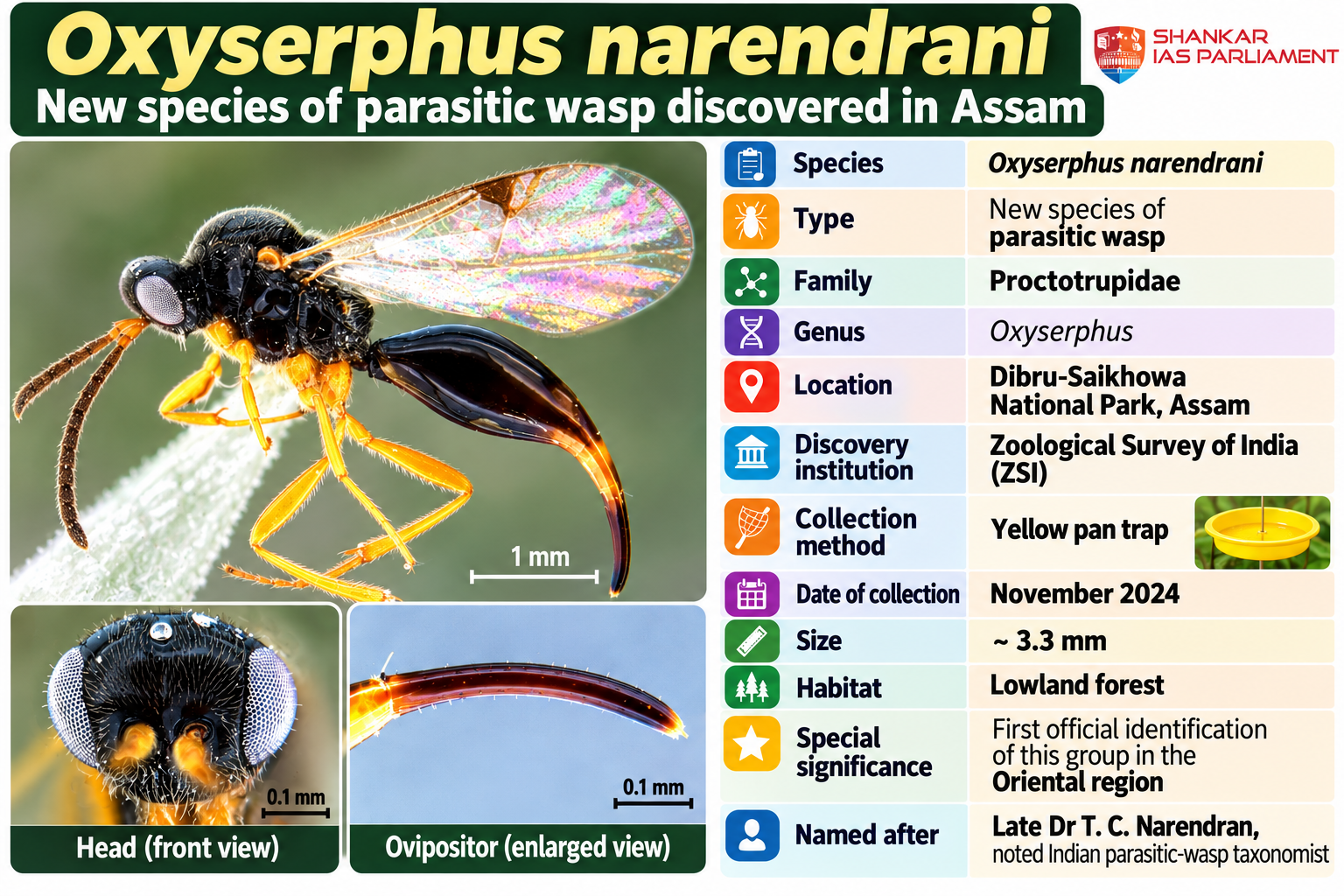
narendranani wasp

  • It represents the 1st official record of this rare group of wasps from the Oriental region.
  • The genus Oxyserphus is rarely represented in insect collections.
  • These species are typically found in high-altitude environments, so their presence in a lowland forest is significant.
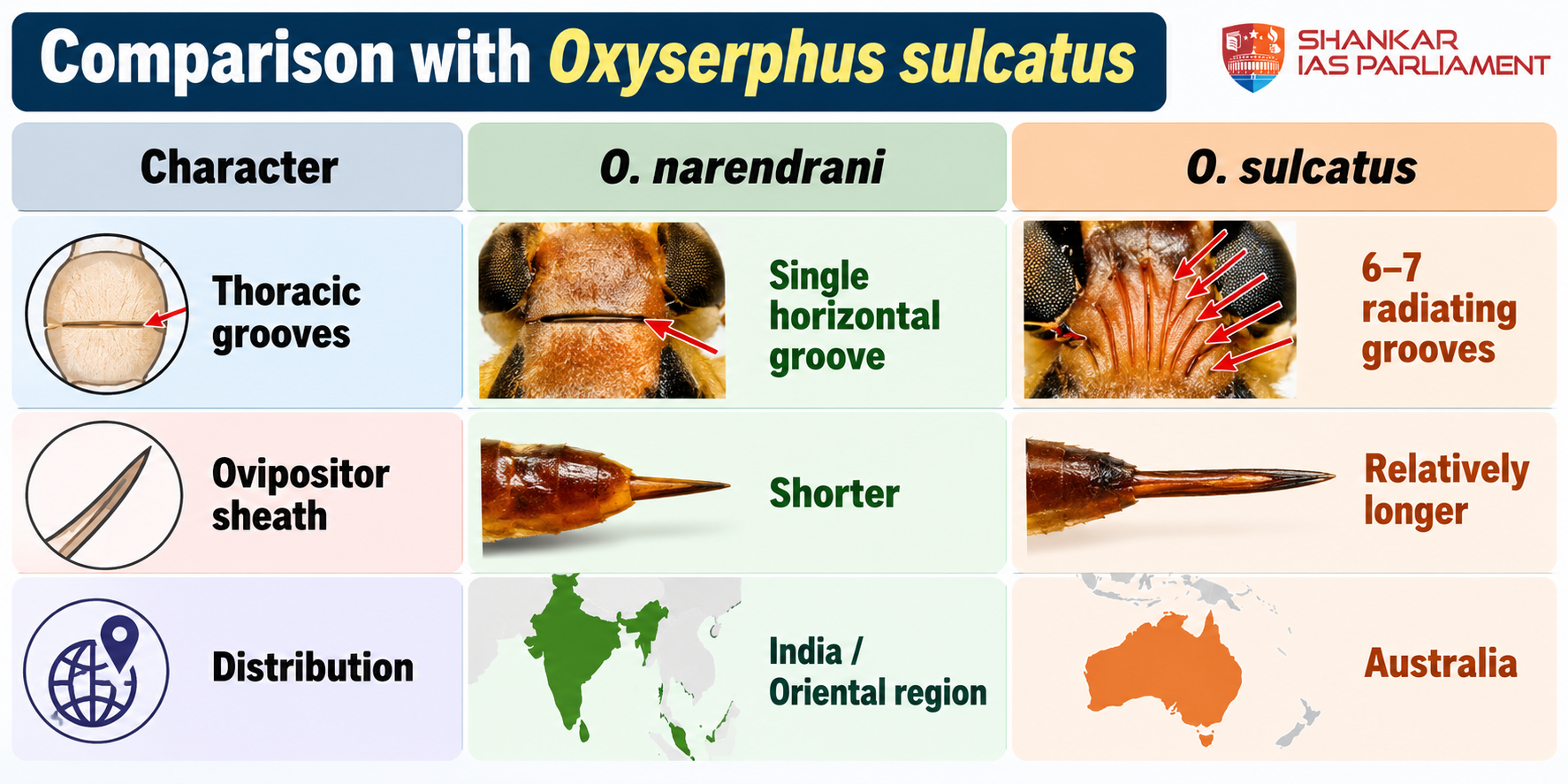
  • Diagnostic Characteristics – The species is differentiated from related taxa based on microscopic morphological characteristics.
  • Key distinguishing features
    • A black head
    • A brownish-black body
    • Yellow legs
    • A single horizontal groove present on the lateral side of the thorax
    • A relatively short ovipositor sheath
    • A distinctive wing spot

wasp comparision

  • Parasitic wasps – These are insects that deposit their eggs in or on other organisms, typically targeting other insects or arthropods.
  • The larvae of parasitic wasps develop by utilizing the host organism for nourishment and growth.
  • Consequently, parasitic wasps play a significant role in regulating populations of other insect species.
  • Many species of parasitic wasps contribute to the natural biological control of insect pests.

Dark Taxa – Organisms with poorly known diversity, hard detection, and undocumented distribution.

  • Yellow Pan Trap – It was employed to collect the specimen.
  • A yellow pan trap is a bright yellow, water-filled dish commonly utilized by entomologists.
  • This trap attracts a range of small insect species.
  • It is particularly useful for conducting insect biodiversity surveys and sampling.

Dibru‑Saikhowa National Park

  • Location – Dibrugarh and Tinsukia districts, Assam.
  • Origin – Established to conserve the rare white‑winged wood duck.
  • Boundaries – Bordered by the Brahmaputra and Lohit rivers to the north, and the Dibru river to the south.
  • Vegetation – Semi‑evergreen and deciduous forests, canebrakes, and grasslands.
  • The park contains the largest Salix swamp forest in Northeast India.
  • Climate – Tropical monsoon with hot, wet summers and cool, dry winters.
  • Flora – Key species include Hollong, Nahor, Simul, Sissoo, Khair, and Jamun.
  • Fauna – Notable wildlife includes Elephant, Wild Water Buffalo, Leopard, Clouded Leopard, Fishing Cat, Jungle Cat, Hog Deer, Sambar, and Barking Deer.

Reference

RM | Oxyserphus Narendrani - Parasitic Wasp

There are no reviews yet. Be the first one to review.

ARCHIVES

sidetext