Mains: GSIII – Science and Technology
Why in News?
Orbit computing or computing in orbit can reduce data transmission delays, improve decision-making and enable shared computing resources in space.
What is Computing in Orbit?
- Computing in orbit – It refers to processing and analysing data directly onboard satellites instead of transmitting all raw data to ground stations.
- It uses onboard computers and Artificial Intelligence (AI) to identify, filter and transmit only relevant information.
- Aim – To transform individual satellites into interconnected, distributed computing systems.
What are the Applications of Computing in Orbit?
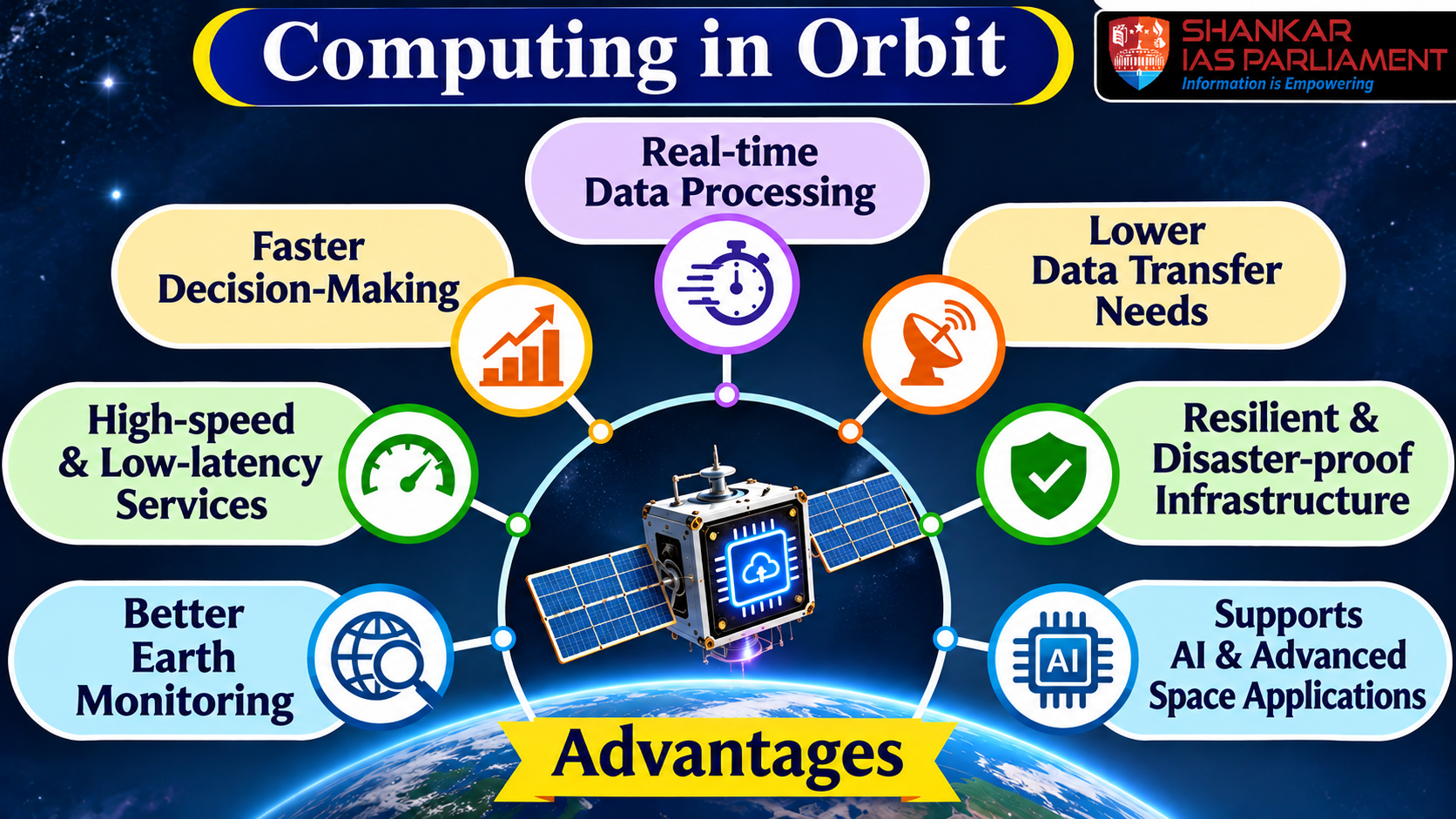
- Disaster Management – AI can identify flood-affected areas, damaged infrastructure and submerged roads, transmitting critical information quickly to response teams.
- Maritime Monitoring – Enables identification and tracking of ships in specific maritime regions.
- Precision Agriculture – Analyses crop health and agricultural conditions using satellite imagery.
- Earth Observation – Filters images affected by cloud cover and prioritises important observations for faster analysis.
- Distributed Space Computing – Satellites can communicate through optical inter-satellite links, sharing data and computing tasks to form interconnected computing networks.
- Existing Developments – Advancements in onboard computing and storage are enabling increasingly complex data processing in space.
- European Space Agency's Phi-Sat-1 – Demonstrated the use of AI to select Earth-observation images for further analysis on the ground.
|
What is Computing Resources as a Service?
|
- Similar to cloud computing on Earth, computing resources could be offered as an on-demand service onboard operational satellites.
- Researchers, universities, start-ups and businesses could access satellite computing facilities without building and launching their own satellites.
- Potential Benefits –
- Reduces the cost of accessing space-based computing infrastructure.
- Encourages innovation and wider participation in space technology.
- Enables researchers to test AI models using satellite datasets and onboard processing facilities.
- Prerequisites –
- Reliable computing infrastructure and standardised software interfaces.
- Adequate computing capacity, cybersecurity and affordable service costs.
|
What are the Challenges of Computing in Orbit?
- Power Constraints – Satellites depend on solar panels and batteries, requiring computing systems to share limited onboard energy resources.
- Thermal Management – Absence of air in space makes heat dissipation difficult, requiring specialised thermal management systems.
- Radiation and Temperature Extremes – Electronic components must withstand radiation exposure and extreme temperature variations.
- Hardware Reliability – Satellite components are difficult to repair or replace, requiring redundancy and error detection and recovery mechanisms.
- High Economic Costs – Satellite construction, launch expenses, power generation and limited servicing increase operational costs.
- Technological Limitations – Space-qualified processors, secure software and reliable communication systems are essential for successful deployment.
|
India's Potential in Orbital Computing
|
- India has established capabilities in satellite technology, launch vehicles and space-based applications.
- Indian Space Policy 2023 – Provides opportunities for private sector participation in space technology development.
- IN-SPACe – Facilitates and promotes private sector participation in India's space ecosystem.
|
What is the Way Forward?
- Increase investments in indigenous space-qualified processors and computing systems.
- Strengthen research, testing infrastructure and in-orbit technology demonstrations.
- Promote collaboration among ISRO, private companies, academic institutions and end users.
- Develop secure, standardised and affordable space-based computing services.
What lies ahead?
- Orbital computing can transform satellites from data-collection platforms into intelligent processing systems.
- Its wider adoption requires technological reliability, economic viability and stronger public-private collaboration, enabling India to emerge as a contributor to global space infrastructure.
Reference
The Hindu| Orbital computing could let scientists rent ‘brainpower’ in space



