Why in News?
U.S. and China are pursuing parallel efforts in partnership with other countries, to be the first to set up a semi-permanent, and in future permanent, moon base.
What is the background of the lunar nuclear energy push?
- Parallel Geopolitical Race – The United States (under the Artemis Program) and a China-Russia bloc (leading the International Lunar Research Station / ILRS) are actively pursuing parallel efforts to build semi-permanent and permanent human outposts near the moon's south pole.
- Planned Reactor Capacities –
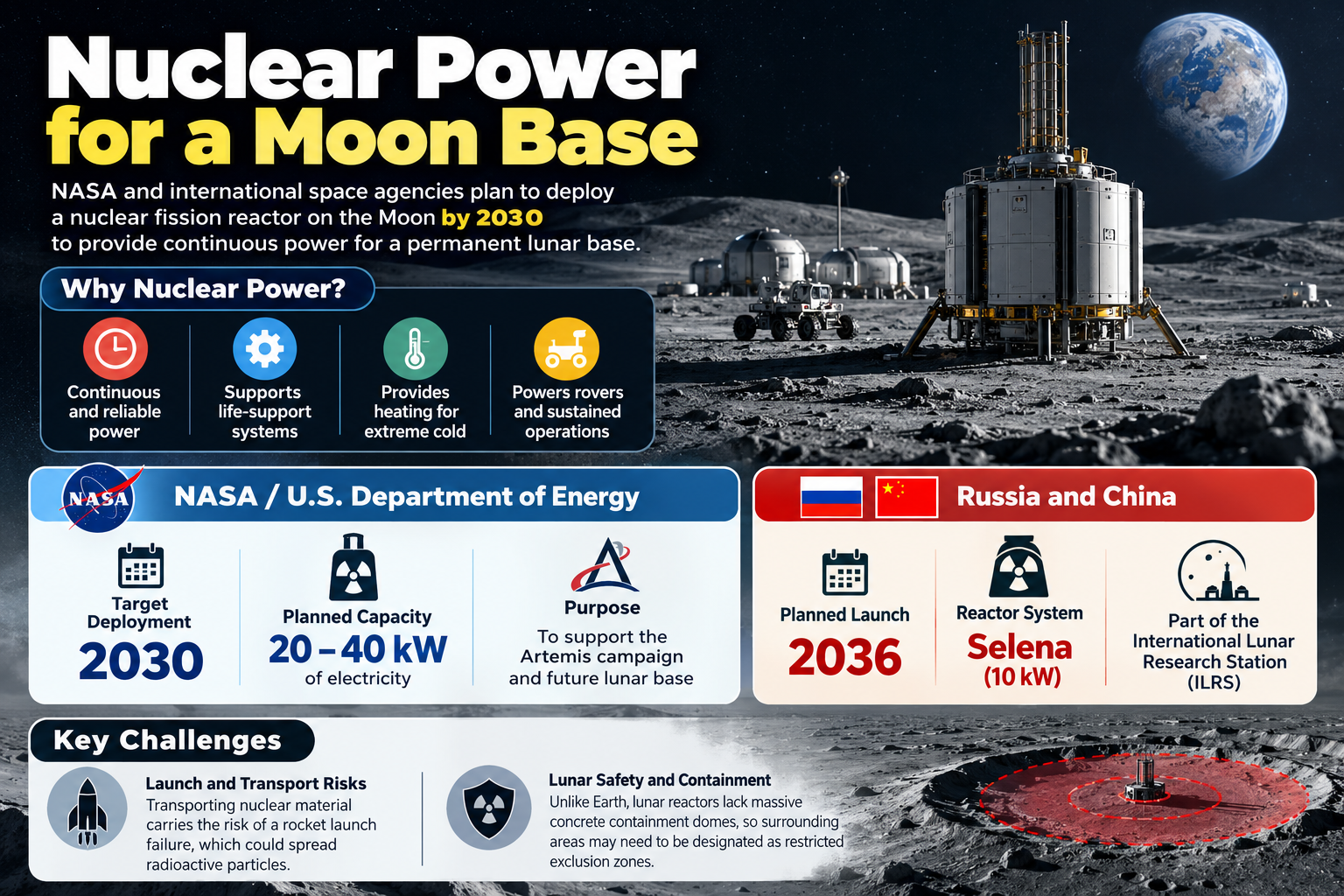
- NASA (US) – Aiming to install a 20-kilowatt (kW) surface nuclear fission reactor by 2030 (comparable to powering a few terrestrial homes).
- Roscosmos/CNSA (Russia-China) – Developing a 10-kW microreactor (termed Selena) targeting deployment for the ILRS by the mid-2030s.
- Strategic Stepping Stone – In-situ resource extraction, such as electrolyzing lunar water ice to produce 10 tonnes of liquid oxygen for rocket propellants, requires around 68 kW of power.
- Deploying 10–20 kW reactors serves as a proof-of-concept phase before scaling up to multi-reactor microgrids needed for industrial-scale lunar manufacturing and rocket refueling.
Why is nuclear power preferred over solar energy at the Lunar South Pole?
- Overcoming the Lunar Night – Most lunar locations experience 14 Earth days of continuous sunlight followed by 14 Earth days of complete darkness.
- Nuclear reactors provide continuous, uninterrupted baseload power regardless of sunlight availability.
- Extreme Thermal Environment – At the lunar south pole, crater interiors remain permanently shadowed where temperatures plunge below –200 °C.
- Solar power cannot function in shadowed regions, whereas nuclear reactors generate vital operational heating alongside electricity.
- High Energy Density for Critical Operations – Continuous power is mandatory for life-support systems, thermal regulation of human habitats, telecommunications, and battery recharging for autonomous mining rovers.
What are the geopolitical and legal implications regarding lunar land rights?
- Scarcity of Prime Lunar Real Estate – While the moon is vast, high-value sites featuring accessible water ice inside shadowed craters, elevated ridges with longer solar illumination, and flat terrain for safe landing pads are extremely limited.
- Safety Distance Requirement as a Spatial De-Facto Claim – NASA-commissioned studies recommend keeping nuclear reactors at least 1 km away from human habitats and sensitive infrastructure to limit radiation exposure.
- Exploiting Treaty Loopholes –
- Outer Space Treaty (OST) 1967 – Article II strictly prohibits national appropriation of the moon or any celestial body by claim of sovereignty, occupation, or any other means.
- Artemis Accords Mechanism – Establishes temporary "Safety Zones" around lunar operations to prevent harmful interference.
- De-Facto Control – By placing a nuclear reactor near a water-ice crater, a nation can claim a mandatory safety zone around it.
- This indirectly limits access to rival states without formally breaking international space law.
What are the technical and environmental challenges of deploying lunar reactors?
- Mass and Launch Logistics – Transporting heavy radiation shielding materials from Earth is extremely expensive. The alternative using lunar regolith for local radiation shielding requires unproven autonomous 3D-printing and mining technology.
- Heat Dissipation in a Vacuum – Because there is no air or water on the moon to conduct or convect heat, reactors must use large radiator panels to discharge waste heat purely through thermal radiation, while keeping them free of abrasive, static-charged moondust.
- Launch Safety and Contamination Risks – Reactors must be launched completely unirradiated to prevent nuclear contamination in the event of a launch failure on Earth.
- If a reactor malfunctions or fails on the moon, it risks permanently contaminating the few resource-rich sites vital for human survival.
- Complex Earth-to-Surface Infrastructure – Operating reactors at safe distances from habitats requires heavy power transmission cables and automated deployment vehicles, adding significant structural complexity and launch weight.
What are the specific imperatives for India and global space governance?
- Strategic Positioning for ISRO – India's Chandrayaan-3 demonstrated soft-landing capability near the lunar south pole.
- To remain competitive in long-term lunar exploration, India must invest in indigenous nuclear power sources (such as Radioisotope Thermoelectric Generators or space-grade microreactors).
- Need for Multilateral Legal Frameworks – The United Nations Committee on the Peaceful Uses of Outer Space (UNCOPUOS) needs to establish clear, binding multilateral guidelines regarding safety zones, nuclear safety, and resource allocation to prevent unilateral land grabbing.
Reference
The Hindu | Nuclear Reactor on Moon



