0.1423
7667766266
x

Nuclear Energy in India

iasparliament Logo
August 29, 2026

Mains: GS III – Energy

Why in News?

India's energy transition faces a unique challenge and nuclear energy has emerged as an important pillar of India's long-term energy strategy.

How nuclear power is produced?

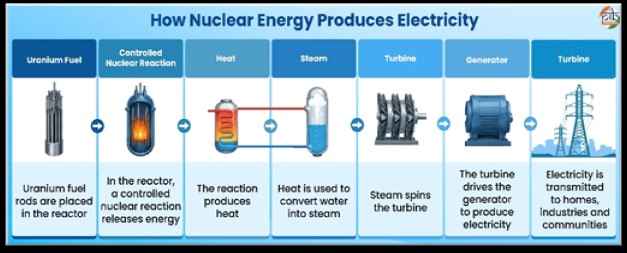
  • Process – Nuclear power plants generate electricity by harnessing heat released through a carefully controlled process called nuclear fission.
  • The heat converts water into steam, which drives a turbine connected to a generator.
  • The generated electricity powers homes, industries, and essential services. The entire process operates within multiple engineered safety barriers and a robust regulatory framework.

Nuclear power. UPSC

  • Nuclear FuelNuclear fuel is the material placed inside a nuclear reactor to generate electricity.
  • Its atoms split through nuclear fission and release large amounts of heat.
  • The heat converts water into steam and the steam drives turbines to generate electricity.
  • Nuclear reactor fuels can be fissile, which directly sustain the chain reaction or fertile, which are first converted into fissile fuels inside the reactor.
  • The most common nuclear fuels are Natural Uranium, Uranium-235 (U-235), Low-Enriched Uranium (LEU), Plutonium-239 (Pu-239), and Mixed Oxide (MOX) fuel.
  • Most countries, including the United States, France, China, Japan, South Korea, Canada, and Russia, use Low-Enriched Uranium (LEU) in Light Water Reactors.
  • India mainly uses Natural Uranium in Pressurised Heavy Water Reactors (PHWRs), which do not require uranium enrichment.
  • India also uses MOX fuel in its Prototype Fast Breeder Reactor (PFBR).
  • India's uranium reserves are of low grade and therefore need to be supplemented through imports.
  • India, however, has abundant reserves of thorium (Th-232).

Nuclear fuel. UPSC

  • This is a fertile rather than fissile radioactive material, found mainly in the coastal sands of Kerala, Tamil Nadu, Andhra Pradesh, Odisha, West Bengal and Jharkhand.
  • Inside a reactor, Th-232 absorbs a neutron and transforms into Uranium-233, which is fissile.
  • India's long-term nuclear strategy is centred on utilising its abundant thorium reserves, through its three-stage nuclear power programme.

Why nuclear energy matters for India?

  • Increasing Energy Demand – India's electricity demand is expected to rise substantially with industrialisation, urbanisation, electrification and the expansion of digital infrastructure.
  • Sustaining Essential Services – Reliable baseload electricity is essential for hospitals, industries, railways, defence establishments, communication networks and other critical services.
  • Low Carbon Footprint – Nuclear power is highly carbon-efficient. Every gigawatt of nuclear capacity avoids about 5.4 million tonnes of carbon dioxide equivalent emissions per year.
  • Net-Zero Target  It helps India cut greenhouse gas emissions and support its long-term climate commitments leading up to 2070.
  • Fossil Fuel Reduction  Nuclear power lowers India's heavy reliance on imported coal and oil.
  • The Thorium Path  India follows a unique three-stage nuclear program designed to eventually use its massive domestic thorium (a radioactive metallic element used as a nuclear fuel) reserves for long-term energy independence.

What are the advantages of nuclear power?

  • Low-carbon generation – Nuclear power produces electricity with very low operational greenhouse-gas emissions.
  • Reliable baseload power – Nuclear reactors can operate continuously and are not dependent on weather conditions.
  • Energy security – Nuclear energy can reduce dependence on imported coal, oil and gas.
  • Land efficiency – Nuclear plants generate large quantities of electricity from relatively compact sites.
  • Industrial development – Nuclear expansion stimulates domestic manufacturing, engineering, research and high-skilled employment.
  • Grid stability – Nuclear generation can complement variable renewable energy such as solar and wind.
  • Thus, nuclear power should not be viewed as a competitor to renewable energy but as a complementary component of India's diversified clean-energy mix.

What is the present status of nuclear power in India?

  • Installed capacity – India currently operates 24 nuclear power reactors with an installed capacity of 8.78 GW.
  • Under construction – Nine reactor units with a combined capacity of 7.5 GW are under construction.
  • The Government has also approved 10 indigenous Pressurised Heavy Water Reactors (PHWRs) in fleet mode and initiated pre-project activities for two 500 MW Fast Breeder Reactors.
  • Initiatives – The country's policy direction has gained further momentum through initiatives such as the Nuclear Energy Mission announced in the Union Budget 2025–26 and the SHANTI Act, 2025.
  • These measures seek to accelerate nuclear capacity addition, encourage indigenous technology and manufacturing, promote innovation and facilitate wider participation in the nuclear sector.
  • India has set an ambitious objective of achieving 100 GW of nuclear power capacity by 2047, making nuclear energy an important component of its long-term development strategy.

More importantly, India's nuclear programme is closely linked with the larger objectives of Aatmanirbhar Bharat, energy security, technological self-reliance and Viksit Bharat.

What is India’s three-stage nuclear power programme?

  • Significance – India's nuclear programme was designed around the country's distinctive resource endowment.
  • While its uranium resources are relatively limited, India possesses substantial thorium reserves.
  • The three-stage programme seeks to progressively convert these resources into a sustainable source of nuclear energy.
  • Stage I: Pressurised Heavy Water Reactors – The first stage uses natural uranium in Pressurised Heavy Water Reactors (PHWRs).
  • Heavy water acts as the moderator and coolant, allowing natural uranium to be used without enrichment.
  • The reactor produces electricity while the spent fuel contains plutonium. Through reprocessing, this plutonium is recovered for use in the second stage.
  • Stage II: Fast Breeder Reactors – The second stage involves Fast Breeder Reactors (FBRs).
  • These reactors use plutonium-based fuel and are designed to generate electricity while producing additional fissile material.
  • The Prototype Fast Breeder Reactor (PFBR) at Kalpakkam, developed with major indigenous technological inputs, attained first criticality in April 2026.
  • This represents a major milestone in India's progression towards the second stage of its nuclear programme.
  • The PFBR was developed under the leadership of the Indira Gandhi Centre for Atomic Research (IGCAR), with extensive participation from Indian industry.
  • Nearly 90 per cent of the reactor's equipment and systems were domestically manufactured, demonstrating India's growing capabilities in advanced nuclear technology.
  • Stage III: Thorium-Based Reactors – The third stage envisages the utilisation of India's abundant thorium-232 resources.
  • Thorium is fertile rather than fissile.
  • When thorium-232 absorbs a neutron, it can ultimately be converted into uranium-233, a fissile material capable of sustaining a nuclear chain reaction.
  • The successful development of the first two stages is therefore critical for establishing the technological foundation for large-scale utilisation of thorium.

Small Modular Reactors – A New Opportunity

  • India is also exploring Small Modular Reactors (SMRs) as an emerging nuclear technology.
  • SMRs generally have a capacity of up to 300 MWe and are designed to enable modular manufacturing, potentially reducing construction time and improving standardisation.
  • Under the Nuclear Energy Mission announced in the Union Budget 2025–26, ₹20,000 crore has been allocated for research, design, development and deployment of indigenous SMRs.
  • India is developing technologies including the 220 MWe Bharat Small Modular Reactor (BSMR-200), the 55 MWe SMR-55, and a High-Temperature Gas-Cooled Reactor aimed at applications such as hydrogen production.
  • SMRs could have applications beyond conventional grid electricity, including remote-area power supply, replacement of retiring coal plants, industrial process heat and hydrogen production.

What are the challenges ahead?

  • High capital – Nuclear projects involve high upfront capital costs and long construction periods.
  • Delays can increase project costs significantly.
  • Need for R&D and Manpower – India needs continued investment in advanced research, skilled manpower and domestic manufacturing capabilities.
  • Waste management – Radioactive waste management and nuclear safety require sustained public confidence.
  • Availability of Fuel – Rapid expansion must ensure adequate availability of nuclear fuel and resilient supply chains.
  • Integration of Energy – Nuclear energy must be integrated with renewable energy, storage technologies and modern transmission infrastructure rather than being pursued in isolation.

What could be done?

  • India should adopt a balanced strategy based on nuclear-renewable complementarity.
  • Faster deployment of indigenous PHWRs, successful commercialisation of breeder technology, continued research on thorium-based systems and development of SMRs can strengthen the country's nuclear ecosystem.
  • Greater investment in R&D, human resources and domestic manufacturing should accompany regulatory reforms.
  • At the same time, safety must remain the overriding principle, with robust institutions, transparent risk communication and strong emergency-response mechanisms.

What lies ahead?

  • With nuclear capacity targeted to reach 100 GW by 2047, India has an opportunity to create a resilient low-carbon energy system in which nuclear power provides dependable baseload electricity while renewables drive large-scale clean-energy expansion.
  • A combination of indigenous technology, responsible regulation, scientific innovation, environmental stewardship and public trust can enable nuclear energy to become a major pillar of India's journey towards a sustainable, secure and self-reliant Viksit Bharat.

Reference

PIB| India’s Nuclear Energy

There are no reviews yet. Be the first one to review.

ARCHIVES

sidetext