Prelims: Current events of national and international importance | Security
Why in News?
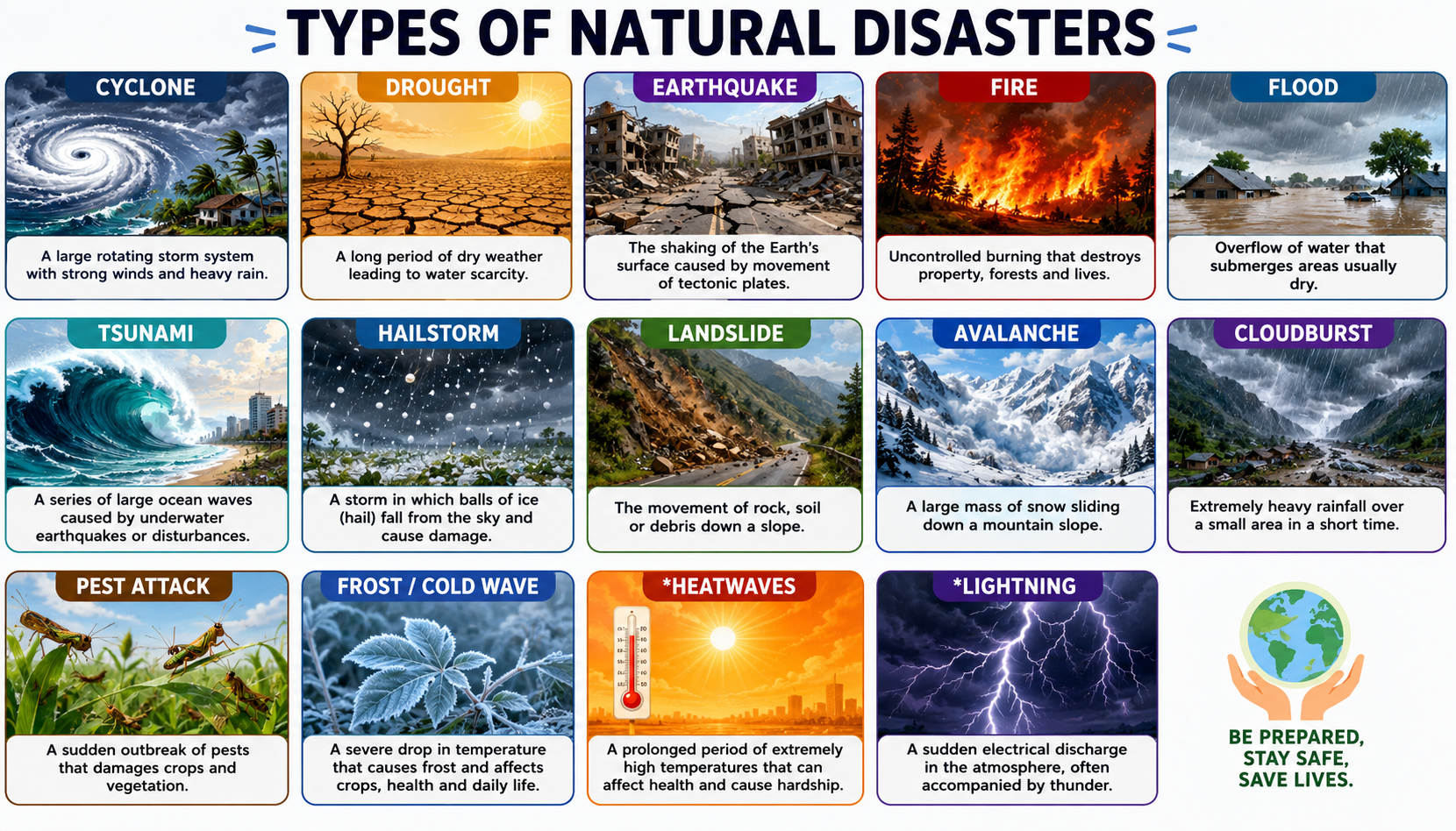
India has added heatwaves and lightning to its list of notified natural disasters.
The Union Ministry of Home Affairs issued operational guidelines for the administration of the State Disaster Response Fund (SDRF) and the National Disaster Response Fund (NDRF) for 2026-31.
Thus, India officially recognises 14 national disasters as notified.
It is making states eligible for financial assistance under the Disaster Management Act, 2005.
The decision follows recommendations by the 16th Finance Commission and comes amid rising concern over extreme weather linked to climate change.
States can now draw on the State Disaster Response Fund and mitigation funds for heatwave and lightning-related relief, with the National Disaster Response Fund available when state funds are inadequate.
Until now, heatwaves were excluded from the Disaster Management Act’s notified disaster list.
That covered only 12 categories: cyclone, drought, earthquake, fire, flood, tsunami, hailstorm, landslide, avalanche, cloudburst, pest attack, and frost/cold wave.
Earlier, states had to notify heatwaves at the state level and could spend only up to 10 per cent of their annual SDRF allocation for heatwave relief.
Now, with the new notification, states can draw on the full state disaster response and mitigation funds, and the national fund also becomes available when state funds are inadequate to deal with a disaster.
The Ministry of Health and Family Welfare (MoHFW) is implementing heat-health interventions through the National Programme on Climate Change & Human Health (NPCCHH) in accordance with the National Action Plan on Heat-Related Illness (NAPHRI).
Additionally, the National Heat-Related Illness and Death Surveillance (NHRIDS) has been activated for over 51,000 reporting units across the country, which include all Primary Health Centres (PHCs) and higher-level hospitals.
SDRF - States use the State Disaster Response Fund for fast, local help.
NDRF - The central government gives extra money from the National Disaster Response Fund if local funds are not enough.
Both are established under the Disaster Management Act, 2005, replacing the old National Calamity Contingency Fund in 2010.
It is financed entirely by the central government, primarily through specific cesses and duties.
It is kept in the Public Account of India under non-interest-bearing reserve funds, allowing quick access without extra parliamentary approval.
The State Disaster Response Fund (SDRF) is the primary fund available with state governments for responses to notified disasters.
The Central Government contributes 75% of SDRF allocation for general category States/UTs and 90% for special category States/UTs (NE States, Sikkim, Uttarakhand, Himachal Pradesh, and Jammu and Kashmir).
SDRF shall be used only for meeting the expenditure for providing immediate relief to the victims
It does not act as property or crop loss compensation.
The National Disaster Response Fund (NDRF) supplements SDRF of a state in case of a disaster of severe nature, provided adequate funds are not available in SDRF.