Prelims: Current events of national and international importance | Awards
Why in News?
Francis Halzen received the 2026 Nobel Prize in Physics for his pioneering work on the IceCube Neutrino Observatory and for discovering high-energy neutrinos of astrophysical origin.

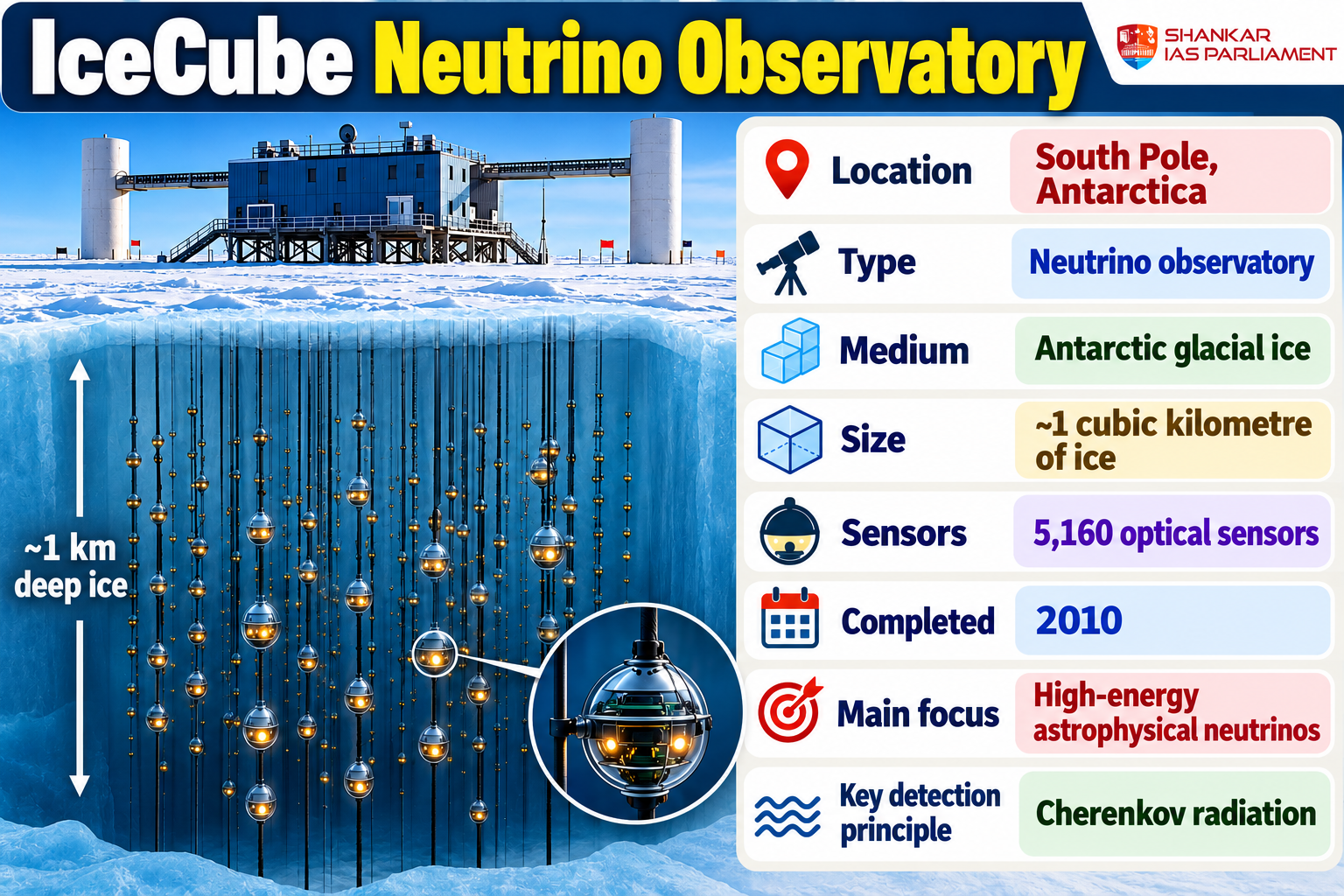
Rationale for Selecting the South Pole
- The South Pole provides a vast volume of clear, undisturbed ice.
- The site experiences relatively low levels of environmental interference.
- It is a geologically stable region characterized by minimal seismic activity.
- The ice serves as a natural detection medium, which eliminates the need to construct a conventional large-scale detector tank.
Major Scientific Milestones
- 1988 – Francis Halzen proposed using South Pole ice to detect neutrinos.
- 2010 – IceCube completed.
- 2013 – First high-energy cosmic/astrophysical neutrinos reported.
- 2018 – A high-energy neutrino was traced to a distant blazar.
Blazar – An active galaxy containing a supermassive black hole, with a relativistic jet directed almost towards Earth.
|
Neutrinos
|
- Neutrinos are extremely small, electrically neutral elementary particles that traverse ordinary matter with minimal interaction.
Key Properties
- No Electric Charge – Neutrinos possess zero electric charge, rendering them unaffected by magnetic and electric fields.
- Small Mass – Neutrinos have a mass significantly smaller than that of other subatomic particles, although it is not zero.
- Weak Interaction – Neutrinos interact exclusively through gravity and the weak nuclear force, resulting in extremely rare collisions with atoms.
- Three Flavors – Electron, Muon, and Tau neutrinos.
Detection Methods
- Large Detection Volumes – Researchers employ massive underground or deep-ice tanks filled with water or liquid scintillator to capture the infrequent neutrino interactions.
- Flashes of Light – When a rare neutrino hits an atomic nucleus, it produces a charged particle that emits a faint flash of light (Cherenkov radiation), which sensitive sensors record.
Cherenkov light - Blue light produced when a charged particle moves through a transparent medium faster than light travels in that medium.
|
Neutrino Research in India
Kolar Gold Fields (KGF), Karnataka
- Scientists at the Tata Institute of Fundamental Research (TIFR) initiated studies on cosmic rays during the 1950s and 1960s.
- Between 1964 and 1965, detectors were installed approximately 2.3 kilometers underground.
- These experiments led to the detection of atmospheric neutrinos.
- Experimental work continued until the closure of the KGF mines in 1992.
India-based Neutrino Observatory (INO)
- The observatory was proposed to be located at Pottipuram in the Theni district of Tamil Nadu.
- The planned detector was a 50,000-tonne magnetised iron calorimeter (ICAL).
- The project aimed to study the following:
- Atmospheric neutrino oscillations
- Effect of Earth's matter on neutrino oscillations.
- The project did not advance to construction due to environmental and local opposition.
Reference
The Hindu | Nobel Prize in Physics 2026



