Prelims: Current events of national and international importance | Science & Technology
Why in News?
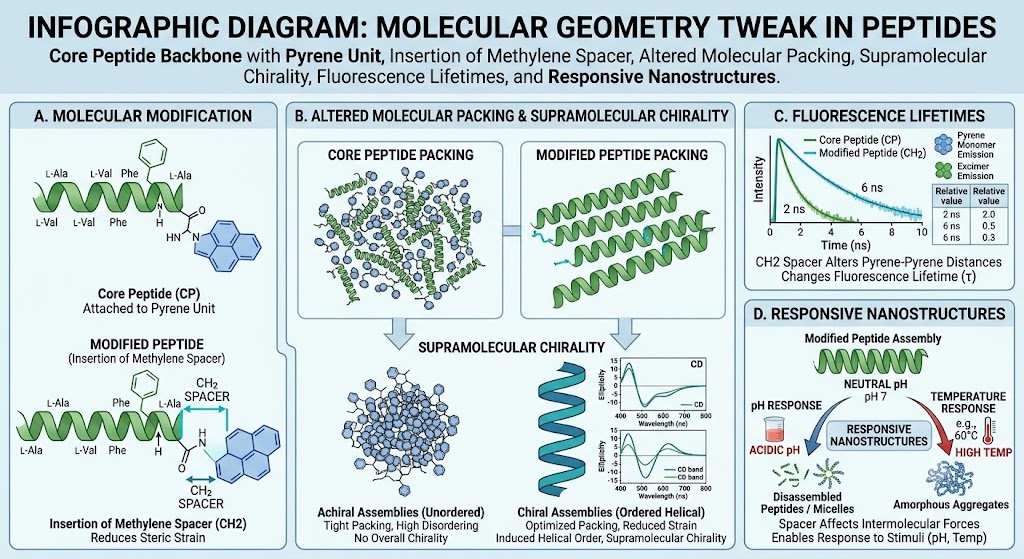
Recently, Scientists highlighted how a subtle tweak in molecular geometry specifically adding a single methylene spacer (-CH2-) to peptide-based molecules profoundly dictates their supramolecular self-assembly.
- Led by - Centre for Nano and Soft Matter Sciences (CeNS), Bengaluru in collaboration with researchers from JNCASR, Bengaluru, and Ghatal Rabindra Satabarsiki Mahavidyalaya, West Bengal
Key Highlights
- Supramolecular Self-Assembly Mechanism
- Peptides (short chains of amino acids linked by peptide bonds) can spontaneously self-assemble into ordered supramolecular nanostructures through non-covalent interactions (such as hydrogen bonding, π-π stacking, and hydrophobic forces).
- However, controlling the precise packing geometry to achieve predictable functional properties has long been a major challenge in soft materials research.
- The "Methylene Spacer" Tweak
- By inserting a single carbon atom (methylene spacer, -CH2-) between the core peptide backbone and a fluorescent aromatic unit (pyrene), the team drastically altered the relative orientation and packing arrangement of adjacent molecules.
- This subtle change altered the collective molecular packing, giving rise to unique supramolecular chirality (hand-like asymmetry at the nanoscale) and significantly prolonged fluorescence lifetimes.
Potential Applications
- Biosensing & Diagnostic Bioimaging - The ability to tune optical properties (such as fluorescence emission and lifetime) through geometric modifications allows for the development of highly sensitive fluorescent probes for real-time cellular imaging, disease biomarker detection, and target molecule tracking.
- Targeted Drug Delivery Systems - Precision control over supramolecular self-assembly enables the design of stimulus-responsive hydrogels and nanocarriers capable of releasing therapeutic drugs in response to specific physiological triggers (e.g., pH shifts or enzymatic activity).
- Establishes a fundamental design principle in molecular nanotechnology—proving that material function can be tuned through simple geometric spacers rather than complex, expensive chemical syntheses.
Reference
PIB | New way for smart biomaterials



