0.1343
7667766266
x

New instance of ‘contagious cancer’ in animals

iasparliament Logo
October 22, 2026

Prelims: Current events of national and international importance | Environment

Why in News?

Recently, researchers at the University of Vermont discovered a rare contagious cancer spreading among brown bullhead catfish in Lake Memphremagog (spanning Vermont, USA, and Quebec, Canada).

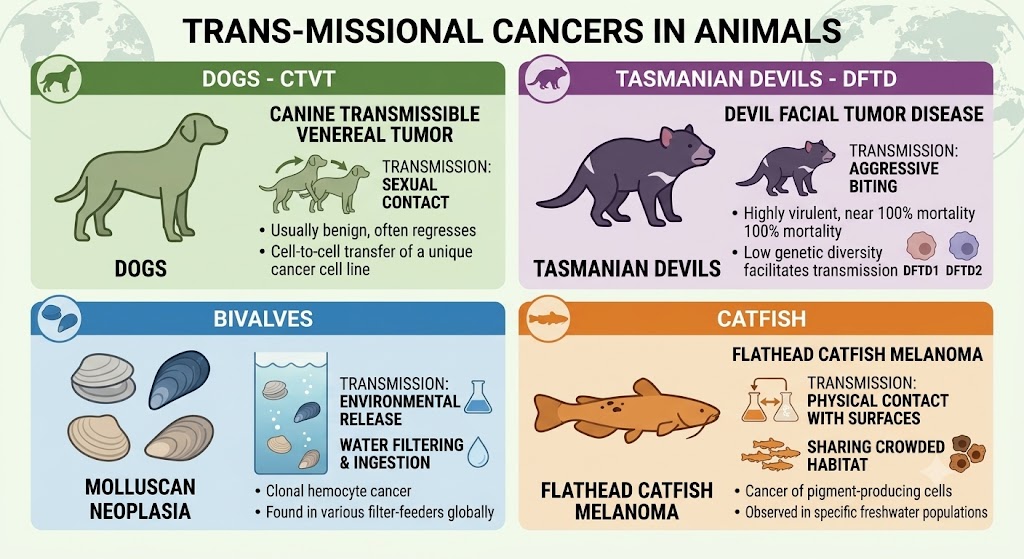
  • It marks only the 4th major instance of transmissible cancer documented in wild animals and the first-ever recorded in a freshwater species.

Known Contagious Cancers in Animals

New instance of ‘contagious cancer’ in animals

Species Group

Cancer Type / Disease

Primary Transmission Vector

Biological Mechanism

1. Canine

Canine Transmissible Venereal Tumor (CTVT)

Sexual contact / Coitus

Older lineage (~11,000 years old); rarely fatal, usually regresses or responds well to chemotherapy.

2. Tasmanian Devils

Devil Facial Tumor Disease (DFTD 1 & DFTD 2)

Bite wounds during territorial/mating fights

Aggressive facial tumors that prevent feeding; caused drastic population declines in wild Tasmanian devils.

3. Marine Bivalves

Bivalve Transmissible Neoplasia (BTN)

Seawater currents (passive filter feeding)

Cancerous blood cells (hemocytes) float through the ocean, infecting clams, mussels, and cockles.

4. Freshwater Catfish (New)

Transmissible Melanoma in Brown Bullhead Catfish

Direct physical contact, mating, or waterborne dispersal (under study)

Black skin lesions/tumors; genome analysis confirmed a shared, identical cancer cell lineage across different individual fish.

Key Mechanisms

  • Cellular Parasitism
    • Unlike standard cancers which arise independently inside an individual host due to somatic mutations transmissible cancers act as infectious cellular parasites.
    • The original tumor cell lineage outlives its initial host by spreading physically to new individuals.
  • Immune Evasion Strategies
    • Normally, an individual's immune system recognizes foreign tissue via Major Histocompatibility Complex (MHC) surface proteins and destroys it.
    • Transmissible cancer cells survive by downregulating MHC molecules or colonizing host populations with low genetic diversity, masking themselves from the host’s immune surveillance.
  • Susceptible to Humans
    • Human immune systems feature high Major Histocompatibility Complex (MHC) diversity, ensuring foreign human cells are quickly rejected as "non-self."
    • Isolated human cancer cells are extremely fragile when exposed to open air or body fluids and die rapidly outside their original host tissue environment.

Strategic Significance

  • Studying how transmissible cancer lineages downregulate immune markers helps oncologists design therapies targeting immune evasion mechanisms in human solid tumors.
  • Highlights environmental factors (like aquatic pollutants or water temperature shifts) that may increase host susceptibility to emerging transmissible diseases in wild aquatic ecosystems.

Reference

The Hindu | New instance of ‘contagious cancer’ in animals

There are no reviews yet. Be the first one to review.

ARCHIVES

sidetext