Prelims: Current events of National and International Importance
Why in News?
New Genetic Tools Are Breathing Fresh Life into India’s Staple Crops.
CRISPR-Based Gene Editing in Rice
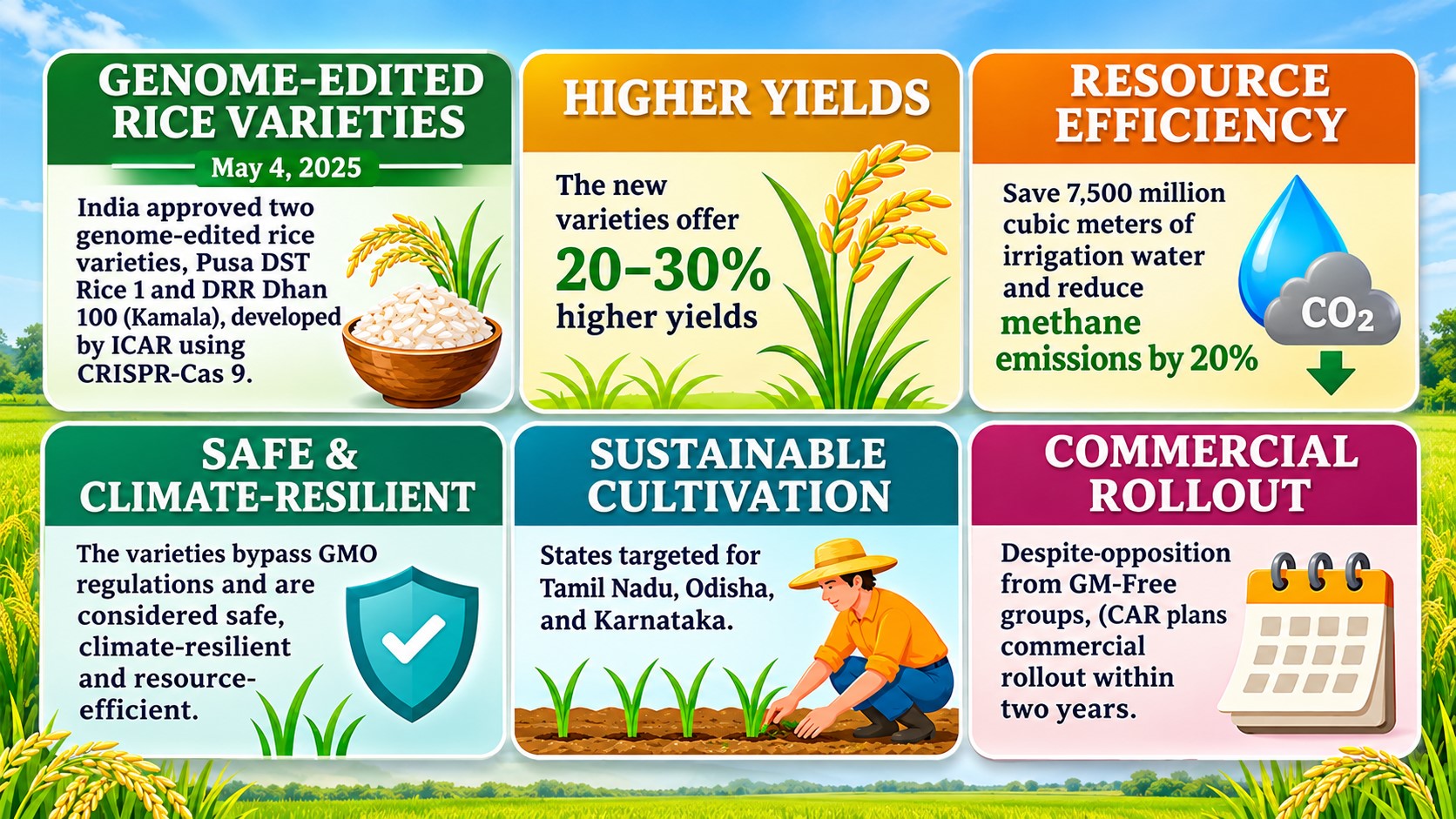
- India became the first country to permit farmers to cultivate gene-edited rice varieties in 2025.
- Two important varieties developed by Indian researchers:
- DRR Dhan 100
- Developed using CRISPR gene-editing technology.
- Matures in 130 days compared to 150 days for the baseline variety.
- Produces approximately 20% higher yield (5.4 tonnes/hectare).
- Reduces water consumption and labour costs.
- Gene editing targets a gene involved in cytokinin degradation, increasing grain number.
- Pusa DST Rice 1
- Developed using CRISPR-Cas9 technology by ICAR-IARI.
- Tolerates saline and alkaline soils.
- Produces 10–30% higher yields under such conditions.
- Shows improved survival under salt stress.
- Significance: Both varieties demonstrate how gene editing can accelerate crop improvement without introducing foreign genes.
Apomixis – Emerging Agricultural Technology
- Apomixis is a form of asexual reproduction in plants in which seeds develop without fertilisation.
- First successfully demonstrated in rice by Venkatesan Sundaresan and Imtiyaz Khanday in 2018.
- It helps preserve desirable parental traits and hybrid vigour across generations.
- Success rates in rice have reached approximately 90%.
- Research is also being extended to maize and sorghum.
Genetic Innovations in Wheat
- India has not yet released gene-edited wheat varieties.
- Climate-resilient wheat varieties are under development.
- Private companies such as Mahyco and Nuziveedu are promoting hybrid wheat research.
- Important Global Developments:
- HB4 Wheat –Developed by Argentina's Bioceres Crop Solutions using a sunflower gene to improve drought tolerance.
- Approved for cultivation in Argentina, Brazil and Paraguay; the US approved its cultivation in August 2024.
- Australia is conducting HB4 field trials and supporting genetic modification and CRISPR-based wheat research.
- International collaborations are targeting improved wheat yields and climate resilience.
Reference
The Hindu| New Genetic Tools in India’s Agriculture



