Prelims: Current events of national and international importance | Species
Why in News?
Neelakurinji has bloomed at Meeshapulimala in Munnar, Kerala. The site was opened to tourists on October 26, 2026.
- This flowering event is considered unusual, as Neelakurinji typically does not bloom at elevations exceeding 2,500 metres.
- The Kerala Forest Development Corporation (KFDC), in collaboration with the Wildlife Trust of India (WTI), has launched the Kurinji mobile application to facilitate online bookings.
- Daily tourist entry is limited to 750 visitors in order to protect the ecologically sensitive landscape.
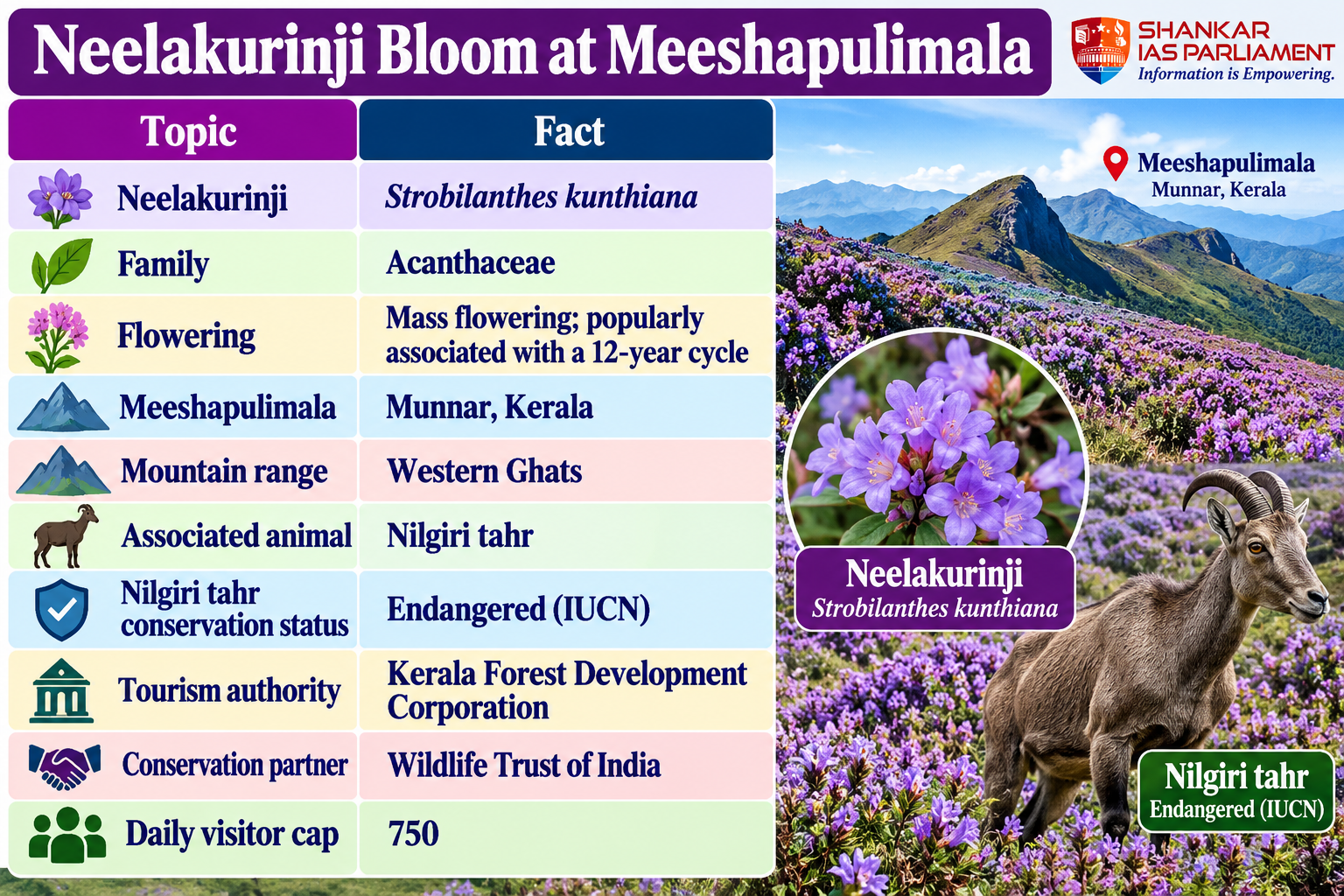
Neelakurinji
- Scientific name – Strobilanthes kunthiana
- Type – Flowering plant/shrub.
- Family – Acanthaceae.
- Habitat – Shola-grassland landscapes and montane regions of the Western Ghats.
- Distribution: Associated with the high-altitude hills of southern India, particularly the Nilgiri and adjoining mountain ranges.
- Flower colour: Bluish-purple.
- Special feature: Mass flowering transforms hillsides into carpets of blue-purple flowers.
Flowering Pattern
- Neelakurinji is renowned for its gregarious flowering, during which a large number of plants bloom simultaneously.
- Neelakurinji is commonly associated with a 12-year flowering cycle; however, flowering intervals may vary among different Strobilanthes species.
- In Munnar, the flowering progressed from lower elevations to higher elevations.
- The Meeshapulimala bloom is projected to continue until December 2026.
- The next Neelakurinji flowering season at Eravikulam National Park is anticipated in 2030.
Meeshapulimala: Geographic Location and Ecological Importance
- Located in – Kerala.
- Situated in – Munnar region of Idukki district within the Western Ghats.
- Ecological significance – A high-altitude mountain habitat that supports specialised flora and fauna.
- Wildlife – It includes the Nilgiri tahr, an endangered mountain ungulate endemic to the southern Western Ghats.
- The area falls under the jurisdiction of the Kerala Forest Development Corporation (KFDC).
Significance of the Neelakurinji Bloom
- Neelakurinji typically does not bloom at elevations above 2,500 metres.
- The KFDC property, Rhodo Mansion, is situated at approximately 2,470 metres, where flowering has been observed on the surrounding slopes.
- Concerns were raised regarding delayed flowering attributed to El Niño effects and fluctuations in the monsoon.
- Subsequently, flowering was also observed on the Meeshapulimala hills.
- The report emphasises the unusual elevation and timing of the bloom but does not identify a definitive scientific cause for the observed flowering pattern.
Reference
The Hindu | Neelakurinji Bloom at Meeshapulimala



