Integrated Strategies Defeated Left-Wing Extremism
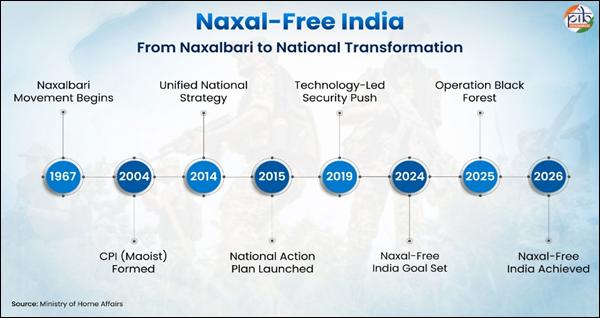
- India achieved a historic milestone on 31 March 2026, becoming effectively free from Left-Wing Extremism (LWE), with no district remaining LWE-affected.
- The achievement resulted from an integrated strategy combining security operations, infrastructure development, rehabilitation of surrendered cadres, tribal welfare and responsive governance.
Background: Left-Wing Extremism in India
- LWE originated from the Naxalbari uprising (West Bengal, 1967), inspired by Maoist ideology and armed revolution.
- Several extremist organisations merged under the Communist Party of India (Maoist) in 2004, making it a major internal security challenge.
- Nearly 92% of Naxalites' weapons were reportedly looted from police armouries.
Violence before 2014:
- Between 2004 and 2014, India recorded 17,542 violent incidents, 1,913 security personnel deaths and 5,019 civilian deaths.
- Violence peaked in 2010, with 1,936 incidents and 720 civilian deaths.
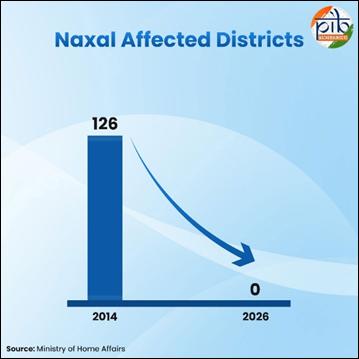
- In 2014, LWE affected 126 districts, including 35 most-affected districts.
Integrated Strategy: From Fragmented Response to Unified Action
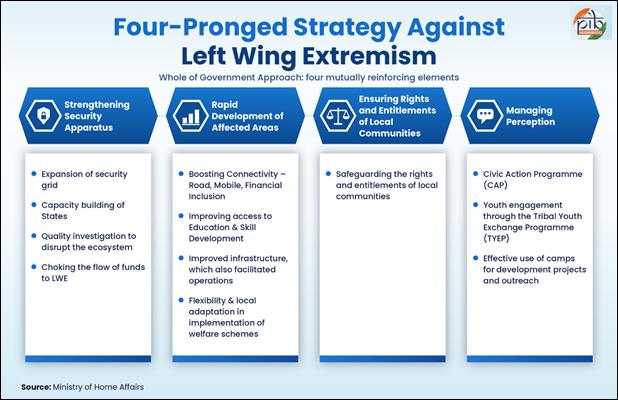
The Government adopted a comprehensive approach based on three mutually reinforcing pillars:
- Restoring faith in the State: Strengthening security operations, inter-agency coordination, community outreach and rehabilitation.
- Expanding infrastructure: Improving road, rail and digital connectivity and extending governance to remote regions.
Delivering welfare: Ensuring inclusive service delivery, tribal rights, livelihood opportunities and cultural integration.
Strengthening Security and State Presence
- The National Policy and Action Plan (2015) replaced fragmented responses with a coordinated, whole-of-government strategy.
- Security operations were strengthened through Central Armed Police Forces (CAPFs), specialised training, intelligence coordination and fortified police stations.
- Financial support was provided through:
- Special Central Assistance (SCA): Approximately ₹4,318.52 crore released since 2017.
- Special Infrastructure Scheme (SIS): Projects worth ₹1,761 crore sanctioned for strengthening Special Forces, intelligence branches and district police.
- Security Related Expenditure (SRE): ₹3,877.98 crore released since 2014–15 for operational requirements and capacity building.
- The National Investigation Agency (NIA) strengthened investigations against Maoist networks, including financial and organisational structures.
Surrender and Rehabilitation
- The rehabilitation policy encourages cadres to surrender and reintegrate into mainstream society.
- Surrendered cadres receive:
- ₹5 lakh for higher-ranked cadres and ₹2.5 lakh for others.
- Monthly stipend of ₹10,000 for 36 months.
- Additional incentives for surrendering and depositing weapons.
- Approximately 8,526 Naxalites surrendered till November 2026.
- Rehabilitation includes skill development, livelihood assistance, housing, self-employment support and education for children of surrendered cadres.
Infrastructure and Connectivity Development
Infrastructure expansion helped integrate previously isolated tribal regions with mainstream economic and administrative systems.
Road Connectivity
- A total of 15,189 km of roads were constructed under the Road Requirement Plan (RRP) and Road Connectivity Project for LWE Affected Areas (RCPLWEA).
- The Border Roads Organisation (BRO) was tasked with constructing critical roads and bridges in areas where Maoist threats discouraged contractors.
Digital Connectivity
- A total of 9,561 mobile towers were commissioned.
- Around 96% of villages (44,728 out of 46,592) in the most affected areas now have mobile connectivity.
Rail Connectivity
- The 95-km Dalli Rajhara–Rowghat railway line has been completed, while the 140-km Rowghat–Jagdalpur line has been approved.
- The Dantewada–Manuguru railway line (153 km) was sanctioned, and 130 km of the Kirandul–Jagdalpur doubling project has been commissioned.
Financial Inclusion
- Between April 2015 and March 2026:
- 1,804 bank branches opened.
- 1,321 ATMs installed.
- 74,720 banking correspondents appointed.
- 6,025 post offices established.
Responsive and Inclusive Governance
- Special campaigns with UIDAI and the postal department improved Aadhaar coverage in remote tribal areas.
- In Bastar, 294 post offices were established after considering geographical and terrain constraints.
- Flexible governance measures included cash wage payments, offline attendance systems, offline Ayushman Bharat card applications and routing sanitation funds through Village Sanitation Committees.
- These adaptations strengthened last-mile delivery of welfare schemes.
Healthcare
- A 240-bed Super Specialty Hospital was established at Government Medical College, Jagdalpur, under PMSSY and inaugurated on 18 May 2026.
- Eleven CAPF field hospitals were also opened to local tribal communities.
Education and Skill Development
- 259 Eklavya Model Residential Schools (EMRS) were sanctioned, of which 179 became functional.
- 47 ITIs and 49 Skill Development Centres were established with nearly ₹800 crore investment.
- More than 90,000 tribal youth and women received skill training.
- The Tribal Youth Exchange Programme (TYEP) enabled 37,655 tribal youth to participate in national exposure visits since 2014.
Civic Action Programme
- ₹221.88 crore has been released since 2014 to CAPFs for medical camps, sports activities and distribution of essential items, strengthening community trust.
Tribal Welfare and Livelihood Development
- Forest Rights Act: 21,26,273 title deeds were distributed, strengthening tribal land and forest rights.
- PM-JANMAN: Focuses on Particularly Vulnerable Tribal Groups (PVTGs) through housing, drinking water, education, healthcare and connectivity.
- Dharti Aaba Janjatiya Gram Utkarsh Abhiyan: Addresses infrastructure gaps in tribal villages and improves their living standards.
- Aspirational Districts Programme: Converges welfare schemes to improve health, education, financial inclusion and connectivity.
- Surrendered cadres receive livelihood assistance, housing support and self-employment opportunities, while their children receive free education up to Class XII.
- Development grants are provided to villages that eliminate Naxal influence and establish democratically elected panchayats.
Case Study: Bastar's Transformation
- The Bastariya Battalion (2017) recruited 1,143 personnel, including around 400 local youth, strengthening intelligence networks and community trust.
- More than 3,240 km of roads and 889 mobile towers improved connectivity across Bastar.
- A rehabilitation plan for approximately 3,000 surrendered cadres was supported by an initial allocation of ₹20 crore.
- The Shaheed Veer Gunda Dhur Seva Dera initiative (May 2026) aims to convert CAPF camps into Integrated Development Centres.
- Initiatives such as Bastar Pandum and Bastar Olympics promoted tribal culture, youth participation and social integration.
Outcomes of the Integrated Strategy
|
Indicator
|
Earlier position
|
Achievement
|
|
LWE-affected districts
|
126 (2014)
|
Zero (March–April 2026)
|
|
Most-affected districts
|
35
|
Zero
|
|
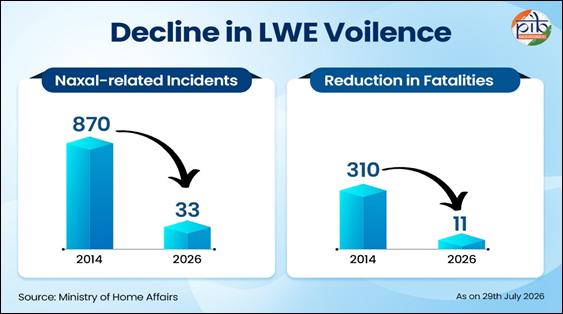
Violent incidents
|
870 (2014)
|
33 (2026, as on 29 July)
|
|
Fatalities
|
310 (2014)
|
12 (2026, as on 29 July)
|
The decline in violence reflects the weakening of Maoist networks and restoration of public confidence and security.
Consolidating Gains after June 2026
- Seva Dera Kendras: One-third of security camps in LWE-free areas are being converted into Integrated Development Centres providing healthcare, banking, skill development, government services and livelihood support.
- NID Collaboration: An MoU was signed with the National Institute of Design, Ahmedabad, to transform five security camps in Bastar into Shaheed Veer Gundadhur Seva Dera Kendras.
- Welfare Saturation Survey: Seven former LWE-affected districts of south Chhattisgarh were surveyed to identify gaps in education, healthcare, basic services and livelihood opportunities.
- Victim Rehabilitation: Assistive devices were distributed to persons with disabilities, including victims of Naxal violence, under the Seva Sankalp Abhiyan.
- First Naxal-Free Diwali: On 8 November 2026, the Prime Minister celebrated Diwali with security forces in Bastar, marking the achievement of a Naxal-free India.
Way Forward
- Consolidate security gains through continued intelligence coordination and effective policing.
- Prevent the resurgence of extremism by addressing socio-economic inequalities and governance deficits.
- Complete the rehabilitation and reintegration of surrendered cadres.
- Ensure effective implementation of tribal rights, welfare schemes and livelihood programmes.
- Strengthen local participation, democratic institutions and community-led development.
Conclusion
- India's achievement of becoming effectively Naxal-free demonstrates that internal security challenges require an integrated approach combining security, development, rehabilitation and inclusive governance.
- Sustaining this achievement requires converting security gains into lasting peace, tribal empowerment and equitable development.
Reference
PIB



