Why in news?
The Union Cabinet has recently approved the introduction of the National Research Foundation (NRF) Bill, 2023.
What are the features of NRF Bill, 2023?
- NRF - The bill will establish National Research Foundation as an apex body.
- SERB - The bill will repeal the Science and Engineering Research Board (SERB), a statutory body that was established in 2008 to promote basic research in Science and Engineering and to provide financial assistance to persons engaged in R&D.
- SERB will be subsumed into NRF which has an expanded mandate and covers activities over and above the activities of SERB.
What is NRF?
- NRF is one of the key recommendations of the National Education Policy (NEP), 2020.
- It is modelled on the lines of the hugely successful National Science Foundation of the United States.
- Aim - The NRF intends to act as a coordinating agency between researchers, various government bodies and industry, thus bringing industry into the mainstream of research.
- The NRF plans to seed, grow and facilitate research in India’s universities, especially State universities, by funding research infrastructure and researchers.
- Governance - NRF will be administrated by the Department of Science and Technology (DST) and governed by a Governing Board.
- Funding – The NRF will operate with a budget of Rs 50,000 crore for five years, of which 28% will be the government’s share, and the remaining 72%will come from the private sector.
|
Composition of Governing Board
|
- Ex-Officio President - Prime Minister
- Ex-Officio Vice Presidents
- Minister of Science and Technology and
- Minister of Education
- Executive Council will govern the functioning of NRF
- Executive Council will be chaired by the Principal Scientific Advisor to the Government of India.
|
What is the significance of NRF?
- Focus on universities - The main objectives of the NRF is to get colleges and universities involved in scientific research.
- Research in social sciences - It promote research not just in natural sciences but also in humanities, social sciences and art.
- National priorities - It also aims to identify priority areas such as clean energy, climate change, sustainable infrastructure, etc. in which S&T interventions can help larger national objectives.
- Democratisation - The focus area for NRF is peripheral, rural and semi urban areas which are often neglected.
- Uniformity – It also aims to bring uniformity in funding and reduce the bureaucratic hurdle associated in raising money.
- Internationalization - It will promote international competition and find solution to complexities of Indian society.
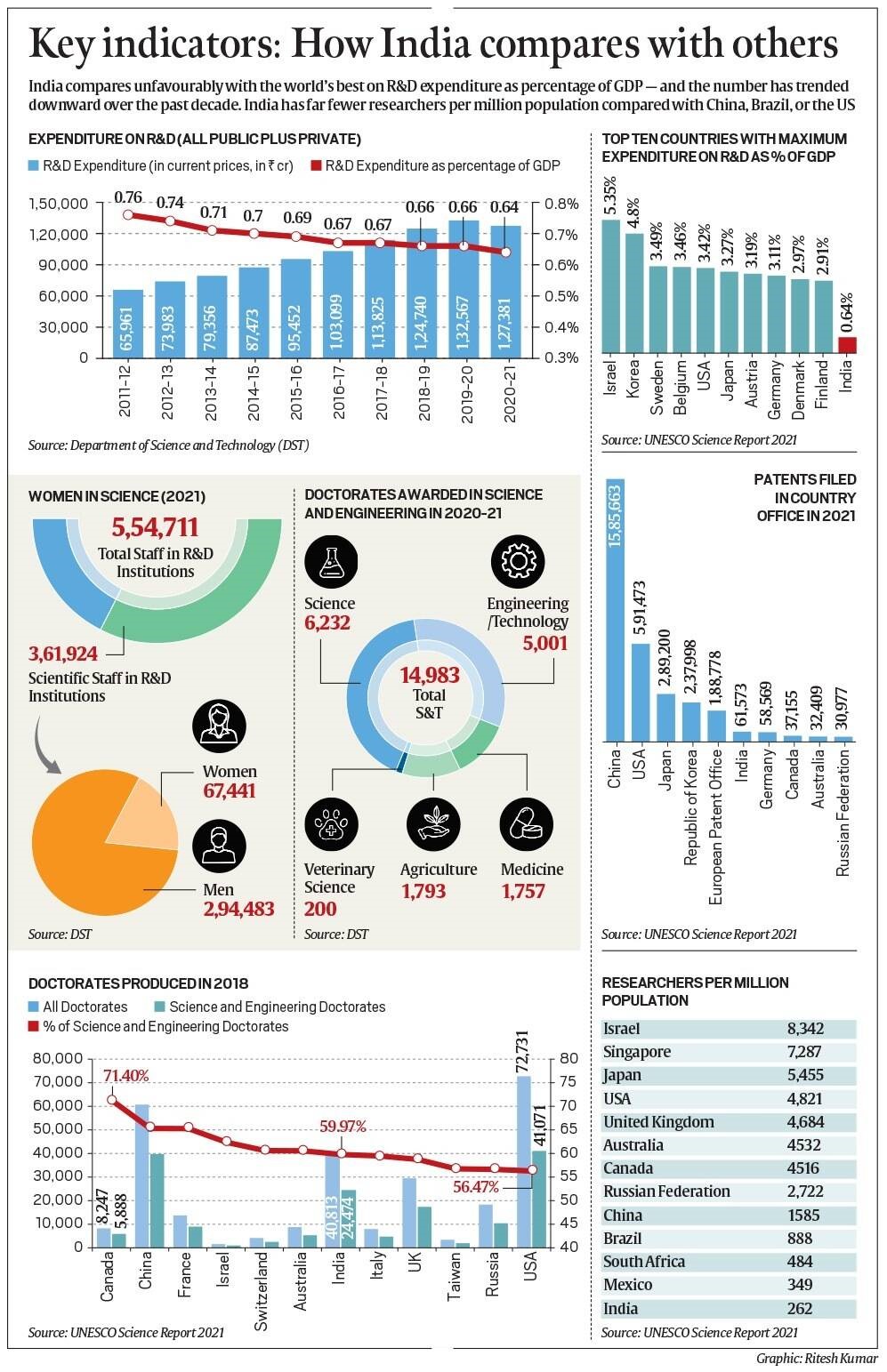
What is the status of R&D in India?
- R&D expenditure - India spends around 0.7% of GDP in R&D which is lesser than many other countries.
- Gross expenditure on R&D in India is declined from 0.84% in 2008 to 0.69% in 2018.
- Research funding - Eminent institutions like the IITs and IISc get a bulk of research funding but State universities get very little about 10% of the research funds.
- Patents - According to the World Intellectual Property Organisation (WIPO), although India registered a 16.5% growth in patent grants in 2021, the patent applications are very much less than China and US.
- Other challenges - Other challenges that constraints the scientific community includes:
- Inconsistent funding stream
- Complex application processes (multiple guidelines & rules)
- Bias towards established researchers and institutions
- Straight-jacketed themes which allow little intellectual freedom
- University bureaucracy and procedures result in delays in decisions
What are the challenges associated with NRF?
- Financial crunch- 50% of the funding mechanism is dependent on private sector.
- While the participation of the private industry in the NRF is an important and welcome step, it is unclear how the government will raise Rs 36,000 crore from the industry.
- Autonomy - The top positions in the NRF board are reserved for members of the government, including the PM and the Ministers of Science, Technology and Education.
- Time period - Although the NRF draft mentions that the peer-review process will be completed within 6 months, releasing funds may take time, pending financial clearance.
What is the need of the hour?
- The time between applying for a research grant and receiving the money must be minimal, preferably within 6 months.
- All the paperwork must be digitally processed without sending stacks of papers in hard copies to the NRF.
- All finance-related queries, paperwork, approval, and acceptance need to be between the NRF and the finance department of the university/research institution keeping the scientist free to focus on research.
- The NRF needs explicit spending guidelines away from the General Financial Rules (GFR) and the government’s e-Marketplace (GeM) usage.
- Although the NRF draft mentions timely disbursal of funds, a mechanism needs to be in place to facilitate and implement this.
|
Department of Science and Technology
|
- Estblished in 1971.
- Functions under the Ministry of Science and Technology.
- Its flagship programs are National Initiative for Developing and Harnessing Innovations (NIDHI), Vigyan Jyoti, INSPIRE etc.,
|
References
- The Indian Express | centre gets nod
- The Indian Express | views on NRF
- Indian Express |boost research



