Why in news?
The Union government has announced its plans to “monetize” about Rs 6 trillion worth of assets held by it, and public sector units (PSUs), under the National Monetisation Pipeline (NMP).
What is monetisation?
- When a government transfers its revenue rights to private parties in return for upfront money, a revenue share, and commitment of investments in the assets, it is called a monetisation transaction.
- It is done for a specified transaction period to raise funds.
- Private players will have to -
- calculate what they can earn from it in various ways in those years
- discount that cash flow to its ‘present value’ (PV)
- deduct from PV their profit margin
- pay the balance amount as upfront rental to the government i.e., pay for operation and management rights
- Unlike the disinvestment, there will not be a change of ownership i.e., the assets or the land therein will not be sold.
- E.g Real estate investment trusts (REITs) and infrastructure investment trusts (InvITs) are the key structures used to monetise assets in the roads and power sectors.
What are the other models?
- Other monetisation models on Public Private Partnership (PPP) basis include
- Operate Maintain Transfer (OMT),
- Toll Operate Transfer (TOT), and
- Operations, Maintenance & Development (OMD).
- OMT and TOT have been used in highways sector while OMD is being deployed in case of airports.
- In sectors like mining, Centre may also look for auction and Mine Development Operator routes.
- The choice of instrument will be determined based on
- nature of asset,
- timing of transactions (including market considerations),
- target investor profile & and
- the level of operational/investment control envisaged to be retained by the asset owner etc.
What is the National Monetisation Pipeline?
- It aims to unlock value in brownfield projects by engaging the private sector.
- It aims to transfer revenue rights to the private players (not ownership in the projects).
- The private players operating the assets are also expected to modernize them.
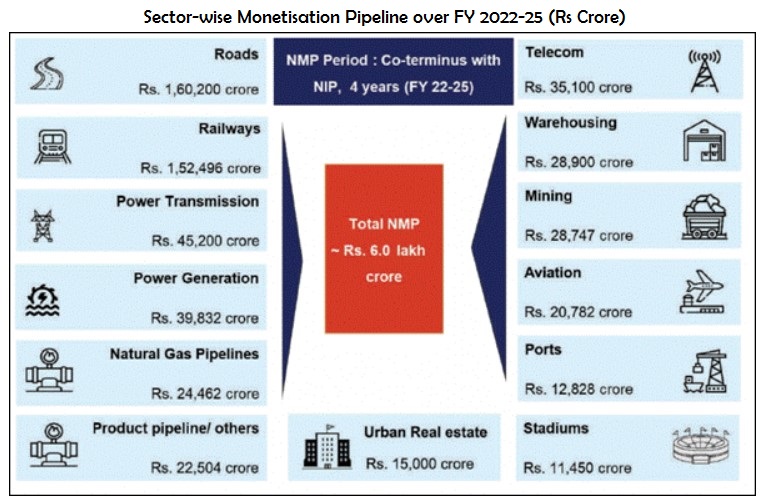
- The funds generated (around Rs. 5.96-lakh crore) will be used for infrastructure creation across the country.
- This, in turn, could help fund the National Infrastructure Pipeline with new projects worth Rs. 100-lakh crore.
- Developed by NITI Aayog, in consultation with infrastructure line ministries.
Greenfield investment - A company will build its own, brand-new facilities from the scratch
Brownfield investment - A company purchases or leases an existing facility.
What are the key assets identified?
- Road sector (maximum) - Rs 1.6 lakh crore worth national highways
- Railways sector - About 400 stations, 150 trains, and some tracks and woodshed
- Power sector - Rs 67,000 crore worth transmission lines from Power Grid and Rs 32,000 crore worth Hydro, Solar, and Wind projects from NHPC, NTPC, and Neyveli Lignite
What are the challenges and risks?
- As there is no transfer of ownership, the operator will limit any additional investment and so, the scope for any increase in efficiency is very limited.
- The concession periods for some assets runup to 60 years. So, the post-transaction troubles are higher.
- There could be challenges in the long-term if they are not structured with end-user interests in mind, balancing the profit and utility motives.
What should be done?
- The sharing of risk and rewards between the public and private partners needs to be weighed carefully.
- Checks and balances are needed for actual infrastructure usage versus projections at the time of bidding.
Source: The Hindu, The Wire, The Indian Express, Economic Times



