Celebrating India's Dairy Strength and Farmer Prosperity
- National Milk Day is observed annually on 26 November to commemorate the birth anniversary of Dr. Verghese Kurien, the Father of India's White Revolution.
- India remains the world's largest milk producer, contributing nearly one-fourth of global milk production.
- The dairy sector supports rural livelihoods, women's empowerment, nutritional security and inclusive economic development.
Milk at the Heart of India's Nutrition and Rural Economy
- Milk provides high-quality animal protein and essential nutrients such as calcium, magnesium and potassium, supporting growth, bone health and overall well-being.
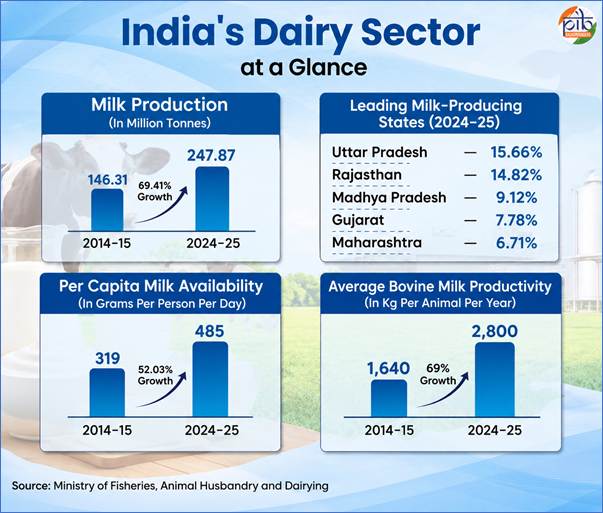
- India’s milk production grew at a CAGR of 5.41% between 2014-15 and 2024-25, reaching 247.87 million tonnes.
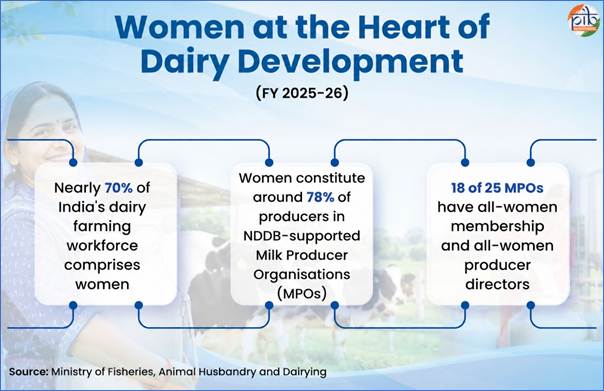
- Dairying supports approximately 8.5 crore rural households, with women constituting nearly 70% of the dairy workforce.
India's Dairy Sector Records Strong Growth
- Milk production increased by 69.41%, from 146.31 million tonnes in 2014-15 to 247.87 million tonnes in 2024-25.
- Leading milk-producing States include Uttar Pradesh (15.66%), Rajasthan (14.82%), Madhya Pradesh (9.12%), Gujarat (7.78%) and Maharashtra (6.71%), together contributing 54.09% of national production.
- Per capita milk availability increased by 52.03%, from 319 grams per day in 2014-15 to 485 grams in 2024-25.
- Average bovine milk productivity increased from 1,640 kg to 2,800 kg per animal annually during the same period.
The Cooperative Strength Behind India's Milk Economy
- India's dairy cooperative movement connects village-level societies with district milk unions and State federations, facilitating procurement, processing and marketing.
- The cooperative network comprises:
- 22 milk federations.
- 241 district cooperative milk unions.
- 28 marketing dairies.
- 25 Milk Producer Organisations (MPOs).
- It covers approximately 2.45 lakh villages and 1.65 crore dairy farmers, providing organised market access and collective bargaining opportunities.
NDDB Dairy Services
- The National Dairy Development Board (NDDB), through its subsidiary NDDB Dairy Services, facilitates the establishment of farmer-owned Milk Producer Organisations (MPOs).
- MPOs promote collective procurement, transparent pricing, direct bank payments and professional management.
- As of 31 October 2026:
- 25 MPOs established, including 18 exclusively women-owned organisations.
- More than 13 lakh milk producers covered across 175 districts in 12 States.
- Women constitute approximately 78% of producers.
- Around 70 lakh litres of milk procured daily.
Milk Procurement and Sales by Dairy Cooperatives
- Dairy cooperatives provide organised markets, regular procurement and direct bank payments to farmers.
- As of 31 October 2026:
- Daily milk procurement: 690.90 lakh kg.
- Daily liquid milk sales: 462.95 lakh litres.
A New Momentum for Dairy Cooperatives
White Revolution 2.0
- Launched on 25 December 2024, it aims to expand dairy cooperatives into uncovered villages and Panchayats and increase cooperative milk procurement by 50% within five years.
- It focuses on strengthening cooperatives, improving market access, generating employment and empowering women.
- By 2028-29, it targets:
- Establishment of 75,000 new Dairy Cooperative Societies.
- Strengthening of 46,422 existing societies.
- Progress by 31 October 2026:
- 24,097 new societies established.
- 31,394 existing societies strengthened.
Sustainability and Circularity in Dairy Sector
- White Revolution 2.0 promotes climate-smart dairying, renewable energy and efficient resource utilisation through the concept of 'Gold out of Garbage'.
- Two multi-State cooperative societies support this approach:
- Cooperative Inputs and Services Delivery Multi-State Limited: Provides animal feed, disease control and artificial insemination services.
- Gomay Sahkari Samiti Multi-State Limited: Promotes scientific management and utilisation of cattle dung.
- GOBARdhan Scheme (2026): With an outlay of ₹23,731 crore for 2026-27 to 2035-36, it aims to expand compressed biogas production nearly ten-fold through assured procurement, capital assistance and infrastructure.
- The original GOBARdhan initiative was launched in 2018 under Swachh Bharat Mission (Grameen) to convert cattle dung and agricultural waste into biogas and bio-slurry.
Building a Stronger Dairy Ecosystem
Government initiatives focus on infrastructure, scientific breeding, livestock productivity, animal healthcare and improved farmer incomes.
Strengthening Dairy Infrastructure through NPDD
- The National Programme for Dairy Development (NPDD) strengthens milk procurement, processing, value addition, marketing and quality infrastructure.
- It has two components:
- Component A: Expands milk procurement, chilling facilities, testing infrastructure and clean milk production, particularly in the North Eastern Region, hilly areas and Union Territories.
- Component B: Strengthens cooperative processing, marketing and producer-owned institutions to improve farmers' market access.
- Component B operates in nine States.
- Achievements by October 2026:
- 40,800 new or revived cooperative societies.
- 25.82 lakh additional farmers enrolled.
- 168 lakh litres per day of milk chilling capacity created.
- 94,000 milk quality testing devices distributed.
Rashtriya Gokul Mission (RGM)
- Launched in December 2014, RGM promotes scientific development and conservation of indigenous bovine breeds.
- Revised in March 2025, it emphasises artificial insemination, sex-sorted semen, IVF technology and breeding infrastructure.
- Progress:
- 50,023 MAITRIs trained and equipped.
- 24 IVF laboratories established.
- 48 semen stations being strengthened.
- 32 heifer rearing centres sanctioned.
Nationwide Artificial Insemination Programme (NAIP)
- Aims to expand artificial insemination coverage using high-genetic-merit bull semen, including indigenous breeds.
- More than 18.71 crore artificial inseminations performed, covering nearly 11.17 crore animals.
Animal Husbandry Infrastructure Development Fund (AHIDF)
- Supports modern dairy processing, value addition and cold-chain infrastructure in private and cooperative sectors.
- Provides 3% interest subvention for eight years.
- Since 2020-21, supported 258 dairy processing plants, leveraging approximately ₹21,797 crore in investments.
Livestock Health and Disease Control Programme (LHDCP)
- Strengthens veterinary infrastructure, disease prevention and doorstep veterinary services through Mobile Veterinary Units.
- As of October 2026:
- 4,019 Mobile Veterinary Units operational across 29 States and UTs.
- Served approximately 1.5 crore farmers and treated 3.3 crore animals.
National Animal Disease Control Programme (NADCP)
- Focuses on controlling and eliminating Foot and Mouth Disease (FMD) and controlling Brucellosis through vaccination and surveillance.
- More than 152 crore FMD vaccine doses administered, benefiting around 8 crore farmers.
- FMD outbreaks declined from 132 in 2019 to 40 in 2025, while Brucellosis outbreaks declined from 22 to 15.
Digital Livestock Records through Bharat Pashudhan
- Developed by the Department of Animal Husbandry and Dairying with NDDB, Bharat Pashudhan maintains digital livestock records.
- Each animal receives a unique 12-digit identification number called Pashu Aadhaar, recording vaccination, breeding and treatment details.
- By October 2026:
- 9.98 crore livestock owners registered.
- More than 39.42 crore Pashu Aadhaar issued.
Indian Dairy Products in Global Markets
- India exported 97,524.82 metric tonnes of dairy products during 2025-26, earning USD 407.12 million.
- Major export destinations include the UAE, Saudi Arabia, USA, Bhutan and Bahrain.
- Growing exports demonstrate the expanding international presence of India's dairy industry.
The Strength Behind Every Drop
- India's dairy sector combines rising milk production, scientific breeding, cooperative institutions and improved animal healthcare.
- National Milk Day recognises Dr. Verghese Kurien's contribution and millions of dairy farmers, particularly women, whose efforts strengthen rural livelihoods, nutritional security and India's global dairy leadership.
Reference
PIB



