Why in News?
Researchers from the Florida University, Canada’s Department of Fisheries & Oceans, in partnership with Inuit communities of Canada used drones to provide new insights into narwhal behaviour.
- It is a medium-sized odontocete or toothed whale.
- It is different from all other toothed whales in that it has no teeth in its mouth.
- Scientific name - Monodon Monoceros (one tooth, one horn).
- Nativity – It is found only in Arctic waters, spend their lives in the Arctic waters of Canada, Greenland, Norway and Russia.
- Habitat – Most narwhals winter for up to 5 months under sea ice in the Baffin Bay-Davis Strait area.
- Coloration – They change color as they age.
- Newborns are a blue-gray
- Juveniles are blue-black
- Adults are a mottled gray.
- Old narwhals are nearly all white
Narwhales coloration contributed to their name “corpse whale”, refers to how their skin colour resembles that of a drowned sailor.
- Diet – They change their diets seasonally, feeding intensely in the winter and eating little during the ice-free summer season.
- Tusks – Some have up to 2 tusks, while others have none.
- The spiralled tusk juts from the head and can grow as long at 10 feet.
- Males – They have a single long, straight tooth (or tusk) that protrudes 2 to 3 meters out of the upper left jaw.
- Females – They almost never have a tusk.
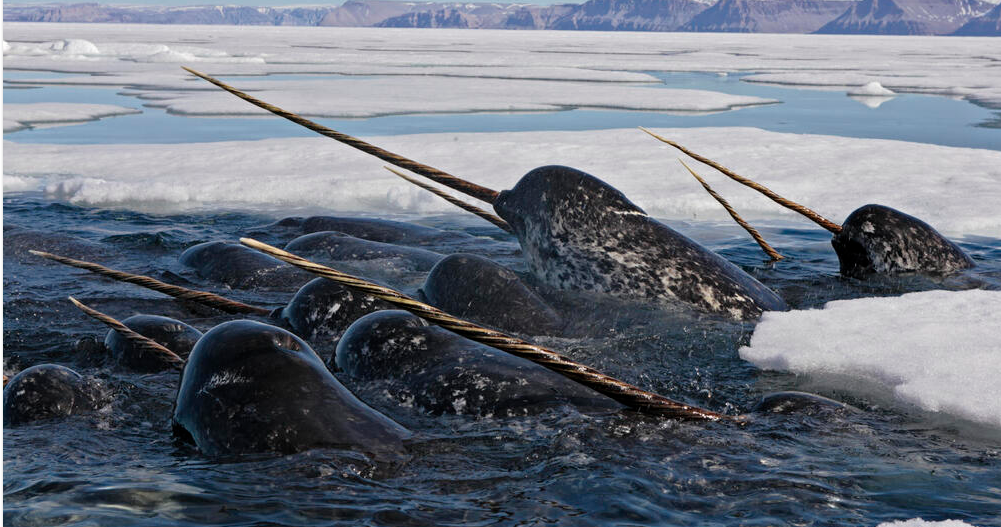
- Usage of tusks – Used to investigate, manipulate and influence the behavior of Arctic char, a prey.
- Tusking behaviour – A situation where 2 or more of them simultaneously raise their tusks almost vertically out of the water, crossing them in what may be a ritualistic behaviour.
- It is to assess a potential opponent’s qualities or to display those qualities to potential mates.
- Threats – Oil and gas development and climate change pose threats to narwhals.
- Conservation status
References
- Down To Earth| Study on Narwhals usage of their Tusks
- WWF| Narwhals are Unicorns of Sea



