Why in News?
Scientists discovered that Mount Erebus is the only known volcano to release metallic gold in solid form.
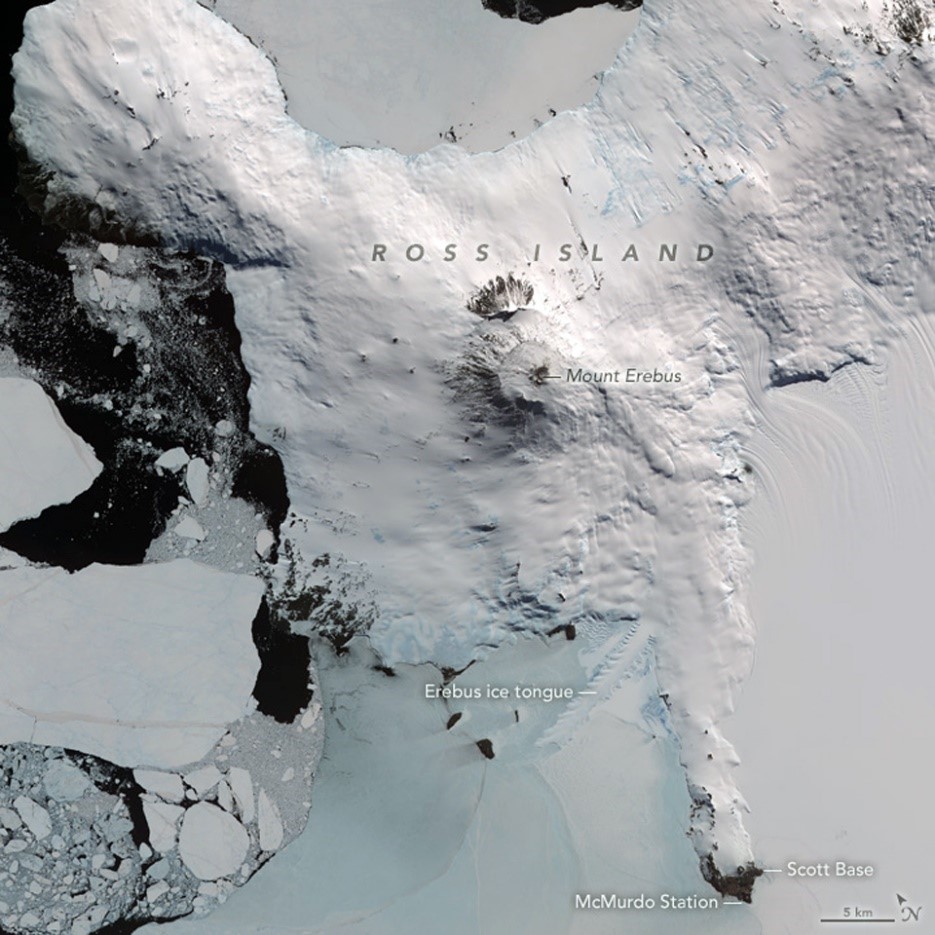
- It is Antarctica’s southernmost active volcano located on Ross Island, towering 12,448 feet above the icy landscape.
- Nomenclature - Mount Erebus was named after the Greek god Erebus, the deity of darkness, by Sir James Clark Ross, a British explorer who discovered the volcano during his Antarctic expedition in 1841.
- It is the 2nd tallest volcano in Antarctica, after Mount Sidley.
- Type - It is a glaciated intraplate stratovolcano, part of the Pacific Ring of Fire.
- The inner crater of the volcano holds the lava lake.
- The lake has been continuously active since at least 1972, releasing gases and steam.
- Sometimes the lake produces explosions, called Strombolian eruptions, that eject magma and pyroclastic rocks.
- The volcano also possesses an inactive side crater.
- Last eruption – 2025.
- Gold Emission – It emits micro-crystals of gold. These particles, as small as 20 micrometers, are carried by volcanic gas and have been detected over 600 miles away.
- Daily emissions amount to around 80 grams, valued at $6,000 (roughly Rs 5 lakh), produces about 64 pounds of gold annually, valued at around $2 million.
- Crystallization in Extreme Cold - When the magma reaches the surface, the freezing temperatures of Antarctica cause the gold to solidify instead of remaining in gas or liquid form.
- Mining this gold is too dangerous due to the volcano’s unpredictable eruptions.
- It is home to a colony of approximately 500,000 Adelie penguins.
- It lies within the sight of the McMurdo Station, a research station of United States.
- Because of the remote location, activity is primarily monitored by satellites.
|
Adelie Penguins
|
- Scientific name- Pygoscelis adeliae.
- Discovered in - 1840 by scientists on the French Antarctic expedition led by explorer Jules Dumont d’Urville.
- Size - They are medium sized penguins, weighing 3 to 6 kg and standing 70 cm tall.
- Appearance - They are distinguished by the white ring surrounding the eye. Males and females are of similar size and difficult to tell apart.
- Breeding - Adélies are excellent swimmers. They breed around the entire Antarctic coast and small islands in places where there is exposed rock.
- Diet - Local meals (those within 20 km of the colony) consist mostly of fish, amphipods and ‘crystal krill’ (Euphausia crystallorophias),
- While offshore meals consist of mainly ‘Antarctic krill’ (Euphausia superba).
- Some Adélie penguins are capable of diving to depths of up to 175 m but usually feed within the upper 70 m of the water column.
|
Reference
Economic Times | Volcano of Riches
Related News - Britanicca | Mount-Erebus



