Why in news?
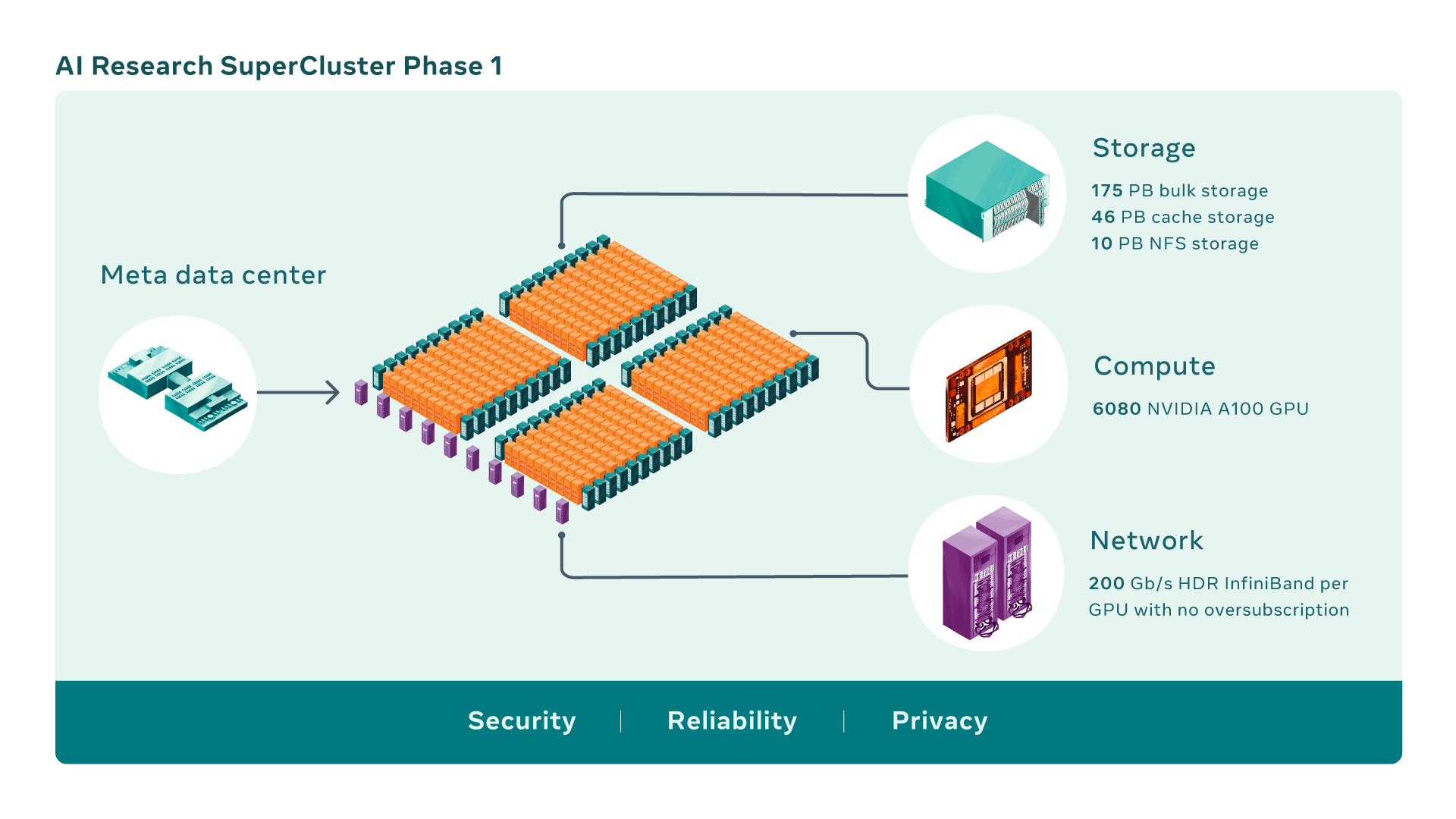
Facebook-parent Meta announced that it is building an AI supercomputer, the AI Research SuperCluster (RSC) which will be the fastest supercomputer in the world once fully built by mid-2022.
What are supercomputers?
- A supercomputer can perform high-level processing at a faster rate when compared to a normal computer.
- Supercomputing is measured in floating-point operations per second (FLOPS).
- Supercomputers are made up of thousands of powerful machines which use better artificial intelligence (AI) models to improve operations processing huge amounts of data in less time.
- They work together to perform complex operations that are not possible with normal computing systems.
- AI supercomputers are built by combining multiple graphic processing units (GPUs) into compute nodes, which are then connected by a high-performance network fabric to allow fast communication between those GPUs.
The National Supercomputing Mission (NSM) envisaged setting up a network of 70 high-performance computing facilities across academia and research institutes by 2022.
What is the RSC?
- RSC is a powerful supercomputer that can perform tasks like translating text between languages and help identify potentially harmful content on Meta's platform.
- It can run computer vision workflows up to 20 times faster.
- It can train large-scale Natural Language Processing (NLP) models 3 times faster.
- It can help its researchers build better AI models that can work across different languages, seamlessly analyse text, images and video together.
- It also powers real-time voice translations to large groups of people speaking different languages so that they can collaborate on a research project, and develop new augmented reality tools.
What is the role of supercomputers and RSC in the metaverse?
- The AI supercomputers will help build the foundation of metaverse to create AI agents in that environment for
- rich user interaction
- mimicking the real world
- provide high-performance computing to specific tasks
- Meta computes that RSC will pave the way toward building technologies for the metaverse where AI-driven applications and products will play an important role.
- RSC can keep people safe in the metaverse through its training models that can detect harmful content faster than earlier systems.
What are the current challenges?
- To fully realise the benefits of advanced AI self-supervised learning of various domains will require training large and complex models for critical use cases like identifying harmful content on Meta's platform.
- Computer vision needs to process larger, longer videos with higher data sampling rates.
- Speech recognition needs to work well even in challenging conditions with a lot of background noise and needs to understand more languages, dialects, and accents.
- There are large-scale scientific problems that need the right level of depth, accuracy and speed which cannot be handled with the current generation of supercomputers.
Reference
- https://www.thehindu.com/sci-tech/technology/metas-ai-supercomputer/article65073934.ece



