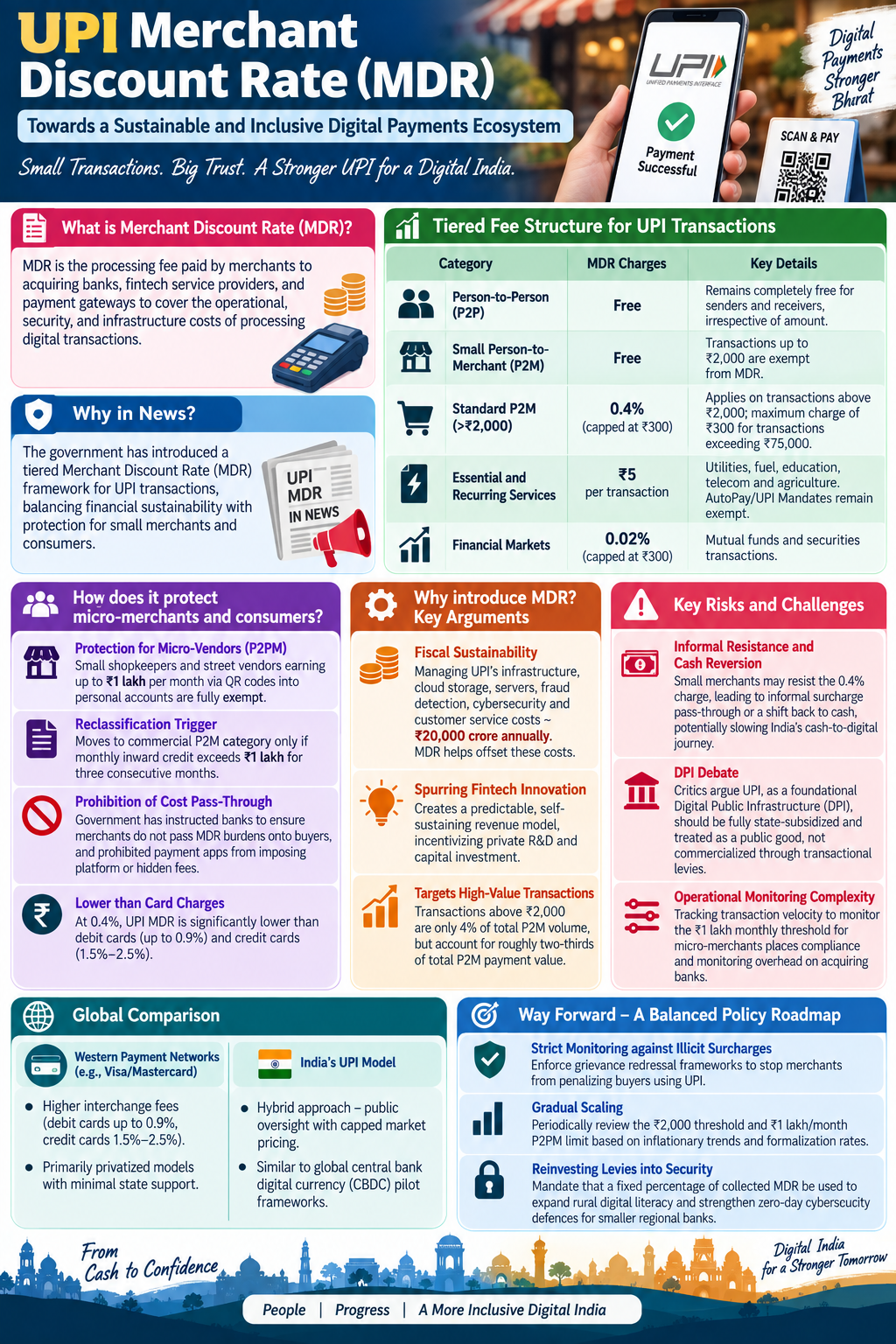
What is the Merchant Discount Rate (MDR) on UPI, and what are its key structural provisions?
Merchant Discount Rate (MDR) – MDR is the processing fee paid by merchants to acquiring banks, fintech service providers, and payment gateways to cover the operational, security, and infrastructure costs of processing digital transactions.
Tiered Fee Structure
Person-to-Person (P2P) – Remains completely free for senders and receivers, irrespective of amount.
Small Person-to-Merchant (P2M) – Transactions up to Rs.2,000 are completely exempt from MDR.
Standard P2M (>Rs.2,000) – Attracts a baseline MDR of 0.4%, capped at a maximum of Rs.300 for high-value transactions exceeding Rs.75,000.
Essential and Recurring Services – Flat fee of Rs.5 per transaction for utilities, fuel, education, telecom, and agriculture. AutoPay/UPI Mandates remain exempt.
Financial Markets – Mutual funds and securities transactions attract a minimal 0.02% MDR (capped at Rs.300).
How does the framework safeguard micro-merchants and protect consumers?
Protection for Micro-Vendors (P2PM Category) – Small shopkeepers and street vendors earning up to Rs.1 lakh per month via QR codes into personal accounts are fully exempt.
Reclassification to the commercial P2M category occurs only if monthly inward credit exceeds Rs.1 lakh for three consecutive months.
Prohibition of Cost Pass-Through – The government has instructed banks to ensure merchants do not pass MDR burdens onto buyers, and expressly prohibited payment apps from imposing platform or hidden fees.
Competitive Advantage over Cards – At 0.4%, UPI MDR is significantly lower than debit cards (up to 0.9%) and credit cards (1.5%–2.5%), reducing the economic incentive for merchants to inflate shelf prices.
What are the economic, infrastructural, and strategic arguments in favour of introducing MDR?
Fiscal and Commercial Sustainability – Managing UPI’s infrastructure cloud storage, server capacity, fraud detection, cybersecurity, and customer service costs the banking and fintech ecosystem Rs.20,000 crore annually, reintroducing MDR offsets these costs.
Spurring Fintech Innovation – A zero – MDR regime forced payment app aggregators to rely on government subsidies or secondary monetization (selling credit, insurance, or advertising).
MDR creates a predictable, self-sustaining revenue model that incentivizes private R&D and capital investment into payment rails.
Targeting High-Value Velocity – While transactions above Rs.2,000 represent only 4% of total P2M volume.
They account for roughly two-thirds of total P2M payment value, ensuring revenue generation focuses on high-value commercial flows rather than everyday micro-purchases.
What critical risks, behavioural friction, and structural challenges does this move introduce?
Informal Resistance and Cash Reversion – Small or unorganized merchants may resist absorption of the 0.4% charge on larger sales, leading to informal surcharge pass-through or a push back toward cash transactions, potentially slowing India's cash-to-digital migration.
Digital Public Infrastructure (DPI) Debate – Critics argue that UPI, as a foundational DPI, should be treated as a public good fully subsidized by the state to drive formalization and financial inclusion, rather than commercialized through transactional levies.
Operational Monitoring Complexity – Systemically tracking transaction velocity to monitor the Rs.1 lakh monthly threshold for micro-merchants places compliance and monitoring overhead on acquiring banks.
How does this policy compare globally, and what is the strategic way forward?
International DPI Precedents – Unlike privatized payment networks in Western economies (e.g., Visa/Mastercard charging high interchange fees).
India’s hybrid model balances public oversight with capped market pricing, similar to central bank digital currency (CBDC) pilot frameworks globally.
Balanced Policy Roadmap –
Strict Monitoring against Illicit Surcharges – Enforce strict grievance redressal frameworks to stop merchants from penalizing buyers using UPI.
Gradual Scaling – Periodically review the Rs.2,000 threshold and Rs.1 lakh/month P2PM limit based on inflationary trends and formalization rates.
Reinvesting Levies into Security – Mandate that a fixed percentage of collected MDR be funnelled into expanding rural digital literacy and strengthening zero-day cybersecurity defences for smaller regional banks.