Mains: GS II – Issues Relating to Development and Management of Social Sector/Services relating to Health, Education, Human Resources
Why in News?
Recently, the World Health Organization (WHO) report revealed that, more than 1 billion people are living with mental health disorders.
What is mental health?
- Mental health – The World Health Organization (WHO) defines mental health as a state of well-being in which every individual realizes his or her own potential, can cope with the normal stresses of life, can work productively and fruitfully, and is able to make a contribution to her or his community.
- Mental health is a public and global health topic that is not discussed as much as physical health.
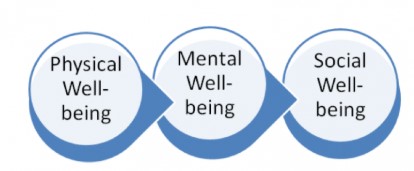
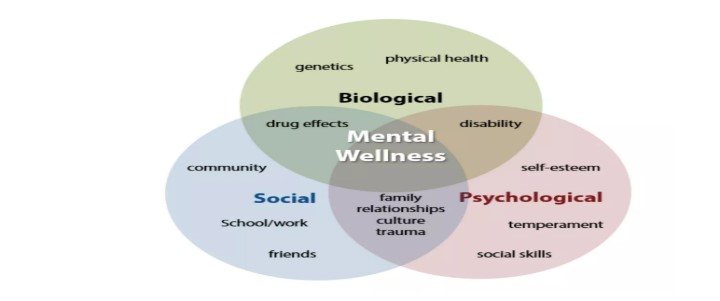
- Issues – The issues and impacts of mental health are
- Impacts everyone – Mental health conditions adversely affect people of all ages and income levels.
- Reason for disability – They represent the second biggest reason for long-term disability, contributing to loss of healthy life.
- Increases health care costs – They drive up health-care costs for affected people and families while inflicting substantial economic losses on a global scale.
- Transforming mental health services is one of the most pressing public health challenges.
- Stigma and reluctance – The hesitancy to seek help and treatment and lack of manpower remain the major concerns in the sector.
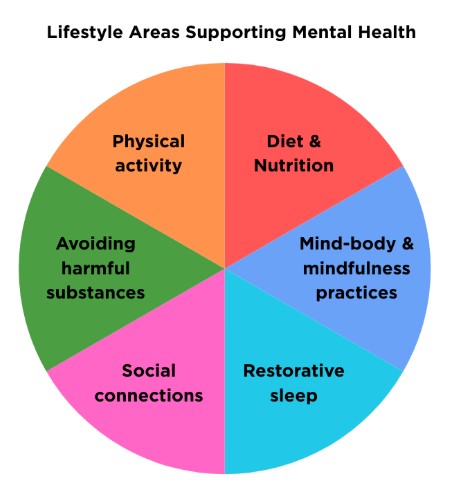
- Lifestyle components
What are the key findings of the report?
- Report – The new findings published in two reports
- World mental health today
- Mental Health Atlas 2024
- These highlight some areas of progress while exposing significant gaps in addressing mental health conditions worldwide.
- Status of women – The report shows that while prevalence of mental health disorders can vary by sex, women are disproportionately impacted overall.
- Anxiety and depressive disorders – These are the most common types of mental health disorders among both men and women.
- Suicide – It remains a devastating outcome, claiming an estimated 7,27,000 lives in 2021 alone.
- It is a leading cause of death among young people across all countries and socioeconomic contexts.
- Despite global efforts, progress in reducing suicide mortality is too low to meet the United Nations Sustainable Development Goal (SDG) of a one-third reduction in suicide rates by 2030.
- On the current trajectory, only a 12% reduction will be achieved by that deadline.
- Economic impact – While health-care costs are substantial, the indirect costs – particularly in lost productivity – are far greater.
- Depression and anxiety alone cost the global economy an estimated $1 trillion each year.
- Global Efforts – The 2024 Mental Health Atlas found that since 2020, countries have been making significant strides in strengthening their mental health policies and planning.
- The report states that most countries have functional mental health promotion initiatives such as early childhood development, school-based mental health and suicide prevention programmes.
- Over 80% of countries now offer mental health and psychosocial support as part of emergency responses, up from 39% in 2020.
- Outpatient mental health services and tele-health are becoming more available, though access remains uneven.
- Measures to be taken – The WHO has said that, greater investment and action are needed globally to scale up services to protect and promote people’s mental health.
- The findings also underscore the urgent need for sustained investment, stronger prioritization.
- Multi-sectoral collaboration to expand access to mental health care, reduce stigma, and tackle the root causes of mental health conditions.
What are the flaws in the mental care environment?
- Absence of legal reforms – While many countries have updated their policies, adopted rights-based approaches, and enhanced preparedness for mental health and psychosocial support during health emergencies, this momentum has not translated into legal reform.
- Countries remain off track to achieve the targets set in WHO’s Comprehensive Mental Health Action Plan.
- Fewer countries have adopted or enforced rights-based mental health legislation, and only 45% of countries evaluated laws in full compliance with international human rights standards.
- Reduced investments – The report reveals a concerning stagnation in mental health investment.
- Median government spending on mental health remains at just 2% of total health budgets, unchanged since 2017.
- Disparities in investments – While high-income countries spend up to $65 per person on mental health, low-income countries spend as little as $0.04.
- Less availability of mental health experts – The global median number of mental health workers stands at 13 per 100,000 people, with extreme shortages in low- and middle-income countries.
- Less Reforms and development of mental health services – Fewer than 10% of countries have fully transitioned to community-based care models, with most countries still in the early stages of transition.
- Inpatient care continues to rely heavily on psychiatric hospitals, with nearly half of admissions occurring involuntarily and over 20% lasting longer than a year.
- Integration of mental health into primary care is advancing, with 71% of countries meeting at least three of five WHO criteria.
- Gaps in data – Only 22 countries provided sufficient data to estimate service coverage for psychosis.
- Lack of care – In low-income countries fewer than 10% of affected individuals receive care, compared to over 50% in higher-income nations, highlighting an urgent need to expand access and strengthen service delivery.
What is India’s status on mental health?
- Progress made – There has been significant infrastructure development, the national tele-mental health programme has expanded.
- The educational development is happening at a fast pace and focused work is being done to create awareness about mental health and the treatment.
- Insufficient budget – India’s direct mental health budget has remained at roughly Rs.1,000 crore for recent fiscal years, with FY 2025-26 allocating Rs.1,004 crore.
- This constitutes just over 1% of the Ministry’s budget, with significant portions going to central institutions and programmes.
- Adequate funding for community-based programmes and the effective utilisation of allocated funds is still a concern.
- Lack of experts – India has a significant shortfall of mental health professionals, with roughly 0.7 psychiatrists per 100,000 people, far below the WHO’s recommended ratio of 3 per 100,000 people.
What is the way ahead?
- Governments and global partners could urgently intensify efforts toward systemic transformation of mental health systems worldwide.
- Equitable financing of mental health services, legal and policy reform to uphold human rights, can be carried out.
- Sustained investment in the mental health workforce and expansion of community-based, person-centered care could be done.
If you are in distress, please reach out to MANAS at 14416 or 18008914416 and Sanjivini Society for Mental Health at 011-40769002
Reference
The Hindu| Mental health



