Why in News?
Recently deficiencies in maternity entitlements and their implementation came under scrutiny.
What are the maternity entitlements available in India?
- Fundamental right - Article 21 of Right to life guarantees the right to health and medical care, encompassing maternal health.
- Directive principles to state - Article 42 of Directive Principles of State Policy directs the State to make provisions for securing just and humane conditions of work and for maternity relief.
- The Maternity Benefit Act, 1961 – The act provides 26 weeks of maternity leave at the time of delivery.
- NFSA act - Under the National Food Security Act (NFSA) 2013, all pregnant women (except those already covered in the formal sector) are entitled to maternity benefits of Rs.6,000 a child.
- Pradhan Mantri Matru Vandana Yojana (PMMVY)- It provides nutritional support and partial wage compensation to pregnant and lactating women.
What are the challenges in ensuring maternity entitlements?
- Declining coverage - Effective coverage was only 36% in 2019-20 and declined sharply after that, except for a partial revival in 2022-23.
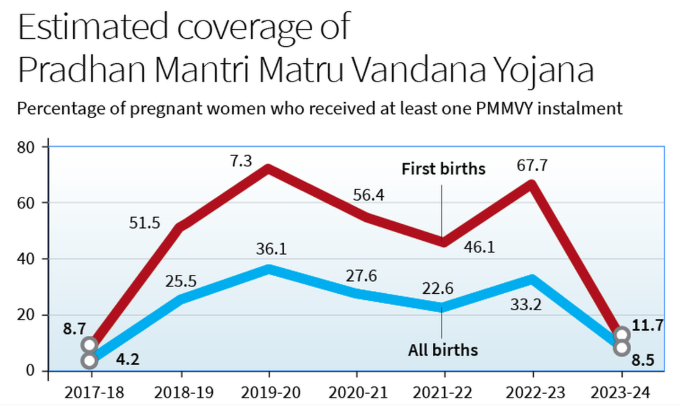
- Low allocation of funds - Central government spending on the PMMVY was at an all-time low of Rs.870 crore in 2023-24 , barely one third of the corresponding figure five years earlier
- Regional disparities - Maternal health services vary widely across regions, rural and poorer areas often lag behind.
- Socio-economic inequalities - Poorer households have limited access to maternal healthcare.
- Urban-Rural divide - Urban women generally receive better care compared to rural women.
- Resource shortages - A lack of healthcare professionals, facilities, and efficient referral systems hampers quality care.
- Overcrowded facilities - Urban health centers are often overburdened, reducing service quality.
- Awareness gaps - Many women are unaware of the available maternal health services.
- Cultural barriers - Language differences and cultural practices, especially among migrants, can deter women from seeking care.
- Implementation gaps - Discrepancies between policy design and actual execution result in inconsistent service delivery.
What can be done to improve it?
- Universal maternity entitlements - Expand benefits to cover every birth, not just the first and Simplify eligibility by removing restrictive conditions.
- Increase benefit amount - Raise the benefit to at least Rs.12,000 (inflation-adjusted).
- Timely disbursement - Ensure timely, structured disbursement (e.g., trimester-wise payments).
- Integrated implementation - Integrate maternity programs with nutrition and healthcare programs like POSHAN Abhiyaan.
- Remove bureaucratic hurdles - Simplify documentation by reducing Aadhaar dependency and allowing alternative IDs.
- Transparency - Regularly publish data on beneficiaries, fund usage, and coverage gaps.
- Accountability - Strengthen grievance redressal with effective helplines and complaint systems and Promote independent audits and social monitoring.
- Learn from state-level best practices - Emulate Tamil Nadu’s model and Adopt Odisha’s integrated approach (cash benefits plus robust interventions).
To Solve Mains Question- Click here
To Watch News Analysis - Click Here
Reference
The Hindu | Maternity Entitlements



