0.0968
7667766266
x

Maritime Archaeology of Poompuhar

iasparliament Logo
September 30, 2026

Mains: GS I – History

Why in News?

Recently, Fresh underwater excavations off Poompuhar, the ancient Chola port city in Tamil Nadu, have yielded new evidence of the settlement’s maritime connections.

What is the historical and cultural significance of Poompuhar in Tamil history?

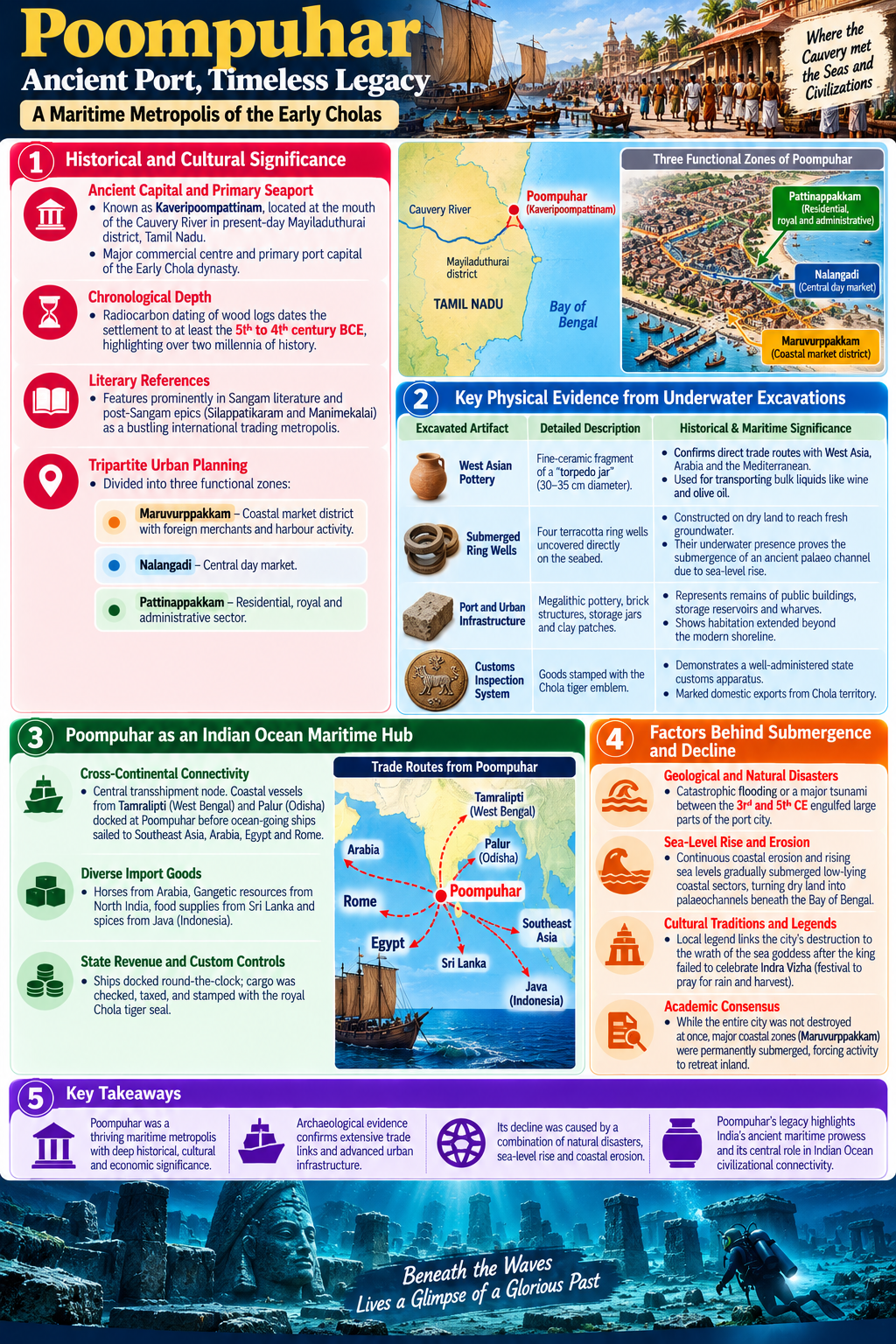
  • Ancient Capital and Primary Seaport – Poompuhar, historically referred to as Kaveripoompattinam, was located strategically at the mouth of the 800-km-long Cauvery River in present-day Mayiladuthurai district, Tamil Nadu.
  • It served as a major commercial centre and the primary port capital of the Early Chola dynasty.
  • Chronological Depth – Radiocarbon dating of wood logs retrieved during earlier excavations dates the urban settlement back to at least the 5th to 4th century BCE, highlighting over two millennia of continuous historical relevance.
  • Literary References – The city features prominently across classical Sangam literature and post-Sangam epics (Silappatikaram and Manimekalai), which describe it as a bustling international trading metropolis.
  • Tripartite Urban Planning – Ancient literature and spatial studies divide the city into three distinct functional zones –
  • Maruvurppakkam – The bustling coastal market district situated directly along the seashore, housing foreign merchants, warehouses, and harbor activity.
  • Pattinappakkam – The residential, royal, and administrative sector located further inland to the west.
  • Nalangadi – The central day-market running continuously between the coastal and inland divisions.

What key physical evidence was uncovered in the underwater excavations?

Excavated Artifact

Detailed Physical Description

Historical and Maritime Significance

West Asian Pottery

Fine-ceramic fragment of a "torpedo jar" measuring 30 cm to 35 cm in diameter.

  • Confirms direct maritime trade routes with West Asia, Arabia.
  • The Mediterranean world for transporting bulk liquid cargo like wine and olive oil.

Submerged Ring Wells

Four terracotta ring wells uncovered directly on the seabed.

  • Since ring wells were constructed on dry land to reach fresh groundwater.
  • Their underwater presence proves the submergence of an ancient palaeo channel (riverbed) due to sea-level rise.

Port and Urban Infrastructure

Megalithic pottery, brick structures, storage jars, and clay patches.

  • Represents the structural remains of ancient public buildings, storage reservoirs, and wharves.
  • It proves the habitation extended well beyond the modern shoreline.

Customs Inspection System

Historical accounts of goods stamped with the Chola tiger emblem.

  • Demonstrates a well-administered state customs apparatus that controlled foreign goods.
  • Marked domestic exports originating from Chola territory.


How did Poompuhar function as an Indian Ocean maritime hub?

  • Cross-Continental Connectivity – Poompuhar operated as a central transshipment node. Coastal vessels originating from domestic ports like Tamralipti (West Bengal) and Palur (Odisha) docked at Poompuhar before large ocean-going ships set sail for Southeast Asia, Arabia, Egypt, and Rome.
  • Diverse Import Goods – Historical records highlight a wide array of commodities passing through the harbour.
  • Horses from Arabia, Gangetic resources from Northern India, food supplies from Ceylon (Sri Lanka), and spices from Java (Indonesia).
  • State Revenue and Custom Controls – Ships docked round-the-clock at the harbour, where incoming and outgoing cargo was systematically checked, taxed, and stamped with the royal Chola tiger seal.

poompuhar

What factors led to the coastal submergence and decline of Poompuhar?

  • Geological and Natural Disasters – Geological studies indicate that catastrophic environmental events—including severe coastal flooding or a major tsunami between the 3rd and 5th CE — engulfed large parts of the port city.
  • Sea-Level Rise and Erosion – Continuous coastal erosion and rising sea levels gradually submerged low-lying coastal sectors, transforming dry land into paleochannels beneath the Bay of Bengal.
  • Cultural Traditions and Legends – Popular local legend links the city's destruction to the wrath of the sea goddess after the reigning king failed to celebrate Indra Vizha (A festival dedicated to Lord Indra (Vendhan) to pray for rain and harvest).
  • Academic Consensus – Modern archaeologists conclude that while the entire city was not destroyed at once, major coastal zones (Maruvurppakkam) were permanently submerged, forcing commercial and urban activity to retreat inland.

Reference

Indian Express | Poompuhar

There are no reviews yet. Be the first one to review.

ARCHIVES

sidetext