Mains: GS III – Environment
Why in News?
Recently, there has been growing demands from the people and environmentalists civil societies to preserve the Western Ghats.
What is Western Ghats?
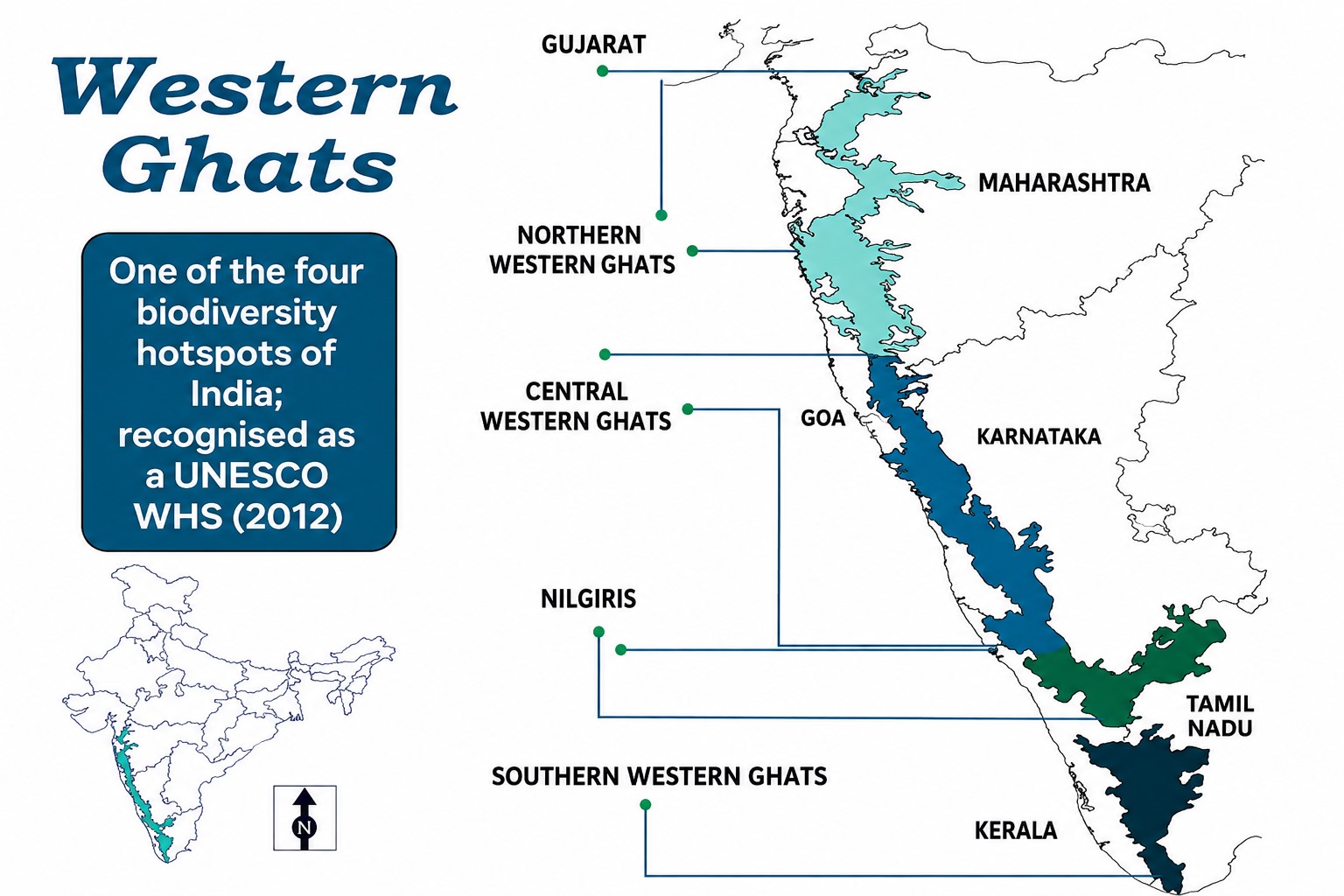
- The Western Ghats - They are a vast mountain chain running parallel to the west coast of India.
- States covered – It passes through the 6 states of Gujarat, Maharashtra, Goa, Karnataka, Kerala, and Tamil Nadu.
- It is recognized globally as a major biodiversity hotspot.
- Elevation – The range reaches elevations of 3,000 to 5,000 feet in the north but rises less than 3,000 feet south of Goa.
- In the far south, the range terminates in uplifted blocks bordered by steep slopes, where Anai Peak rises to 8,842 feet.
The Western Ghats are a biodiversity hotspot and a UNESCO World Heritage site that significantly influences India’s monsoon weather patterns.
- Originating rivers
- East-Flowing Rivers (Draining into the Bay of Bengal) – Godavari River, Krishna River, Kaveri (Cauvery) River, Tungabhadra River, Bhima River.
- West-Flowing Rivers (Draining into the Arabian Sea) – Periyar River, Sharavathi River, Netravati River, Bharathappuzha River, Mandovi River.
What is the significance of Western Ghats?
- Monsoon barrier – They block moisture-laden southwest monsoon winds from the Arabian Sea, forcing them to rise and drop heavy rainfall on the western coast.
- Carbon capture –The dense forests absorb millions of tonnes of carbon dioxide every year, helping fight global climate change.
- Major watershed – They feed nearly 40% of India’s perennial river systems.
- Lifeline Rivers – Major rivers like the Godavari, Krishna, and Kaveri originate here, supplying drinking water and farm irrigation to millions of people.
- Unique species – They are home to thousands of rare plants and animals found nowhere else on Earth (endemic species).
What are the challenges faced by Western Ghats?
- Endangered wildlife – Rare animals like the Nilgiri Tahr and the lion-tailed macaque live safely inside these forest habitats
- Deforestation – Large areas of natural forest are cleared for commercial plantations (like tea, coffee, and rubber) and monoculture tree farming, reducing native biodiversity.
- Mining and Quarrying – Unregulated stone quarrying and iron ore extraction cause severe soil erosion, landslides, and river pollution.
- Infrastructure Projects – Large dams, wide highways, and railway expansions cut through continuous forests, splitting animal and plant populations into isolated groups.
- Invasive Species – Non-native plants like Lantana camara and Senna spectabilis spread rapidly and choke out native vegetation.
- Human-Wildlife Conflict – As human settlements and tourism expand near forest borders, animals frequently stray into farms and villages, raising tensions.
- Policy Deadlocks – State governments and local communities often push back against central protection laws—such as the ongoing disputes over Ecologically Sensitive Area (ESA) notifications—fearing that strict bans on mining and construction will harm local livelihoods and regional development
What are the measures & frameworks to conserve Western Ghats?
- Gadgil Committee (WGEEP, 2011) – Recommended declaring the entire Western Ghats an Ecologically Sensitive Area (ESA) with strict sector-wise restrictions on commercial and industrial projects.
- Kasturirangan Committee (HLWG, 2013) – Proposed a balanced approach to designate roughly 37% (about 56,000–60,000 sq km) of the Western Ghats across six states as an ESA, shielding natural landscapes while keeping human-inhabited areas secure.
- Draft Notifications – Successive draft notifications under the Environment (Protection) Act, 1986, aim to legally notify these tracts to block harmful industrial encroachment.
- Mining Ban – Total prohibition on new mining, quarrying, and sand mining operations within identified ESAs.
- Industry Restrictions – Ban on thermal power plants and "Red category" highly polluting industries.
- Large Infrastructure – Rigorous clearance requirements or restrictions on large-scale construction, township expansions, and major new highway or railway projects.
- National Afforestation Programme & Green India Mission – Active tree-planting, forest fire prevention, and landscape restoration.
- Wildlife Protection – Integrated Development of Wildlife Habitats and Project Tiger implementations across regional sanctuaries and national parks.
- CAMPA Funds – Utilization of Compensatory Afforestation funds for local forest and wildlife conservation
What could be done to preserve Western Ghats?
- Ecologically Sensitive Area (ESA) Tag – Finalize and implement government frameworks (such as the updated Ministry of Environment draft notifications) to legally restrict fragile zones.
- Ban Destructive Industries – Prohibit illegal mining, quarrying, sand extraction, and red-category polluting factories in vulnerable hill tracts.
- Regulate Large Construction – Restrict massive infrastructure projects, large townships, and new thermal plants that destabilize hill slopes.
- Protect Water Towers – Safeguard river networks, natural streams, and catchment areas vital for peninsular India's water and food security.
- Enforce Existing Laws – Strictly apply the Wildlife Protection Act and Forest Conservation Acts to stop illegal poaching and forest encroachment.
- Promote Green Livelihoods – Encourage zero-chemical organic farming, sustainable agroforestry, and responsible eco-tourism.
- Involve Local Stakeholders – Empower village councils and local residents through participatory decision-making instead of top-down exclusion.
- Inter-State Consensus – Build coordinated agreement among the six relevant state governments to balance regional development with ecological survival.
What lies ahead?
- The future of the Western Ghats depends on balancing ecological protection with sustainable development.
- Strengthening community-led conservation, restoring degraded forests, and promoting climate-resilient land-use practices are essential.
- Improved enforcement against illegal mining, encroachment, and deforestation, supported by modern technologies such as GIS and remote sensing, can enhance monitoring.
- Long-term success will require coordinated action by governments, local communities, scientists, and civil society to preserve this globally significant biodiversity hotspot for future generations.
References
- The Hindu| Western Ghats Conservation
- PIB| Schemes to protect WG
- UNESCO| Western Ghats



