Mains: GS III – Science & Technology | Indigenization of Technology and Developing New Technology.
Why in News?
India’s earlier breakthroughs in identity, payments, and data as public digital infrastructure are now being paralleled by calls for Artificial Intelligence to serve as the fourth foundational utility.
What are the India’s achievements in digital public infrastructure?
- World-Leading DPI Foundation – India’s world‑leading DPI foundation integrates:
- Aadhaar for low‑cost digital identity,
- UPI for real‑time interoperable payments,
- Account Aggregator for consent‑based financial data sharing, and
- ONDC for open digital commerce,
- Creating a unified, scalable public infrastructure stack.
- Affordability of Digital Access – India’s rapid decline in 4G mobile data prices brought hundreds of millions online, accelerating growth in payments, e-commerce, fintech, and digital services.
- This demonstrates the effectiveness of the “public rails + private competition” model for affordable digital transformation.
- Digital Governance at scale – It shows how DPI supports mass service delivery.
- Initiatives such as Aadhaar, UPI, DigiLocker, Account Aggregator, ONDC, CoWIN, and IndiaAI together create a unified infrastructure for over a billion citizens.
- Global Recognition and Replicability – India's DPI model serves as a key example for developing countries aiming to create affordable, interoperable digital ecosystems.
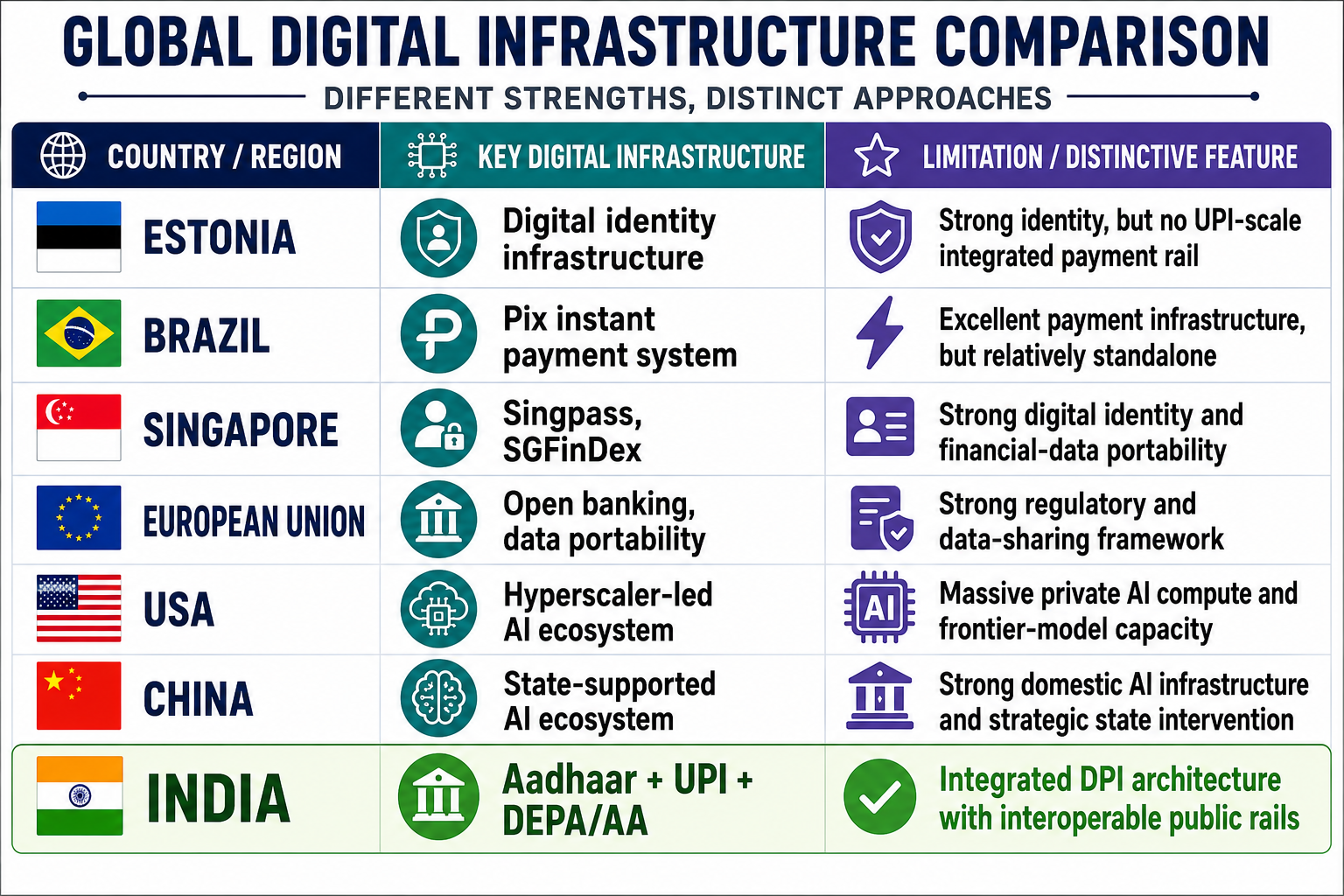
What are the global existing AI/digital infrastructure models?
- India's proposed Artificial Intelligence Digital Public Infrastructure (AI-DPI) should be analyzed in the context of prevailing international frameworks.
What are the key initiatives taken by the Indian government?
IndiaAI Mission
- Scale and Funding – The initiative is supported by a ₹10,372 crore outlay and is backed by the government.
- Model – It operates through a public–private partnership model, thereby preventing the establishment of a state-run monopoly.
- Compute Access – It empanels private cloud providers, with approximately 38,000 GPUs currently onboarded and a target of 100,000 GPUs.
- Affordability – GPU hours are subsidised at approximately ₹65 per hour, which is significantly lower than prevailing global rates.
- Goal – To democratise AI compute resources for startups, researchers, and innovators, and to expand the ecosystem in an inclusive manner.
IndiaAI Compute Capacity
- Common Pool – The government is establishing shared AI compute resources to prevent concentration of resources among a limited number of technology companies.
- Objective – To democratise AI infrastructure and prevent monopolisation by hyperscale entities.
- Subsidised Access – Startups, universities, and researchers are provided opportunities to experiment with AI technologies at reduced costs.
- Impact – This initiative reduces entry barriers, fosters innovation, and supports the development of an inclusive AI ecosystem.
IndiaAI Models
- Models – The government seeks to develop sovereign AI models specifically designed to address Indian requirements.
- Language and Data – Emphasis is placed on supporting over 22 Indian languages, utilizing local datasets, and incorporating governance records.
- Sectoral Applications – Targeted sectors include agriculture, healthcare, education, and public service delivery.
- Strategic Value – This approach reduces reliance on foreign proprietary application programming interfaces (APIs) and ensures national control over AI infrastructure.
- Open and Inclusive Approach – The initiative promotes open-source Indic large language models (LLMs) and enhances sovereign AI capabilities.
DPI Foundation
- Current Foundational Layers:
- Aadhaar – Digital identity layer
- UPI – Real-time payments infrastructure
- DEPA/Account Aggregator – Consent-based data sharing framework
- Emerging Layer – AI-DPI: Artificial intelligence integration
- Key Functions – Facilitates a unified interface for government departments, startups, academic institutions, and citizens.
- Enables access to diverse artificial intelligence models through interoperable public infrastructure.
National DPI Ecosystem
- Model – “Public rails + private innovation.”
- Process – Govt builds infrastructure & standards → private sector develops apps → competition lowers costs → citizens benefit at scale.
- Examples – Aadhaar, UPI, DEPA/AA, ONDC, CoWIN.
- AI Extension – Proposed AI-DPI can replicate this model — govt provides compute & open models, startups build applications, competition drives affordability.
What are the key challenges existing in India?
- High cost of Input – AI models require significant computational resources.
- However, the high cost of GPUs, capital-intensive data centers, restricted access for startups and universities.
- Dependence on foreign models – Foreign AI Dependence leads to API lock-in, dollar costs, pricing vulnerability, and reliance on global firms.
- It risks a scenario where India exports talent and data but imports costly intelligence at a premium.
- Infrastructure Needs – Reliable power, strong transmission, renewable energy, data centre clusters, and advanced grid planning.
- Domestic GPU Gap – India faces semiconductor manufacturing shortfalls, import dependence, export control risks, and supply chain vulnerabilities.
- Data Challenge – Despite vast datasets, fragmented records, poor standardisation, silos, privacy concerns, weak Indian-language resources, and anonymisation and interoperability issues limit usability.
- Indian Language Gap – AI models are stronger in English but weak in Indic languages.
- Need for Indic datasets, LLMs, local-language speech AI, and region-specific apps.
- Safety, Privacy and Accountability – It includes data privacy breaches, algorithmic bias, hallucinations, cybersecurity threats, deepfakes, and copyright issues.
What steps need to be taken?
- AI training to AI inference – It emphasizes the reduction of model usage costs through affordable computing resources and accessible inference.
- AI UPI Concept – Unified Intelligence Interface for model interoperability, identity, consent, secure data exchange, transparent billing, and safety norms.
- Develop Open‑Source Indian AI Models – Government should promote open‑weight foundation models, Indic LLMs, Indian‑language datasets, open benchmarks, and collaborations.
- Data Aggregation Hub – Collect and anonymise high-value datasets responsibly (agriculture, healthcare, education, legal, schemes, languages, land records, administration).
- Create an AI Token/Freemium Model – It would provide targeted AI credits for students, teachers, researchers, startups, MSMEs, and public institutions.
- AI Hardware Ecosystem – Invest in semiconductor fabs, advanced packaging, AI accelerators, GPU alternatives, data-centre hardware, high-speed networking, and indigenous cloud services.
Reference
The Hindu | Democratising AI Infrastructure



