Mains: GS II – Constitutional Bodies
Why in News?
Recently, the Supreme Court has clarified that the National Commission for Scheduled Castes (NCSC) does not have adjudicatory powers under Article 338 of the Constitution.
What is National Commission for Scheduled Castes (NCSC)?
- NCSC – It is a constitutional body established under Article 338 of the Constitution of India.
- Structure of the Commission – It is composed of 5 total members:
- A Chairperson, a Vice-Chairperson, and three additional members.
- Appointment and Service Conditions
- Appointing Authority – The President of India via a warrant under his hand and seal.
- Term of Office – 3 years for the Chairperson, Vice-Chairperson, and other members.
- Term Limit – Members are eligible for reappointment for a maximum of two terms.
- Service Rules – Conditions of service and tenure are decided and fixed by the President.
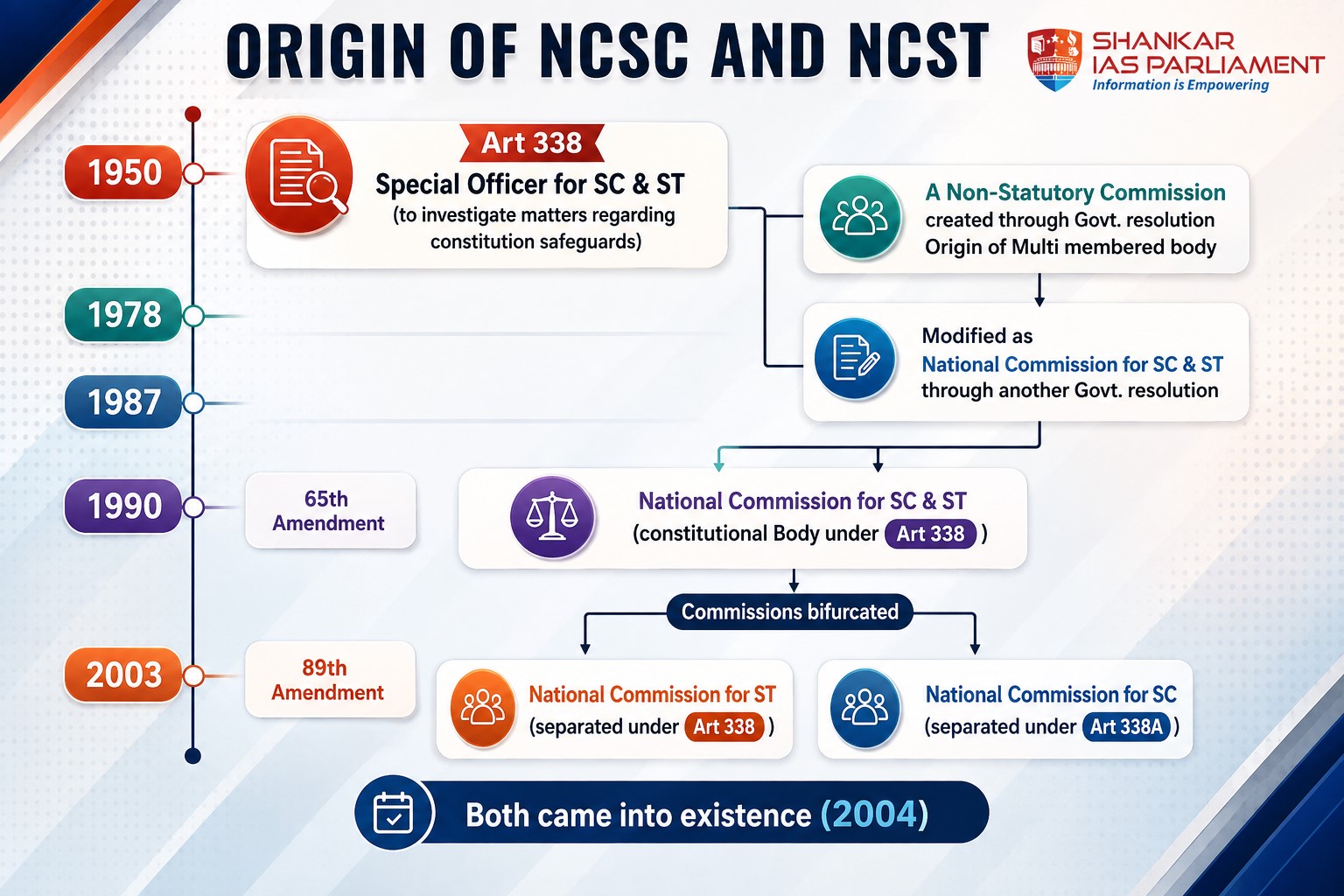
What are the key functions of the NCSC?
- Investigate and Monitor – Oversee all constitutional and legal safeguards provided for Scheduled Castes and evaluate how well they work.
- Inquire into Complaints – Look into specific complaints regarding the deprivation of rights and safeguards of Scheduled Castes.
- Planning and Advice – Participate and advice in the socio-economic planning process and evaluate development progress under the Union and States.
- Reporting – Present annual and periodic reports to the President of India on the working of those safeguards.
- Recommendations – Recommend specific measures to the Union and State governments for effective implementation of protections and welfare schemes.
What are the powers of the NCSC?
- Civil Court Authority – Possess all the powers of a civil court trying a suit during any investigation or inquiry.
- Summoning – Summon and enforce the attendance of any person from any part of India and examine them under oath.
- Document Discovery – Require the discovery and production of documents.
- Evidence – Receive evidence on affidavits and requisition any public record or copy from any court or office.
What are the limitations of NCSC?
- Non-binding powers – Recommendations are purely advisory; the commission lacks authority to issue binding, interim, or permanent punitive orders against offenders.
- No adjudicatory authority – Courts have clarified that civil court-like summoning powers are strictly for investigation, not for settling legal or service disputes directly.
- Heavy caseloads – The body manages thousands of complaints spanning atrocities, land disputes, and job discrimination, leading to procedural delays.
- Resource shortages – Budgetary limitations and staff constraints restrict deeper field evaluations and proactive monitoring.
- State apathy – Bureaucratic hurdles and slow response times by local law enforcement stall justice.
- Ignored reports – Annual reports submitted to the President are rarely debated thoroughly in Parliament, reducing administrative pressure on agencies.
What is the recent observations by the SC?
- Background of the case – A Mumbai Port Authority stenographer was promoted using reservation-related consequential seniority under a 2002 government memorandum.
- After the Supreme Court's M. Nagaraj (2006) judgment and later government directions, this benefit was withdrawn and she was reverted to a lower post.
- After losing before the Central Administrative Tribunal, she approached the NCSC.
- The NCSC ordered the Port Authority to restore her promotion and pay all monetary benefits.
- The Bombay High Court upheld the NCSC's order, leading the Port Authority to appeal to the Supreme Court.
- Supreme Court's ruling – A Bench of Justice Sanjay Karol and Justice Augustine George Masih held that the NCSC's powers are limited to investigation, monitoring, inquiry, and making recommendations.
- Although Article 338(8) gives the Commission some powers of a civil court (such as summoning witnesses, receiving evidence, and calling for documents), these powers are only to assist investigations and do not allow it to issue enforceable orders.
- The Court stated that the NCSC may record factual findings and recommend action to the Central or State Government, but it cannot decide disputes or grant relief like a court or tribunal.
- Reasoning – The Court interpreted Article 338 as assigning the NCSC the role of:
- Investigating safeguards for Scheduled Castes,
- Monitoring their implementation,
- Inquiring into complaints,
- Advising governments, and
- Submitting reports to the President.
- It relied on earlier judgments, including All India Indian Overseas Bank SC and ST Employees' Welfare Association v. Union of India (1996) and Collector v. Ajit Jogi (2011), which also held that the Commission's role is advisory rather than adjudicatory.
- Outcome – The Supreme Court set aside the Bombay High Court's judgment.
- It declared the NCSC's direction requiring the Port Authority to restore the employee's promotion and pay arrears within 30 days unconstitutional and legally unenforceable.
- Significance – The judgment clearly defines the constitutional limits of the NCSC, as well as similar commissions under Articles 338A and 338B, confirming that they cannot perform judicial or quasi-judicial functions and may only make recommendations.
What could be done to strengthen NCSC?
- Binding Authority – Grant the Commission the power to make its recommendations and directions legally enforceable, ensuring that public authorities are obligated to comply.
- Greater Institutional Independence – Strengthen the Commission's administrative autonomy by providing adequate staffing, financial resources, and operational independence to reduce delays and improve the efficiency of inquiries.
- Expanded Monitoring Mechanisms – Establish a centralized digital platform to record, track, and monitor caste-based atrocities and complaints across all states in real time, enabling better coordination and accountability.
- Monitoring of SC Sub Plan Funds – Ensure rigorous oversight of the mandated 15% allocation under the Scheduled Caste Sub Plan by regularly auditing spending across central and state government departments.
- Capacity Building and Sensitization – Organize specialized training programs for police officers, prosecutors, and judicial personnel to improve their understanding and empathetic handling of cases under the SC/ST (Prevention of Atrocities) Act.
- Strengthening Community Partnerships – Foster collaboration with community leaders, youth organizations, civil society groups, and legal aid institutions to improve awareness, accessibility, and grassroots implementation of safeguards for Scheduled Castes.
References
- The Hindu| SC Ruling on NCSC
- NCSC



