0.1147
7667766266
x

SHANTI – India’s Cooperative Security Vision

iasparliament Logo
August 03, 2026

Mains: GS II – International Relation

Why in News?

Recently, External Affairs Minister introduced “SHANTI” while announcing India’s candidature for the “UN Security Council (2028-29)”.

What is SHANTI?

  • SHANTI – It stands for Securing Holistic Advancement through Norms, Trust and Integrity.
  • It is conceptualized as a normative framework intended to govern shared maritime spaces.
  • Evolution – It operationalises the vision of SAGAR (Security and Growth for All in the Region), 2015.
  • It extends the scope of MAHASAGAR (Mutual and Holistic Advancement for Security and Growth Across Regions), 2025. 
  • Core Philosophy – It represents a shift in security thinking from competition to demand-driven cooperation
    • From influence to non-prescriptive institution-building.
    • From Deterrence to Resilience
    • From Rivalry to Shared Responsibility
    • From Crisis Response to Long-term Governance
    • From Power Projection to Cooperative Capacity-building.

SHANTI is primarily a maritime-security and cooperation framework, not merely a military exercise. The proposed BIMSTEC joint exercise can become one instrument to operationalise it.
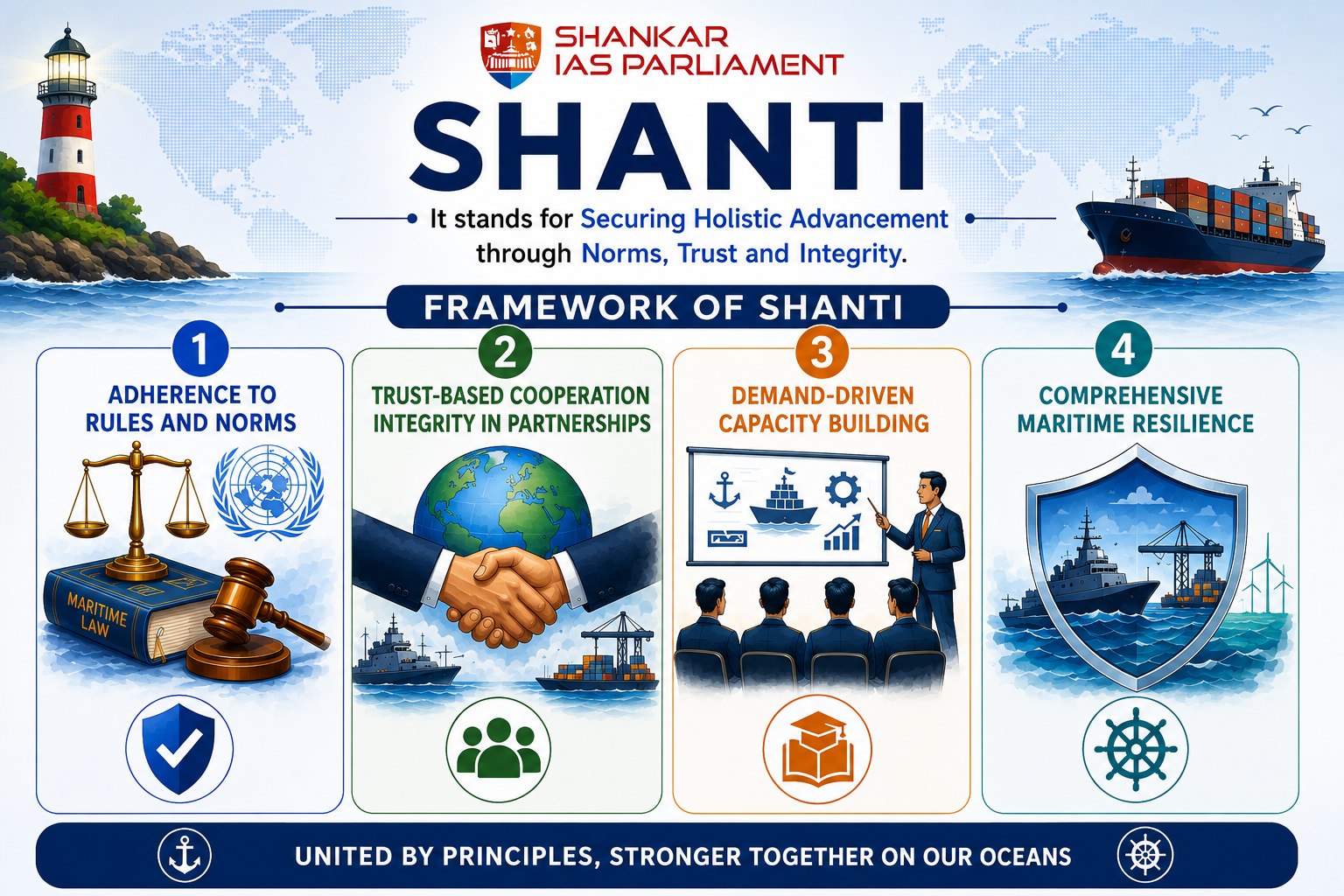
shanti framework upsc

What is the proposed framework of SHANTI?

  • Adherence to Rules and Norms – Emphasizes respect for the United Nations Convention on the Law of the Sea (UNCLOS) and international maritime law.
  • Trust-based Cooperation – Prioritizes collaboration rather than coercive approaches.
  • Integrity in Partnerships – Advocates for transparency, inclusiveness, and respect for national sovereignty.
  • Demand-driven Capacity Building – Initiatives are tailored to the specific requirements of partner countries.
  • Comprehensive Maritime Resilience – Expands the focus beyond traditional military security to encompass broader maritime challenges.

What are the key advantages of implementing SHANTI?

  • Common framework – It establishes unified principles that align previously fragmented institutions, thereby facilitating more effective cooperation.
  • Addressing non-traditional threats – It involves mitigating shared vulnerabilities such as climate-related disasters, illegal, unreported, and unregulated (IUU) fishing, and cyber risks.
  • Preferred partnership model – This positions India not only as a first responder but also as the preferred regional security partner.
  • Disaster Preparedness – Implementation of joint drills, establishment of early-warning systems, pre-positioning of relief supplies, and acceleration of Humanitarian Assistance and Disaster Relief (HADR) operations.
  • Maritime Awareness – Enhancement of vessel tracking, information sharing, anti-piracy and illegal, unreported, and unregulated (IUU) fishing measures, as well as protection of maritime infrastructure.
  • Trust Building – Promotion of dialogue, reduction of mutual suspicion, encouragement of cooperative behavior, and recognition of India’s role as a first responder.
  • Institutional Alignment It harmonises BIMSTEC, IORA, ASEAN, IONS, Colombo Conclave.
  • Countering Geopolitical Competition – Offers a trust-based alternative to China's port and infrastructure-driven influence.
  • Global South Model – Positions India's cooperative maritime governance as a replicable template for the Indo-Pacific and Global South, emphasizing a shift from rivalry to shared responsibility.

Bay of Bengal – Ideal Anchor for SHANTI

  • The Bay of Bengal forms an interconnected maritime system in which cyclones, pollution, fish stocks, shipping routes, and security threats extend beyond national borders.
  • Common regional challenges -
    • Coastal countries in the region face similar threats:
    • Frequent cyclones, tsunamis, floods and coastal erosion;
    • Illegal, unreported and unregulated (IUU) fishing;
    • Marine pollution and degradation of coastal ecosystems;
    • Piracy, trafficking, drug smuggling and human trafficking;
    • Vulnerability of ports, shipping lanes and undersea communication cables;
    • Cybersecurity threats to maritime infrastructure;
    • Supply-chain disruptions and energy insecurity.
  • Because no single country can address these threats alone, the Bay requires a cooperative, rules-based regional response.

What are key strategic locational benefits of conducting SHANTI in Bay of Bengal?

  • Historical and Cultural Conduit – The Bay of Bengal has facilitated enduring exchanges in trade, culture, and ideas between South and Southeast Asia, predating contemporary diplomatic structures.
  • Geopolitical Support – The region connects India’s Act East Policy with ASEAN and grants access to the strategically vital Malacca Strait, a key chokepoint in global trade and the so-called “Malacca Dilemma.”
  • Cooperative Space – It is an interconnected system where cyclones, fish stocks, and shipping lanes create shared challenges.
  • Governable Strategic Space – In contrast to the conflict-prone western Indian Ocean, the strategic geography of the Bay of Bengal is more favorable to cooperation than to contestation.
  • Andaman and Nicobar Islands – Located near the western entrance of the Malacca Strait.
  • They provide India with strategic oversight of vital sea lanes of communication.
  • Trade, Connectivity and Blue Economy Potential – The Bay hosts major ports, including Chennai, Kolkata, Chattogram, Colombo, Sittwe, and Yangon.
  • It supports key projects such as:
    • India-Myanmar-Thailand Trilateral Highway.
    • Kaladan Multimodal Transit Transport Project.
    • BIMSTEC connectivity initiatives.
    • Coastal shipping and port-led development.

What are the key challenges?

  • Strategic mistrust – It results from divergent threat perceptions and a prevailing caution regarding alignment with major powers.
  • Institutional fragmentation – It is demonstrated by the existence of multiple organizations, overlapping mandates, and isolated operational structures.
  • Capacity asymmetry – It persists as smaller states lack naval, financial, and technological resources, necessitating a demand-driven approach from India.
  • China presence – It complicates regional consensus, highlighting the importance of avoiding exclusionary frameworks.
  • Domestic instability – It encompassing political and economic crises, impedes the prospects for sustained regional cooperation.

What lies ahead?

  • BIMSTEC Maritime Exercise – Conduct annual or biennial drills with navies, coast guards, and disaster management agencies emphasizing HADR, SAR, anti-piracy operations, and pollution response.
  • White-Shipping Arrangement – Facilitate real-time sharing of commercial shipping data to enhance maritime domain awareness and counter illegal activities.
  • HADR Coordination Mechanism – Establish common standard operating procedures (SOPs), develop regional stockpiles and logistics hubs, and integrate early warning systems.
  • Blue Economy Cooperation – Promote joint management of fisheries, implement pollution control measures, develop climate-resilient ports, and protect regional livelihoods.
  • Legal and Normative Cooperation – Reaffirm commitment to the UNCLOS, establish common norms regarding environmental protection, cyber resilience, undersea cable security, and peaceful dispute resolution.
  • Inclusiveness – Ensure a cooperative, sovereignty-respecting, open framework prioritizing regional public goods over dominance.

Reference

The Hindu | Bay of Bengal as India’s SHANTI Anchor



Login or Register to Post Comments
There are no reviews yet. Be the first one to review.

ARCHIVES

sidetext

