Prelims: Current events of national and international importance | Science & Technology
Why in News?
Chemists at ETH Zürich developed a milder, direct method for single-atom skeletal editing, allowing the direct swapping of a carbon atom for a nitrogen atom in core organic scaffolds.
Single-Atom "Skeletal Editing"
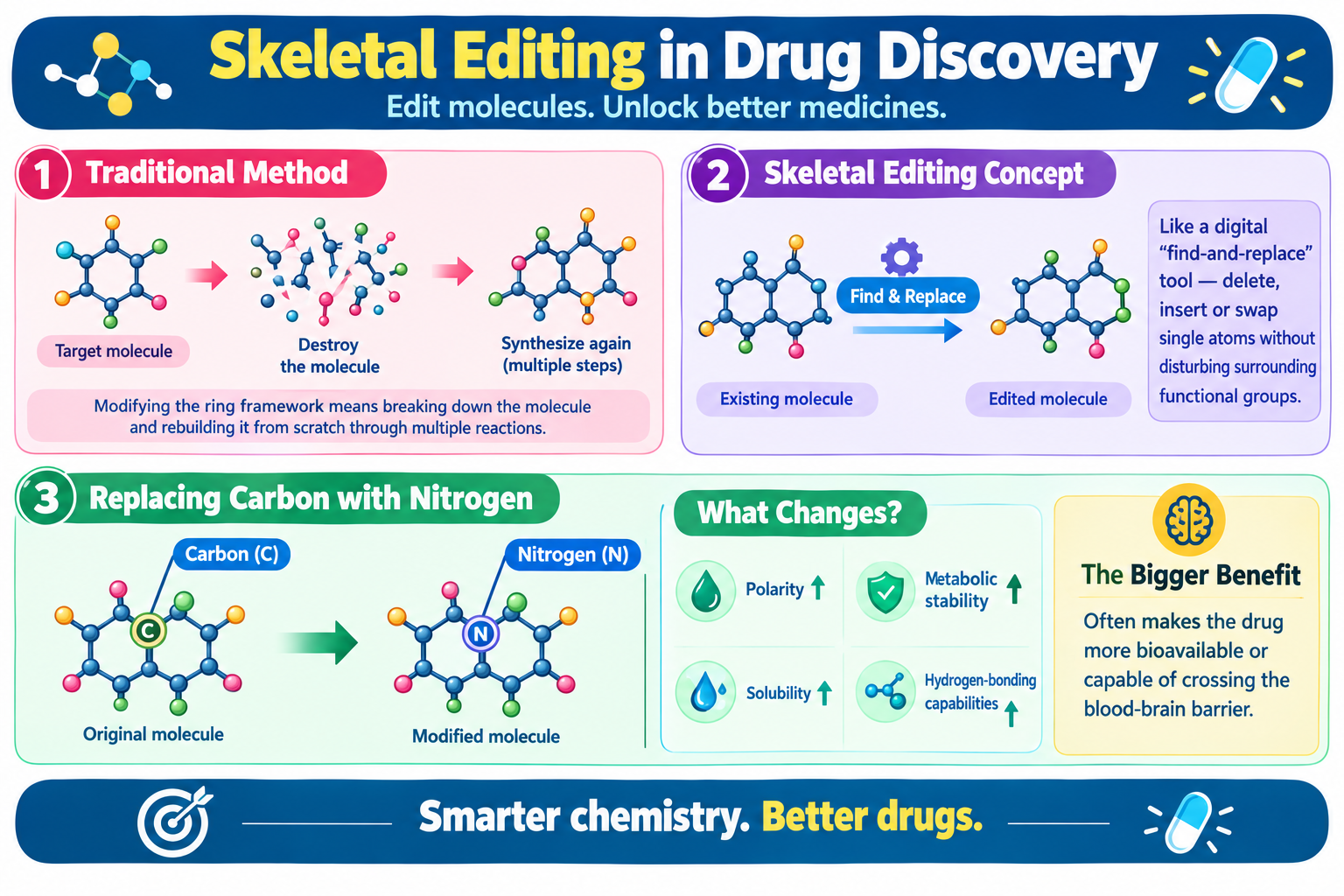
- Traditional method - In drug discovery, modifying the underlying ring framework of a complex molecule traditionally requires destroying the molecule and synthesizing it again from scratch over multiple step-by-step chemical reactions.
- Skeletal Editing Concept - Functions like a digital "find-and-replace" tool for molecules, enabling synthetic chemists to delete, insert, or swap single atoms inside a pre-existing, fully assembled molecular skeleton without disturbing surrounding functional groups.
- Replacing Carbon with Nitrogen - Swapping a carbon atom (C) for a nitrogen atom (N) alters a drug molecule's polarity, metabolic stability, solubility, and hydrogen-bonding capabilities.
- It often makes the drug more bioavailable or capable of crossing the blood-brain barrier.
Reaction Mechanism
- Reagents Used - Operates under mild conditions using a simple, commercially available combination of
- Hypervalent Iodine Reagent - Phenyliodine(III) diacetate (PIDA) as the oxidant.
- Nitrogen Source - Ammonium carbamate (H4N+H2NCOO) as a mild, safe nitrogen donor.
- Cascade Pathway
- Oxidative Cleavage - The reagent selectively opens the double bond in the core indole ring.
- Oxidative Amidation & Hofmann-Type Rearrangement- Inserts the nitrogen atom while removing a single carbon atom.
- Recyclization- Spontaneously re-closes the ring structure into a benzimidazole scaffold.
- High Functional Group Tolerance - Unlike earlier atomic-swap methods requiring harsh reagents (such as ozone or hazardous azides), this mild protocol tolerates sensitive functional groups across highly complex, late-stage drug molecules.
Applications in Pharmaceutical Chemistry
- Streamlining Drug Discovery - Enables chemists to perform rapid testing by how adding nitrogen atoms into drug candidates impacts biological efficacy without building new molecules from scratch.
- Accessing Bio-isosteres- Facilitates direct interconversion between indoles and benzimidazoles.
- Late-Stage Diversification - Successfully demonstrated on complex, drug-like molecules, cutting down research timelines and hazardous chemical waste in pharmaceutical development.
Reference
The Hindu | ‘Milder’ way to swap carbon for nitrogen atoms



