Mains: GSIII – Infrastructure| Environment
Why in News?
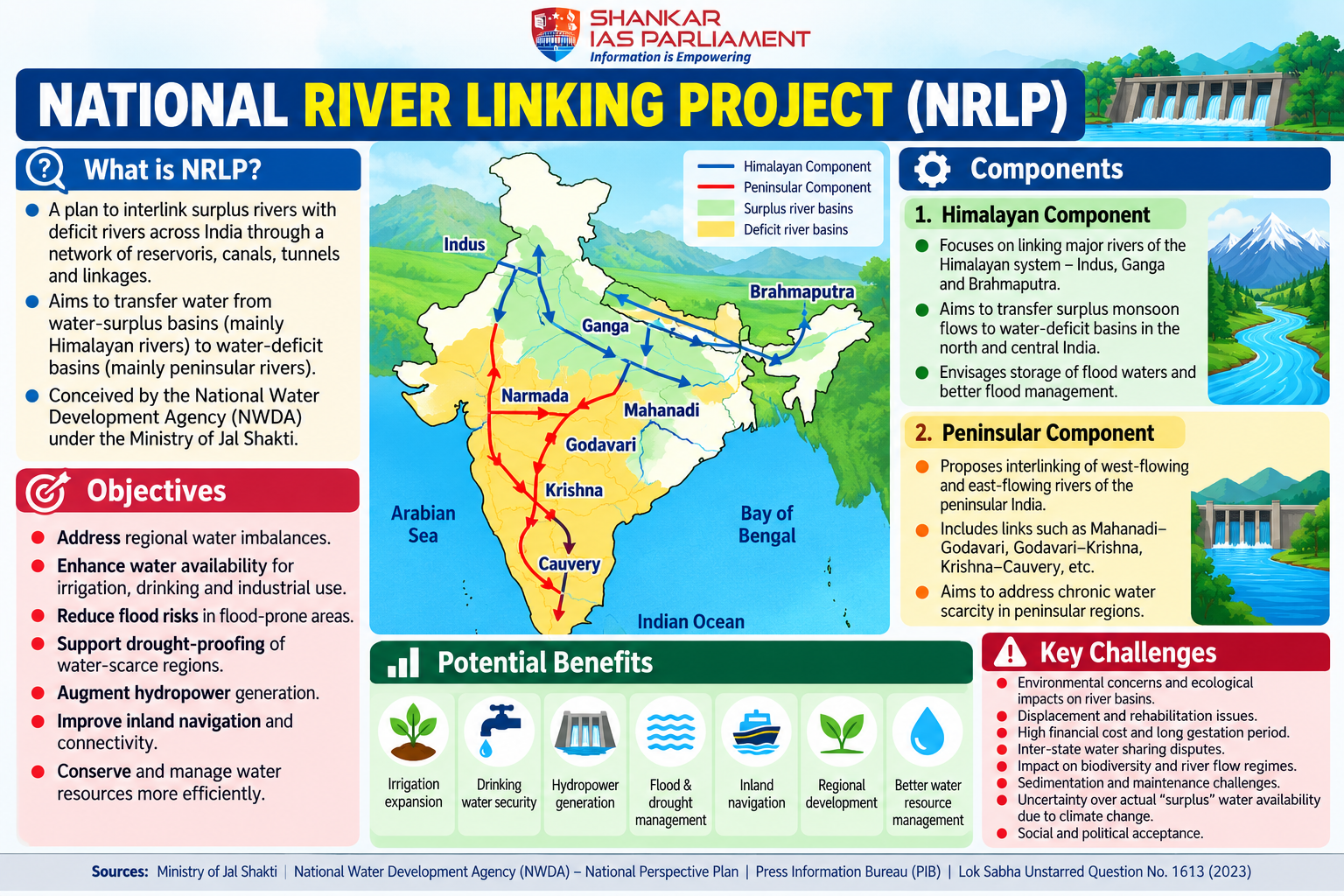
India’s National River Linking Project, covering 37 river basins through 30 links, aims to address water scarcity and generate hydropower. However, it may also facilitate the spread of invasive alien species and aquatic pathogens across river basins.
What is the National River Linking Project?
- Scale of the project – The project proposes transferring around 174 billion cubic metres of water from identified surplus to deficit basins.
- Multiple objectives – It aims to address water scarcity, improve irrigation, manage floods and generate hydropower.
- Ecological concerns – Dams, reservoirs and canals can alter river flows, sediment transport, fish migration, floodplains and aquatic habitats.
- Climate change dimension – Changing rainfall patterns and river flows may challenge the assumption that some basins will consistently remain water-surplus.
How River Interlinking can be an “Ecological Highway”?
- Spread of Invasive Alien Species – Inter-basin water transfers can carry invasive species into ecosystems where they are not naturally found.
- Threat to Endemic Species – Invasive species can outcompete native species, disrupt food chains and threaten endemic biodiversity.
- Spread of Aquatic Pathogens – Connected rivers can facilitate the spread of pathogens to species with limited resistance.
- Disruption of Fish Migration – Dams, canals and altered flows can disrupt fish migration, breeding and aquatic ecosystems.
- Ecologically Vulnerable River Basins – Peninsular and Northeastern basins are more vulnerable, with the Lower Ganga hosting 13–15 invasive species and the Mahanadi supporting 69 threatened species.
What are the Other Ecological Concerns?
- Alteration of River Flows – Water diversion can reduce downstream flows and threaten species dependent on natural river regimes.
- Sediment Disruption – River-linking structures can alter sediment transport and degrade downstream habitats and floodplains.
- Fragmentation of Ecosystems – Dams and canals can fragment aquatic habitats and disrupt ecological connectivity.
- Impact on Livelihoods – Ecological changes can adversely affect fisheries, agriculture and communities dependent on river ecosystems.
What are the Key Challenges Associated?
- Limited Invasive Species Management – India needs stronger systems for preventing, detecting and controlling invasive alien species.
- Basin-Centric Planning – River-linking must consider basin-level ecological characteristics rather than focusing only on water availability.
- Uncertainty under Climate Change – Changing rainfall and river flows make fixed surplus-deficit classifications increasingly uncertain.
- Limited Ecological Assessment – Project assessments must consider cumulative impacts on biodiversity, pathogens, sediment and downstream ecosystems.
What could be done?
- Strengthen Environmental Impact Assessment – Conduct comprehensive basin-level assessments covering biodiversity, invasive species and downstream impacts.
- Develop an Invasive Species Management Framework – Establish mechanisms for prevention, early detection, rapid response and control of invasive species.
- Adopt Basin-Level Planning – Integrate ecological flows, biodiversity and long-term water availability into river-linking decisions.
- Establish Biosecurity Measures – Introduce safeguards and continuous monitoring to prevent the movement of invasive species and pathogens.
- Integrate Climate Change into Planning – Account for changing rainfall, droughts, floods and future water availability in river-linking projects.
- Promote Nature-Based Solutions – Prioritise watershed management, rainwater harvesting, aquifer recharge, wetland conservation and demand-side management.
Conclusion
- River interlinking can contribute to water management and regional development, but its ecological consequences require careful consideration.
- Water cannot be treated merely as a transferable resource; rivers are complex ecosystems supporting biodiversity and livelihoods.
- A scientifically informed approach based on basin-level planning, and climate-resilient water governance is essential for balancing developmental objectives with ecological security.
Reference
The Hindu| India’s river interlinks may carry invasive species to more areas



