Why in news?
Recently, the Union cabinet approved for constructing 3 crore more rural and urban houses under the Pradhan Mantri Awas Yojana with higher assistance per beneficiary.
What is Pradhan Mantri Awas Yojana?
- In pursuance to the goal of Housing for all, PM awas Yojana was launched.
- Types – There are two types of schemes covering both urban and rural areas.
- PMAY-G – Pradhan Mantri Awas Yojana Gramin
- PMAY-U – Pradhan Mantri Awas Yojana Urban
- Mission – To achieve the objective of providing “Housing to All” by the year 2024.
- To construct a house for poor people who don’t have their own house which is beneficial for both urban and rural areas.
- Mode - It is a centrally sponsored scheme, by which the Centre and states share expenses in
- 60:40 ratio – In plain areas
- 90:10 ratio – In northeastern states, two Himalayan states and the UT of Jammu and Kashmir.
- 100% by Centre – In case of other Union Territories, including the UT of Ladakh.
- Eligibility – The applicant should also be an Indian citizen who should not own any pucca house before applying.
- No member of the family should have a government job as well.
- Targeted beneficiaries – A total of 4.21 crore houses have been built for eligible poor families in the last 10 years.
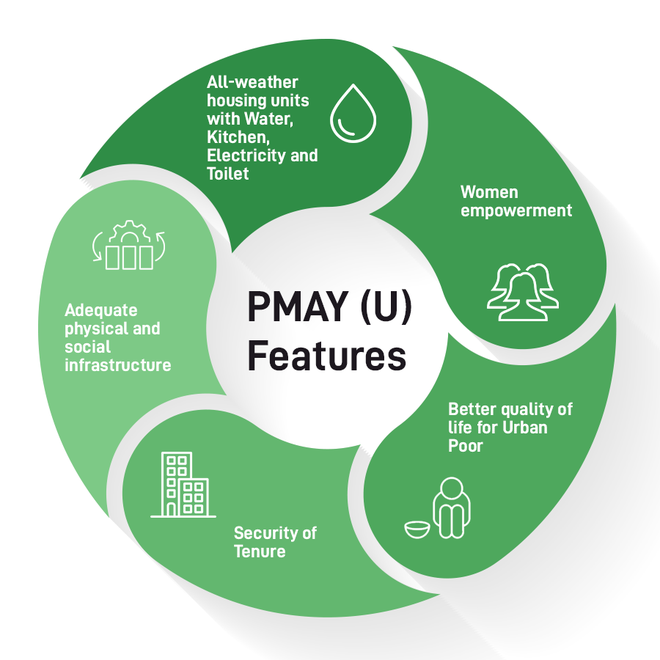
- Empowers women – It provides the ownership of houses in name of female member or in joint name.
- Empowers marginalized groups – Preference is also given to differently abled persons, senior citizens, SCs, STs, OBCs, Minority, single women, transgender and other weaker & vulnerable sections of the society.
- New initiatives in 2024 – Among sanctioned three crore houses, two crore will be constructed under PMAY-Gramin, while 1 crore under PMAY-Urban.
- The government have decided to increase the cost of construction of the PMAY-G house from existing Rs 1.2 lakh to Rs 1.8 lakh in the plains and Rs 1.3 lakh to Rs 2 lakh in the hilly areas.
What is PMAY-Urban?
- Launched in – 2015
- Nodal ministry – Ministry of Housing and Urban Affairs (MoHUA).
- Coverage – Over the entire urban area including Statutory Towns and Notified Planning Areas.
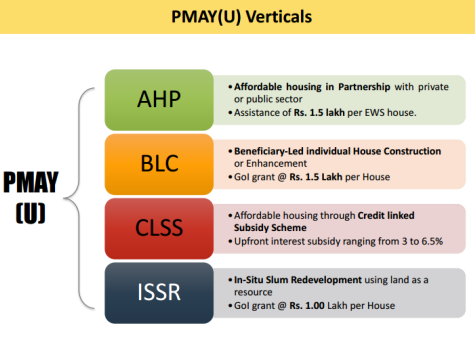
- Approach – It adopts a cafeteria approach to suit the needs of individuals based on the geographical conditions, topography, economic conditions, availability of land, infrastructure etc.
- Basic amenities – Facilities like toilet, water supply, electricity and kitchen are covered.
- Major initiatives – Robust MIS System to help all stakeholders to seamlessly manage information pertaining to physical and financial progress.
- The transfer of the assistance beneficiaries is being done through Direct Benefit Transfer (DBT).
- A web based monitoring system, CLSS Awas Portal (CLAP) integrates all stakeholders in real time environment.
- ANGIKAAR (A campaign for change management) focuses on adopting best practices.
- Global Housing Technology Challenge aims to identify and mainstream a basket of innovative construction technologies.
- Light House projects under this ushered a paradigm shift in the construction technology.
What is PMAY-Grameen?
- Launched in – 2016, it was previously known as the Indira Awas Yojana.
- Nodal Ministry – Ministry of Rural Development
- Coverage – It covers rural regions of India (excluding Chandigarh and Delhi).
- Beneficiaries – They are selected on the basis of housing deprivation parameters in the Socio-Economic Caste Census 9SECC) 2011 data and the list of beneficiaries is validated by the Gram Sabha.
- Assistance – It gives financial assistance to the people who have land and want to build houses.
- The banks also provide home loans at low interest rates under this scheme while the government provides subsidies on home loans.
- Along with financial assistance, the beneficiary is also offered 90 days of employment under the Mahatma Gandhi National Rural Employment Guarantee Act (MGNREGA) to construct toilets.
- Targets – Of the sanctioned 2.95 crore houses, 2.61 crore have been built till date.
What are the challenges associated with PMAY?
- Scarcity of land – There is little to no space for further development in urban areas.
- Land acquisition – The tedious acquisition process makes it difficult to initiate affordable housing projects.
- Delayed project approvals – Lengthy and cloudy approval process has often a barrier towards curbing the cost of realty projects.
- Higher cost – There is issue of rising cost of raw materials and labour.
- Age-old technologies – It leads to have an extended gestation period and extend the construction cycle up to 2-3 years.
- Lack of skilled workforce – It affects not only the quality but also delays the completion of the projects.
What lies ahead?
- Moving to the peripheral areas where land is available in plenty and at competitive prices.
- Easing land acquisition process or government acquiring land and handing over the same to developers at a higher subsidy/incentive.
- An efficient single-window clearance system enabling speedy approvals to realty projects.
- Curbing inflation, tax rebates on construction material for PMAY projects.
- Adopting globally-available mass construction technologies.
- Development of training centres across the country and to have internationally recognised certification to skilled professionals.
References
- Indian Express | Addition of 3 Crore houses under PMAY
- Mygov.in| Pradhan Mantri Awas Yojana - Urban
- Vikaspedia| PMAY-Gramin



