India’s nuclear power journey began with the Tarapur Atomic Power Station in 1969.
At present, India operates 24 nuclear reactors across seven sites, with an installed capacity of 8.78 GW.
Nine reactors are under construction and preparations are underway for 10 additional units.
- Nuclear power provides reliable, low-carbon electricity and can complement variable renewable sources such as solar and wind.
- In FY 2025–26, one GW of nuclear capacity reportedly avoided around 5.4 million tonnes of CO₂-equivalent emissions, compared with 2.7 million tonnes for hydropower, 1.6 million tonnes for wind and 0.9 million tonnes for solar.
- The Nuclear Energy Mission aims to raise nuclear capacity to 100 GW by 2047, while the Union Budget 2025–26 allocated ₹20,000 crore for indigenous Small Modular Reactors (SMRs).
Applications Beyond Electricity
1. Healthcare
- Nuclear technology supports cancer diagnosis, radiotherapy, medical imaging and radiopharmaceutical development.
- Institutions such as BARC, IGCAR and Tata Memorial Centre are developing indigenous technologies for affordable healthcare.
- During FY 2024–25, the Tata Memorial Centre registered around 1.3 lakh patients and screened nearly five lakh women for oral, breast and cervical cancers.
- Indigenous radiation technologies also helped sterilise around 1.53 crore medical devices.
2. Agriculture
- Radiation-induced mutagenesis and conventional cross-breeding are used to develop crop varieties with higher yields, early maturity and improved tolerance to drought, heat, salinity and diseases.
- BARC has developed around 70 crop varieties, including TBM-9 banana and RTS-43 sorghum.
- Collaboration with ICAR and agricultural universities helps in their wider adoption.
3. Food Preservation
- Food irradiation can extend the shelf life of fruits, vegetables, grains, fish and spices while reducing post-harvest losses.
- It also supports chemical-free preservation and facilitates compliance with international phytosanitary requirements.
- In 2025, the government signed 17 MoUs to expand food irradiation infrastructure, while six gamma radiation processing facilities were commissioned, taking operational facilities to around 40.
4. Critical Minerals and Rare Earths
- Nuclear analytical technologies assist in the exploration, characterisation and processing of minerals and rare earth elements.
- India has developed its first Certified Reference Material for Rare Earth Elements—Ferrocarbonatite (BARC B1401)—providing a standard benchmark for geological and geochemical analysis and strengthening critical-mineral security.
5. Semiconductors and Electronics
- Nuclear technologies are contributing to semiconductor manufacturing through high-purity isotopes and speciality materials.
- India has established its first electronics-grade Boron-11 enrichment facility at Talcher, producing material with 99.8% purity.
- This can reduce import dependence on critical materials and support the India Semiconductor Mission.
6. Green Hydrogen
- Nuclear energy can provide both reliable electricity and high-temperature process heat for low-carbon hydrogen production.
- In 2026, India inaugurated a nuclear-process-heat-based hydrogen production facility at Kalpakkam, supporting the National Green Hydrogen Mission and Net Zero objectives.
Nuclear Safety: A Multi-Layered Approach
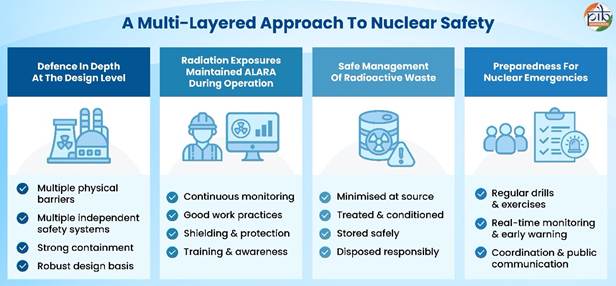
- Safety remains the central principle of India’s nuclear programme.
- Nuclear facilities follow the globally accepted Defence-in-Depth philosophy, which uses multiple independent layers of protection.
- These include:
- High-quality design and construction.
- Continuous monitoring and testing.
- Multiple physical barriers against radioactive release.
- Independent reactor shutdown and cooling systems.
- Backup power systems.
- Protection against earthquakes, floods, cyclones, tsunamis and other external hazards.
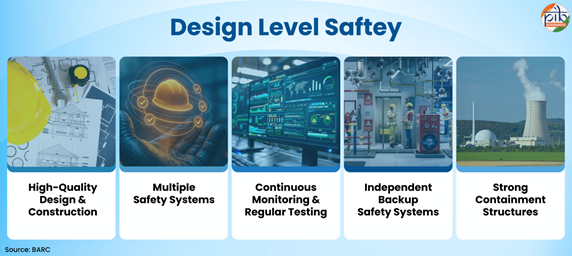
- In Indian PHWRs, two independent and diverse shutdown systems can automatically shut down the reactor during abnormal conditions, while dedicated cooling systems remove residual heat.
Radiation Protection
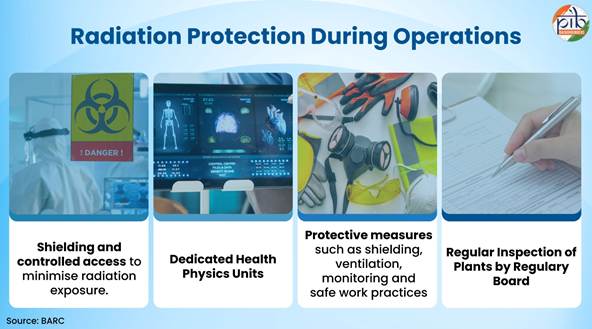
- India follows the ALARA principle — “As Low As Reasonably Achievable” — to minimise occupational radiation exposure.
- The AERB prescribes an average occupational dose limit of 20 mSv per year over five years, with a cumulative limit of 100 mSv and a maximum of 30 mSv in any single year.
- Every nuclear plant has a dedicated Health Physics Unit to monitor radiation levels, personnel exposure and environmental releases.
- The annual radiation dose limit for the general public is 1 mSv.
Radioactive Waste Management
- Radioactive waste is managed through a multi-layered regulatory system under the supervision of the Atomic Energy Regulatory Board (AERB).
- Liquid waste is treated and discharged only after meeting prescribed standards.
- Solid waste is processed and disposed of in engineered facilities.
- Disposal methods are matched to the level of radioactivity.
- Environmental Survey Laboratories continuously monitor air, water, soil, vegetation and food.
- India has also developed indigenous vitrification technology, through which high-level radioactive waste is converted into stable glass blocks for long-term management.
Nuclear Emergency Preparedness
- India follows a multi-level emergency management framework involving national, State, district and plant authorities.
- Key mechanisms include:
- Integration of nuclear emergencies into the National Disaster Management Plan.
- Dedicated Crisis Management Plans under the Department of Atomic Energy.
- Mandatory On-site and Off-site Emergency Response Plans.
- Regular mock drills involving district administration and disaster-management authorities.
- Specialised training for police, emergency responders and medical professionals.
- Radiation Emergency Medical Networks for specialised healthcare.
- A 16-km Emergency Planning Zone around nuclear power plants.
- Continuous environmental monitoring through Environmental Survey Laboratories.
Following the 2011 Fukushima accident, Indian nuclear plants underwent comprehensive safety reviews.
Short- and medium-term safety enhancements have been completed, while long-term improvements continue.
Way Forward
- India’s nuclear expansion should focus on indigenous reactor technologies, SMRs, strong regulatory capacity, safe waste management and transparent public communication.
- Greater investment in research can further expand nuclear applications in healthcare, agriculture, critical minerals, semiconductors and hydrogen.
Nuclear energy can play a crucial role in India’s pursuit of energy security, Net Zero by 2070 and Viksit Bharat 2047.
Its importance extends well beyond electricity generation, covering healthcare, food security, industrial development and strategic technologies.
A combination of robust regulation, Defence-in-Depth safety, emergency preparedness, indigenous innovation and public confidence will be essential for ensuring that India’s nuclear expansion remains safe, sustainable and development-oriented.
Reference
PIB| Nuclear energy



