Why in news?
The Reserve Bank of India (RBI) has launched a crackdown on some P2P lending platforms for regulatory breaches, including Ponzi-like schemes, illegal deposit-taking, and aggressive recovery methods.
What is NBFC-P2P lending platforms?
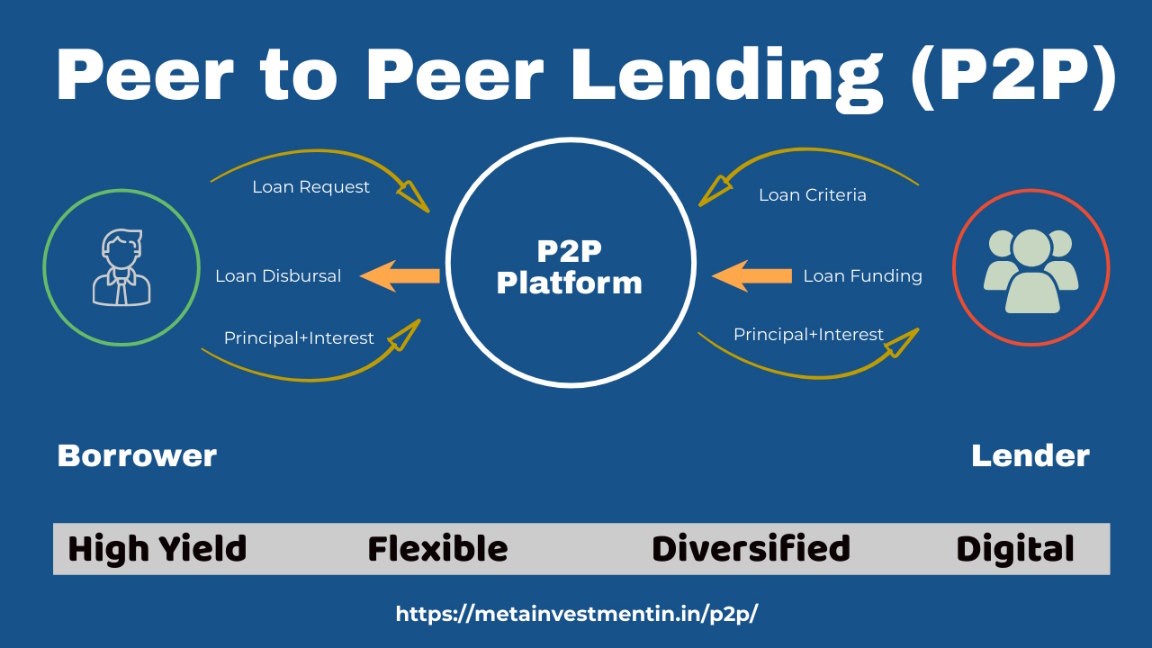
- NBFC-P2P- It is the Non-Banking Financial Company - Peer-to-Peer lending platforms are financial intermediaries.
- Role – It enables direct borrowing and lending between individuals, bypassing traditional financial institutions.
- It offers accessible credit to underserved groups and attractive investment options for lenders.
- Tech-Driven credit solutions- They use technology to assess the creditworthiness of borrowers, match them with suitable lenders, and facilitate loan transactions.
|
Regulation in India
|
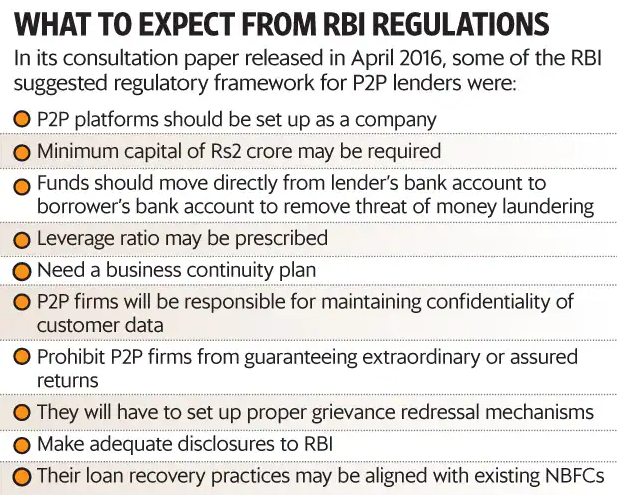
- It is regulated by the Reserve Bank of India (RBI).
- Mandate registration- Only NBFCs can register as P2P lenders with permission and must obtain a certificate of registration.
- Capital limit- The RBI sets a minimum capital requirement of Rs. 2 crores to set up a P2P platform.
|
What are the concerns highlighted by RBI?
- Breaching of regulations – They significantly have high balances in escrow accounts.
An escrow account is a bank account that holds money or assets until certain conditions are met by the parties involved in a transaction.
- There has been high non-performing asset (NPA) levels.
A NPA is a loan or advance for which the principal or interest payment remained overdue for a period of 90 days.
- Delayed disbursement - Funds transferred by lenders not being immediately disbursed to borrowers, kept in escrow accounts for long periods while assured returns were provided.
- Non-compliance- There is a violation in net owned fund and disclosure requirements.
- Operating models allowing premature recall of funds by lenders, which were replaced by new lenders without transparency.
- Profit Margins and High Interest- No cap on interest charged to borrowers, leading to exorbitantly high rates.
- Platforms profiting from the spread between the returns paid to lenders and the interest charged to borrowers.
- Capital diversion- Risk of capital diversion from banks and similar financial institutions due to the appeal of high assured interest rates and immediate liquidity options.
What are the new guidelines by RBI?
- Deposit controls – They are prohibited from accepting public deposits, lending directly, or arranging guarantees for lenders.
- Loan Disbursement Rules- Loans should not be disbursed unless lenders and borrowers are matched according to a board-approved policy.
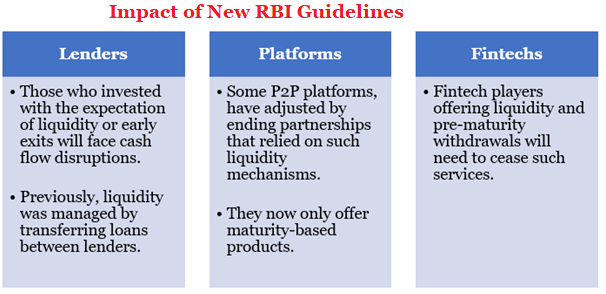
- Transactions between lenders are now prohibited.
- Monitoring transactions - All fund transfers between lenders and borrowers must be conducted through escrow accounts.
- Funds in escrow accounts must not remain there for more than one day beyond the date of receipt (T+1 rule).
- Prohibition on early withdrawals- They can no longer offer early withdrawals or liquidity options that allowed lenders to exit before the maturity of loans.
- Disclosure of losses- The RBI mandates full disclosure of any losses incurred by lenders on principal or interest which aims to enhance transparency and risk awareness.
- No investment product promotion- They must not promote peer-to-peer lending as an investment product offering features like assured minimum returns or liquidity options.
- Prohibition on Cross-Selling- NBFC-P2P platforms are prohibited from cross-selling insurance products that act as credit enhancement or credit guarantees.
What lies ahead?
- A robust regulatory framework is essential to ensure the stability and credibility of the P2P lending market.
- Refining guidelines to safeguard both borrowers and lenders.
- Educating potential borrowers and lenders about the P2P lending model, its benefits, and its risks is crucial.
- Building and maintaining trust is crucial for the success of P2P lending platforms.
- Adopting best practices and leverage new age technologies to overcome challenges and achieve sustainable growth.
References
- Business Standard| Issues with P2P Lenders
- Business Standard | New Norms for P2P lending platforms
- Business Today| Impact of new Rules on P2P Lenders



