GS – III – Indian Economy and issues relating to planning, mobilization of resources, growth, development and employment.
Why in news?
In the 56th GST Council meeting, chaired by Union Finance Minister, the Next-Gen Goods and Services Tax (GST) reforms have been approved.
What are the features of current GST 1.0?
- Launch – GST, indirect tax structure, was launched with in 2017 by the Constitution 101st Amendment Act 2016.
- GST was born out of subsuming of 17 taxes and 13 cesses levied by the Central and State governments.
- Tax Slabs - Apart from zero-rated goods, it had four tax slabs 5%, 12%, 18 and 28%.
- GST Council - The GST Council is a joint forum of the Centre and the States which makes recommendations to the Union and the States on GST.
- Decision taking - Every decision of the GST Council is taken at its meeting by a majority of not less than 3/4th of the weighted votes of the Members present and voting.
- Features of GST -
- Destination-based tax
- Eliminated cascading of taxes (tax on tax)
- Created a single national market with common rates and procedures
- Input tax credit
- Completely automated and faceless administration with all processes being online.
What is the performance of GST so far?
- Expansion of Tax Base - GST taxpayer base has grown from 66.5 lakh in 2017 to 1.51 crore in 2025, reflecting greater formalization of the economy.
- Record Revenue Growth - FY 2024–25 saw Rs.22.08 lakh crore in gross GST collections, doubling in just four years with a CAGR of 18%.
- Economic Confidence - Rising collections and active taxpayers reflect stronger compliance, improved systems, and robust economic fundamentals.
- Average monthly collections have risen to Rs. 2.04 lakh crore year from Rs. 82,000 crore in 2017–18.
What are the features of GST 2.0?
- Next-Gen GST reforms – It builds on GST’s success with a simplified 2-tier structure, fairer taxation, and digital filing for ease and faster refunds.
- Focus – It focuses on improving the lives of the common man and ensuring ease of doing business for all, including small traders and businessmen.
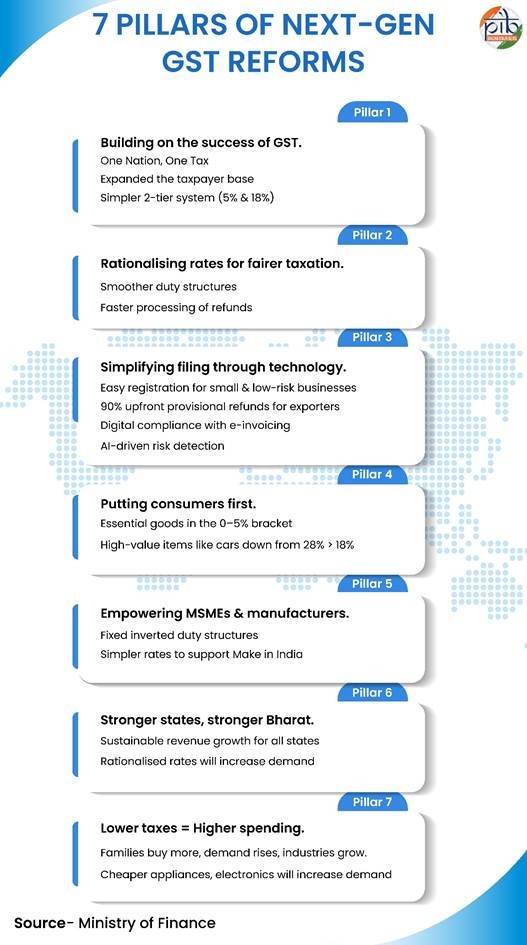
- Two slabs - GST is simplified into a two-slab structure - Slab 1 – 5%, Slab 2 – 18%.
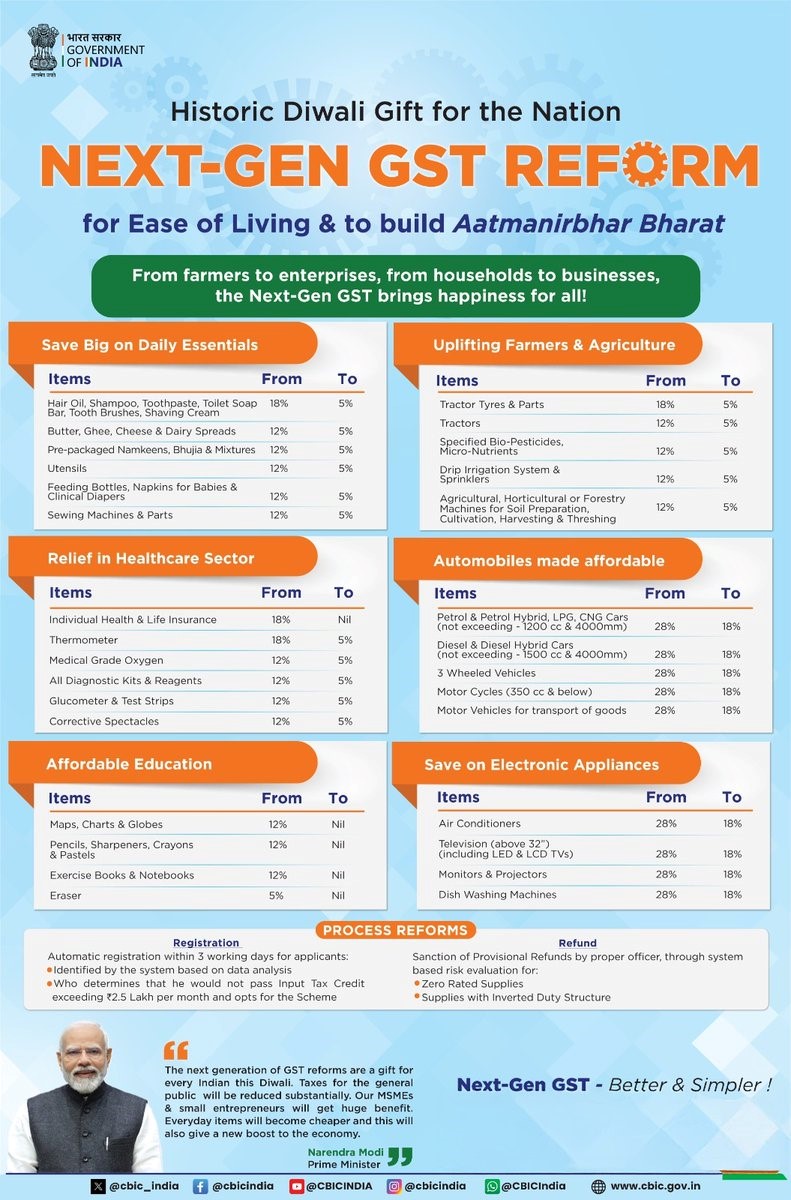
- Household essentials - GST reforms cut taxes on household essentials (soaps, toothpaste, Indian breads) to 5% or Nil boosting affordability
- Home Building & Materials - The cut in GST on cement (from 28% to 18%) and construction materials like marbles, granites, wooden flooring, etc. cuts from 12% to 5%.
- Health care sector - Life-saving drugs, medicines reduced from 12% to Nil or 5% making healthcare affordable
- Agriculture Sector - Farm machinery, irrigation equipment cut from 12% to 5%, reducing farming costs
- Service sector - Lower GST will reduce costs for citizens and gives a fillip to the hospitality and service industries.
- For hotels the cuts from 12% to 5%; Gyms, salons, barbers, yoga GST cut from 18% to 5%.
- Toys, Sports & Handicrafts - Reduction of GST rate on manmade fibre from 18% to 5% and manmade yarn from 12% to 5% and for Wooden/metal/textile dolls & toys from 12% to 5%.
- Luxury items and sin goods - Tobacco, pan masala, aerated drinks, and luxury goods taxed at 40%.
What are the potential benefits GST 2.0 reforms?
- Virtuous cycle - The Next-Generation GST reforms are designed not just to reduce tax rates, but to create a virtuous cycle of growth.
- Lower Prices, Higher Demand - Cheaper goods and services increase household savings and stimulate consumption.
- Support for MSMEs - Reduced rates on inputs like cement, auto parts, and handicrafts lower costs and make small businesses more competitive.
- Disputes Reduction- A two-rate structure means fewer disputes, quicker decisions, and simpler compliance.
- Wider Tax Net - Simpler rates encourage compliance, expanding the tax base and improving revenues.
- Support for Manufacturing - Correcting inverted duty structures boosts domestic value addition and exports.
- Economic Momentum - Lower costs leads to higher demand which creates larger tax base and stronger revenues leading to sustainable growth.
- Social Protection - Exemption of GST on insurance and essential medicines strengthens household security and access to healthcare.
What are the challenges in implementing GST 2.0?
- Effects on poor and middle class - Two-thirds of the total GST, i.e. 64%, comes from the pockets of the poor and the middle class, but only 3% GST is collected from billionaires.
- Impact on Center-State Relations - A key demand of the states, made in the true spirit of cooperative federalism, the extension of compensation for another five years to fully protect their revenues, remains unaddressed.
- Revenue Impact - The rate rationalization is expected to lead to a short-term dip in revenue for both the central and state governments.
- The State of Kerala has said that it will lose upto Rs 8,000–10,000 crore annually under the new slabs.
- Technical and Procedural Hurdles – The system continues to face technical issues in GSTN portal during peak hours, the frequent changes in return formats can also be confusing for taxpayers,.
- Sector-Specific Challenges - For example, while the automotive and consumer durables sectors will likely see a boost from lower tax rates, other sectors like coal may face increased costs due to a higher GST rate.
- Passing on Benefits to Consumers - With the anti-profiteering provisions having expired, there's no legal mandate for businesses to pass on the savings from reduced tax rates directly to the end consumer.
What lies ahead?
- Robust IT Infrastructure - Upgrade GSTN systems to handle new rate structures and enable real-time invoice matching and simplified credit note issuance.
- Public Awareness & Stakeholder Engagement - Launch nationwide campaigns to educate consumers and businesses on benefits and changes.
- Monitoring & Feedback Mechanisms - Set up dashboards to track compliance, refund timelines, and dispute resolution.
- Use analytics to identify bottlenecks and areas needing policy tweaks.
- Boosting Consumption & Inclusion - Lower taxes on essentials and insurance will increase affordability, especially for middle- and lower-income households.
Conclusion:
- The adoption of a simplified GST structure and wide-ranging rate reductions marks a new chapter in India’s tax journey.
- By focusing on affordability for citizens, competitiveness for businesses, and transparency in compliance, these reforms make GST not just a tax system, but a catalyst for inclusive prosperity and economic transformation.
Reference
1. NDTV | New GST slabs
2. PIB | GST Reforms 2025
3. The Hindu | Reduction of GST rates





 Loading Comments