Why in news?
Karnataka, Maharashtra and Goa seek shrinking of eco-sensitive areas in Western Ghats.
What are Eco-Sensitive Zones?
- Conception – The concept of ESZ was conceived during the XXI meeting of the Indian Board for Wildlife held in 2002, when the Wildlife Conservation Strategy, 2002 was adopted.
- The National Wildlife Action Plan (NWAP) (2002-2016) indicated that ‘Areas outside the protected area network are often vital ecological corridor links and must be protected to prevent isolation of fragments of bio-diversity which will not survive in the long run.
- National Environment Policy (2006) has defined the ESZ.
- Definition – An areas/zones with identified environmental resources having incomparable values which require special attention for their conservation” because of its landscape, wildlife, biodiversity, historical and natural values.
- Declaration – They are declared by the Ministry of Environment, Forest and Climate Change (MoEFCC) as per the Environment (Protection) Act, 1986.
- Coverage – The lands falling within 10kms of the boundaries of national parks and sanctuaries should be notified as eco-fragile zones under the Environment (Protection) Act, 1986.
- While the 10-km rule is implemented as a general principle, the extent of its application can vary.
- Areas beyond 10-km can also be notified by the Union government as ESZs, if they hold larger ecologically important “sensitive corridors.”
- Purpose – Protect environment and avoid its degradation due to anthropogenic activities.
- Create some kind of barrier/ shock absorber for the specialized ecosystem (PAs).
- Act as transition zone from areas of higher protection to areas involving lesser protection.
- Objective – To maintain the response level of an ecosystem within the permissible limits w.r.t environmental parameters.
- To notify the area as an Eco- sensitive zone and to regulate the developmental activities in a sustainable manner taking into consideration the needs and aspiration of the local people.
- Salient features of ESZ – The ESZ Notification captures the following features:
- Brief on the Protected Area
- Area of ESZ and Extent of ESZ (Minimum and Maximum)
- Available Flora, Fauna [Including Endemic, Rare, Endangered and Threaten (RET) species]
- Boundary Description of ESZ
- Maps of the ESZ
- Geo-coordinates of prominent locations of PA and ESZ along with Shape/ KML files
- List of villages along with Geo-co-ordinates
- General guideline on Zonal Master Plan
- Measures to be taken by the State Government
- Prohibited and Regulated Activities along with Promoted Activities
- Details of Monitoring Committee
- It does not involve displacement and evacuation of farmers/people living in the villages.
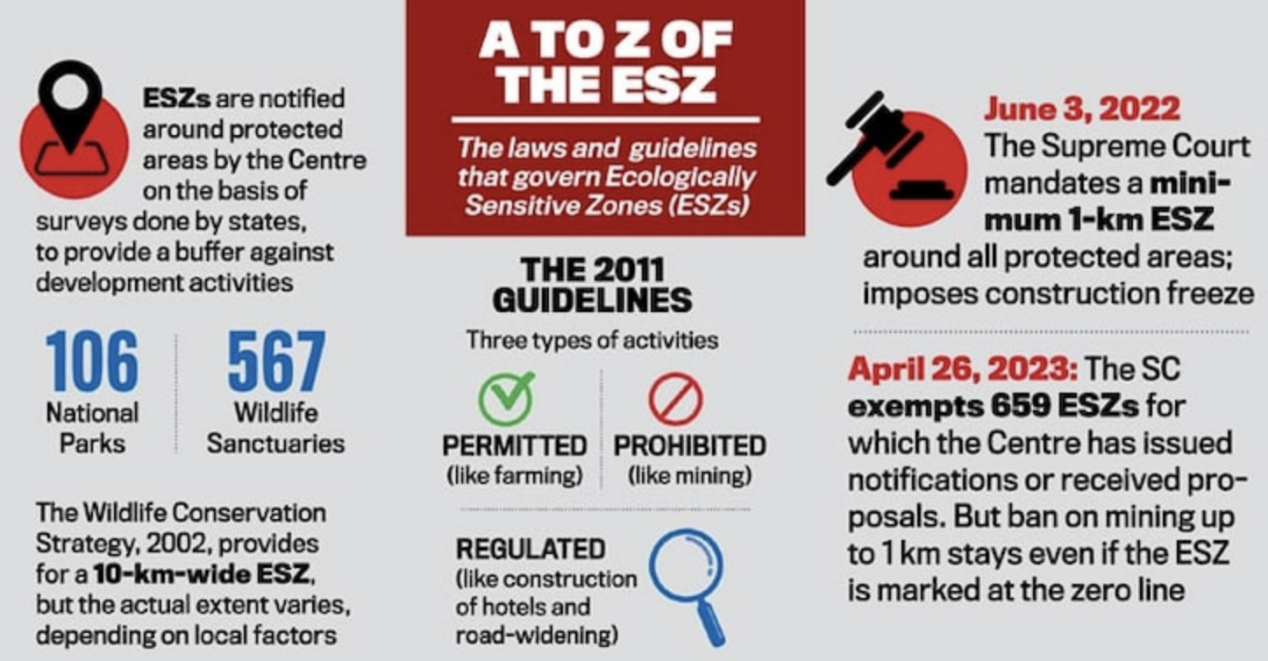
What are the Prohibited, Regulated and Permitted activities in ESZs?
Prohibited activities
- Commercial mining, but it will not prohibit the digging of earth for construction for repair of houses and for manufacture of country tiles or bricks for personal consumption.
- Setting of saw mills
- Setting of industries causing pollution (water, air, soil, noise etc)
- Commercial use of firewood
- Establishment of major hydroelectric projects
- Use or production of any hazardous substances
- Undertaking activities related to tourism like over-flying the National Park area by any aircraft, hot-air balloons
- Discharge of effluent and solid waste in natural water bodies or terrestrial area.
Regulated activities
- Felling of trees
- Establishment of hotels
- Drastic change of agriculture systems
- Commercial use of natural water resources including ground water harvesting
- Erection of electrical cables be regulated while underground cabling should be promoted
- Fencing of premises of hotels and lodges
- Use of polythene bags by shopkeepers
- Widening of roads should be done with proper EIA and mitigation measures
- Movement of vehicular traffic at night for commercial purpose
- Introduction of exotic species
- Protection of hill slopes and river banks
- Air and vehicular pollution
- Sign boards & hoardings.
Permitted activities
- Ongoing agriculture and horticulture practices by local communities.
- However, excessive expansion of some of these activities should be regulated as per the master plan.
- Rain water harvesting
- Organic farming
- Use of renewable energy sources
- Adoption of green technology
Why Western Ghats is important?
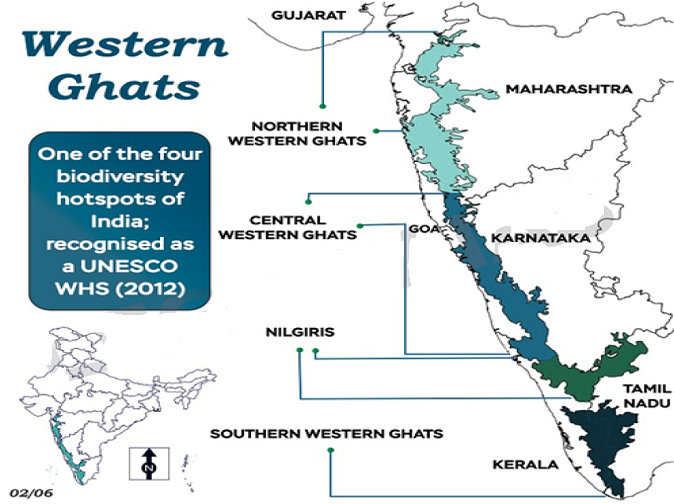
- Western Ghats – They are mountain ranges that runs parallel to the western coast of the Indian peninsula, located entirely in India.
- Coverage – It extends along six states of India.
- They are Gujarat, Maharashtra, Goa, Karnataka, Kerala and Tamil Nadu.
- Biodiversity – It has over 7,402 species of flowering plants, 1,814 species of non-flowering plants, 139 mammal species, 508 bird species, 179 amphibian species, 6,000 insects species and 290 freshwater fish species.
- Measures – Gadgil and Kasturirangan commitee were appointed to identify the areas that needed to be kept out from such activities.
- The Kasturirangan panel – It had identified 37% of the Western Ghats as ecologically sensitive and recommended prohibition or regulation of certain activities.
- Gadgil Commission - The Western Ghats Ecology Expert Panel (WGEEP) also known as the Gadgil Commission has designated the entire hill range as an ESA.
- Recognition – It is a UNESCO World Heritage Site and is one of the eight "hot-spots" of biological diversity in the world.
What are the major concerns in declaring ESZs?
- Development Restrictions – Limits on construction, infrastructure projects, and industrial activities can hinder economic growth and development in the region.
- Livelihood Impact – Restrictions can affect local communities, particularly those dependent on land and natural resources for their livelihoods, such as agriculture, forestry, and mining.
- Property Rights – Landowners may face limitations on how they can use or develop their property, potentially leading to conflicts and disputes.
- Economic Loss – Potential loss of revenue for state and local governments due to reduced industrial and commercial activities.
- Implementation Challenges – Ensuring effective enforcement of ESA regulations can be difficult, requiring substantial resources and coordination among various government agencies.
- Balancing Conservation and Development – Finding a middle ground that protects the environment while allowing for necessary development is often challenging.
What lies ahead?
- Implement a zoning system – Designates specific areas for conservation, sustainable agriculture, limited development, and urbanization.
- This helps in managing human activities while protecting critical ecosystems.
- Involve community participation – They should be allowed to participate in conservation planning and decision-making.
- Empower them with knowledge and resources to manage natural resources sustainably.
- Promote economic diversification – This will reduce dependency on activities of local communities that harm the environment.
- Develop alternative livelihood opportunities, such as eco-tourism, agroforestry, and handicrafts.
- Strengthen the legal and policy framework – Enforce existing environmental laws and regulations, and update them to address emerging challenges.
References
- The Indian Express| Plans to Reduce ESZ in Western Ghats
- MoEFCC| Eco Sensitive Zones (ESZ)



