Why in news?
Recently, the Punjab government has been actively promoting the direct seeding of rice (DSR).
What is direct seeding of rice (DSR)?
- Definition – It is a planting method that involves directly sowing of seeds in the field.
- It requires no nursery preparation or transplantation.
- Need of DSR – The conventional transplanting method require intense labour, continuous flooding of water and takes higher time and labour resources.
|
Transplanting Method of Rice
|
- It is a planting method that involves the planting of seedlings or whole plants in the field or garden.
- Requirement – seed germination may occur inside the greenhouse.
- Advantages – Weed management is easier and it requires less amount of seeds.
- Disadvantages – Slower maturation of crops.
- It is expensive in comparing to DSR.
- It require more usage of water and thereby affecting the ground water table.
|
- Requirements – Soil suitability is crucial for the successful implementation of DSR.
- Soil texture – DSR should be avoided in light-textured soils as they do not retain water well.
- It is more suitable for heavy or medium-to-heavy-textured soils which contains more clay and less sand, whereas light-textured soils have less clay and more sand.
- Iron content – Soil with severe iron deficiency, and weed problems must not be cultivated using this technique.
- Even medium-textured soils are unsuitable simply due to their lack of iron.
- In case iron supplements are being used, farmers should apply ferrace iron, which is green-coloured and not oxidised, rather than oxidised iron, which is brown in colour.
- Lack of iron content can severely impact yields and lead to major financial losses for farmers.
What is tar-wattar technique?
- Sowing of seeds – The paddy seeds are directly sown, roughly 20-30 days prior to when they would have been transplanted.
- Soil levelling – The field is irrigated and laser leveled prior to the seeding process which is carried out using a seed drill or lucky seeder.
- Seed treatment – The seeds soaked in a fungicide solution for eight hours, then dried for half a day before sowing.
- Irrigation – The first round of irrigation is carried out 21 days after sowing, followed by 14-17 more rounds at 7-10 day intervals, depending on soil type and the quality of the monsoon.
- The final irrigation takes place 10 days before harvest.
- The traditional method requires 25-27 irrigations in total.
What are benefits of DSR?
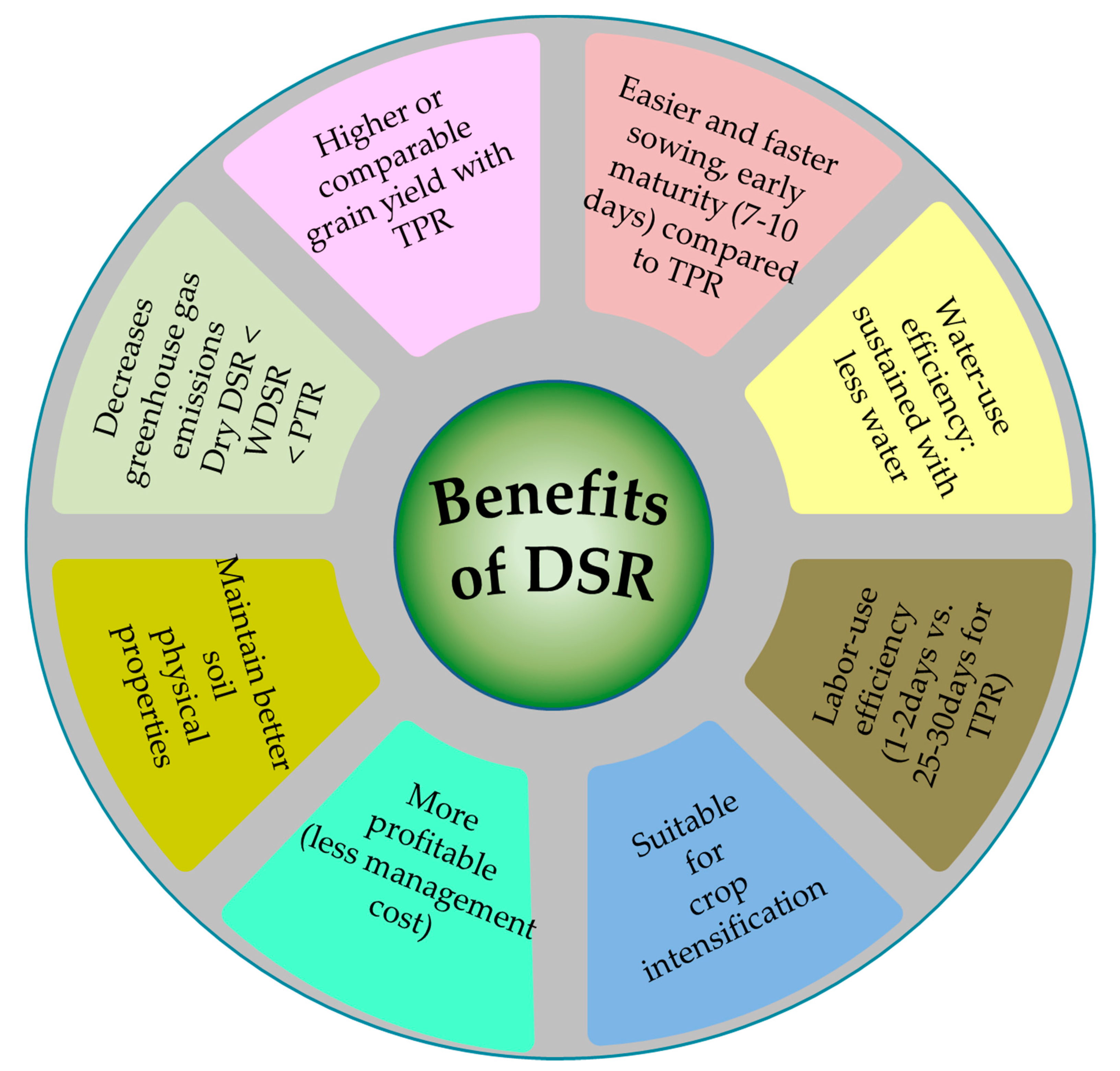
- Saves water - This can reduce water use by 15% to 20% (the traditional puddling method requires 3,600 to 4,125 litres of water to grow a single kilo of rice).
- Saves labour – DSR requires less labour and matures 7 to 10 days faster.
- Ground water recharge – DSR offers avenues for ground water recharge as it prevent the development of hard crust just beneath the plough layer due to puddled transplanting.
- Straw management – It matures 7-10 days earlier than puddle transplanted crop, therefore giving more time for management of paddy straw.
- Higher yield – Research results have also indicated that yield, after DSR, are one to two quintals per acre higher than puddled transplanted rice.
- Environment benefits – It leads to lower GHG emissions.
- Labour welfare – Mechanized DSR provides employment opportunities for youth through service provision business model
- It increases total income by reducing cost of cultivation.
What are the major challenges associated with DSR?
- Irrational use – In the race to avail the government incentives, some farmers use DSR in unsuitable soils, leading to the need for irrigation every second or third day.
- This completely counteracts the water-saving benefits of DSR, and in fact, ends up guzzling down more water.
- Less soil availability – Only 20% of Punjab’s soil is light-textured.
- Lack of iron content – It should not be cultivated in sandy and loamy sand as these soils suffer from severe iron deficiency, and there is higher weed problem in it.
- Higher seed rates – Seed monopoly automatically the price of seeds thereby reducing the income prospects for farmers.
- Seeds exposed to birds and pests – Direct seeding increases the vulnerability of seed to get targeted by the pests and birds.
- Weed management – There is higher growth of unsuitable plants in the DSR fields which compete the paddy crops and thereby reduce the yield.
- Herbicide intolerance – While herbicide needs to be sprayed to control the weeds, irrational use make the crops intolerant to herbicide.
What lies ahead?
- Awareness drive – A basic lack of awareness and understanding is holding DSR back.
- Thus, awareness should be created for rational use of DSR.
- Educating farmers – Extensive training and a ready helpline be provided, to handhold the farmers through the whole process, from pre-sowing to harvesting.
- This can instill confidence among farmers regarding DSR’s efficacy.
References
- The Indian Express| Slower Adoption of DSR in Punjab
- IRRI| Direct Seeded Rice



