What is the issue?
The 1911 to 1947 paradigm of the Indian freedom struggle was primarily dominated by two individuals - Mahatma Gandhi and V D Savarkar (Veer - the braveheart). Here is an overview of their ideologies.
What is the ideological significance of the freedom struggle?
- Besides achieving independence, the freedom struggle also involved nurturing the ideas and values for nation-building.
- The Indian freedom struggle too consisted of different ideologies encompassing the right, left and centre.
- It was indeed a broad socio-economic, cultural movement with the participation of reformists, revolutionaries, constitutionalists, loyalists, progressives and even regressives.
- Besides the Gandhian stream of nation-making, the other parallel but equally forceful stream was the stream of revolutionaries.
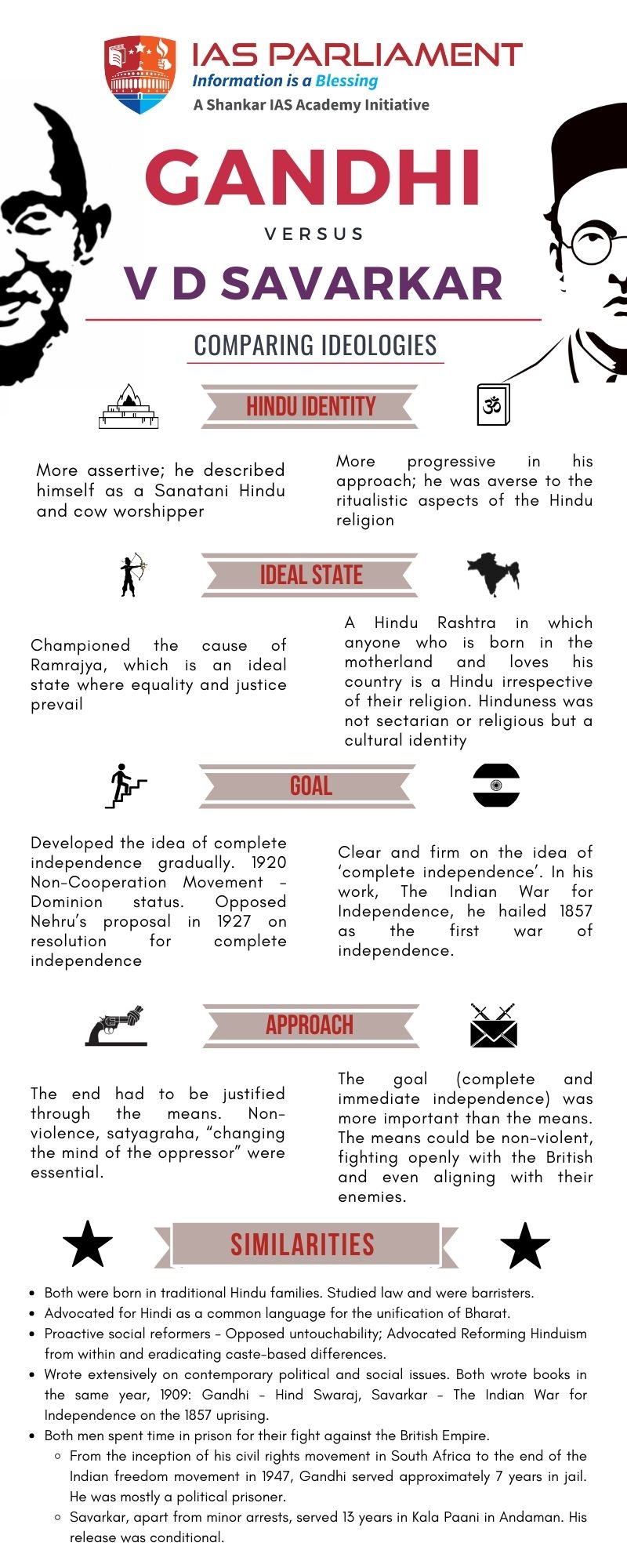
What were the key contributions of Gandhi?
- “Fathered” many of the ideas that are the guiding principles for present-day Bharat.
- Made the freedom struggle a true “national” struggle.
- Promoted the idea of equality.
- Gave non-violence as a method to achieve independence by changing the heart of the oppressor.
What were the other key ideas of Savarkar?
- He evolved an enlightened view of Hinduism - Creating a strong national character by nurturing the individual with the cultural and ideological roots of Hindu culture.
- For his strong ideas and valour, Savarkar was charged with sedition, extradited and sentenced to transportation for two life terms, amounting to a 50-year sentence.
- After he was released with conditional confinement from the jail, Savarkar was engaged in a massive social reform project in Ratnagiri.
- He worked to uproot the caste system, advocated inter-caste dining, inter-caste and inter-regional marriages, widow remarriage, female education and temple entry for all castes.
- Savarkar was totally against the idea of the bifurcation of India. He hailed the glorious past and culture of India to borrow strength from it.
Source: The Indian Express



