Prelims – Current events of national and international importance | Bilateral issues
Why in News?
Nepal recently objected to India and China announcing the reopening of border trade through the Lipulekh Pass, citing its claims over the region.
- Historical context of trade - Border trade between India and China through Lipulekh Pass had commenced in 1954.
- It had been going on for decades till it was disrupted by Covid and other developments, and both sides have now agreed to resume it.
- Territorial Issue – Nepal claims the Lipulekh is part of its territory according to their constitution.
- As regards territorial claims India's position remains that such claims are neither justified nor based on historical facts and evidence.
- India rejected Nepal's claim over Lipulekh, saying any unilateral artificial enlargement of territorial claims was unsound.
- India remains open to constructive interaction with Nepal on resolving agreed outstanding boundary issues through dialogue and diplomacy.
- Nepal is likely to raise the issue bilaterally with India.
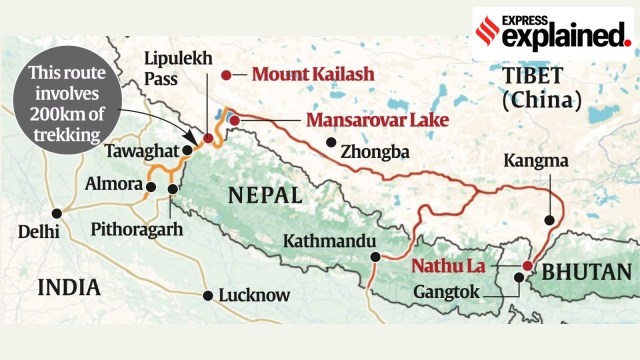
- Location - The Lipulekh Pass is a Himalayan Mountain pass located in the Kumaon region of Uttarakhand, India, at the trijunction of India, China, and Nepal.
- It is a historically significant route for trade and pilgrimage, connecting India with the Tibet Autonomous Region of China.
- Kailash Manasarovar Yatra - The pass is a major pilgrimage route for Hindus traveling to Mount Kailash and Lake Manasarovar in Tibet.
- Strategic importance - Military advantage - The pass holds significant strategic military importance, allowing for faster troop movement along the Line of Actual Control (LAC) with China.
- Infrastructure development - India constructed a road to the pass in 2020 to improve access for pilgrims and traders, which intensified the diplomatic tensions with Nepal.
Reference
Times of India | Lipulekh Pass



