What is the issue?
- Himachal Pradesh faces rising instability from environmental factors such as climate change, heavy rainfall and landslides.
- The rising threat calls for a renewed approach to the developmental designs in the State.
What is the recent happening?
- Landslip/Lanslide in the Kinnaur district of Himachal Pradesh killed at least 14 people and buried several others.
- Severe catastrophe as mud, rocks and debris rained down on vehicles.
- A fortnight back, a similar disaster killed a group of tourists.
What are the recurring threatsand the causes?
- Landslips - They have become more common.
- Seismic events threaten to increase their frequency and aggravate the impact.
- The Landslide Hazard Zonation Map of India marks over 70% of Himachal Pradesh as ‘high risk’ and 14% as ‘severe’ to ‘very high risk’.
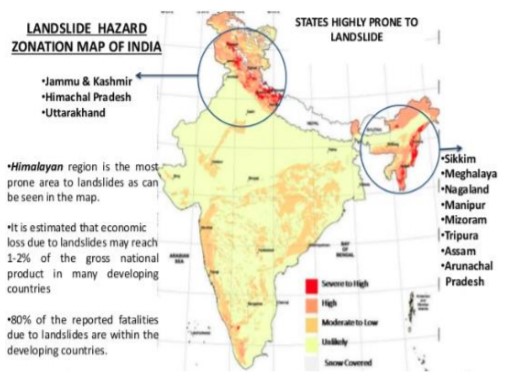
- Earthquakes - Mountains here are geologically young and therefore active (unstable).
- 32% of the State is categorised as a high damage risk zone for seismicity.
- Causes
- Himachal’s mountain slopes experience seismicity and rain-induced stresses.
- Heavily engineered structures such as dams and hydropower (involve rock blasting, tree felling and inundating large spaces), building roads.
- With greater rainfall and cloudburst activity, Himachal Pradesh is bound to face greater uncertainty.
What does this call for?
- A new and redesigned development paradigm.
- Greater caution in pursuing disruptive projects, particularly hydropower.
- An updated action plan on climate changethat goes beyond disaster management.
- Long-term remedial measures for the key hazards.
- Harnessing the available support among local communities for sustainable tourism and expansion of the farm-based economy, particularly apple growing.
Source: The Hindu



