Why in news?
Recently, an Australian startup unveiledlab-grown cultured meat using the genetic sequence from the long-extinct woolly mammoth.
What is cultured meat?
- Cultured meat also called cell-based meat or cultivated meat is genuine animal meat (including seafood and organ meats) that is produced by cultivating animal cells directly.
- The livestock does not need to be killed in order to produce it.
- It uses animal DNA to recreate in a lab the taste and texture of meat.
Singapore is the only country to have approved cell-based meat for consumption.
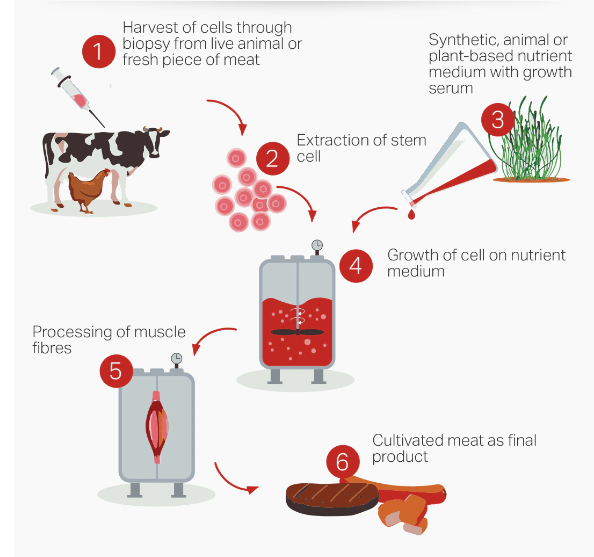
How a lab grown meat is made?
- Harvesting stem cells–Stem cells are harvested through biopsy from fresh piece of meat.
- Isolation -Isolate different types of cells (for instance muscle and fat cells).
- Growth -The cells are put in bioreactor that uses the principals of cell cultivation and tissue engineering for growth and reproduction.
- Differentiation - The cells are distributed onto “moulds” (scaffolds) to stimulate them to differentiate into connective tissues, muscles and fats giving the final product.
What are the impacts of meat industry?
- Produces carbon dioxide, methane and nitrous oxide.
- Inhumane treatment to animals.
- Usage of toxic pesticides to grow animal food.
- Prone to diseases.
- Deforestation and reducing agricultural lands.
- Consumption of more water.
According to the Food and Agriculture Organization of the United Nations (FAO) roughly 14.5% of global emissions of greenhouse gases are attributable to livestock farming
What is the significance of cultured meat?
- Reduce environmental impact-It could vastly reduce the environmental impact of global meat production in the future.
- Reduce emissions-Emissions from conventional animal agriculture could be reduced.
- Uses less water-It uses much less land and water than livestock.
- Renewable energy-It can run on energy produced purely from renewable sources.
- Prevent animal slaughter–Cultivated meat helps save animal slaughter.
- Food accessibility–Provides food accessibility to the population living in under-developed and strife-torn areas.
- High in nutrients- Lab-grown meat is high in protein, vitamins, and minerals and can be lower in fat and cholesterol than conventional animal meat.
Quick facts
Wo0lly mammoths
- The woolly mammoth is an extinct species of mammoth
- It lived during the Pleistocene until its extinction in the Holocene epoch.
- It was one of the last in a line of mammoth species, beginning with the African Mammuthus subplanifrons in the early Pliocene.
References
- The Indian │ Express Cultured Meat
- Swiss Info │ Cultured Meat Process



