Mains: GS-III- Ecology & Environment
Why in news?
Recently, the Karnataka Legislature unanimously passed a resolution rejecting the K. Kasturirangan Committee report to declare parts of the Western Ghats as an Ecologically Sensitive Area (ESA).
What is ESA and Karnataka’s case?
- Ecologically Sensitive Area (ESA) — Often referred to in India as an Eco-Sensitive Zone (ESZ)—is a protected buffer zone designated around National Parks, Wildlife Sanctuaries, and fragile ecosystems.
- Notified by the Ministry of Environment, Forest and Climate Change (MoEFCC) under the Environment (Protection) Act, 1986.
- These zones act as environmental "shock absorbers" to minimise the impact of human activity on wildlife and biodiversity.
- Typically, these zones extend up to 10 kilometres around a protected area, though the width can vary depending on crucial ecological corridors.
- Karnataka’s case – This was the 7th instance of the Karnataka government rejecting the draft, which was first published in 2014.
- Successive governments have acknowledged the Western Ghats as an ecologically sensitive region, but have highlighted the ESA’s impact on lives and livelihoods.
- There have been widespread protests over fears of loss of livelihood, as well as public consultations in the Malnad region.
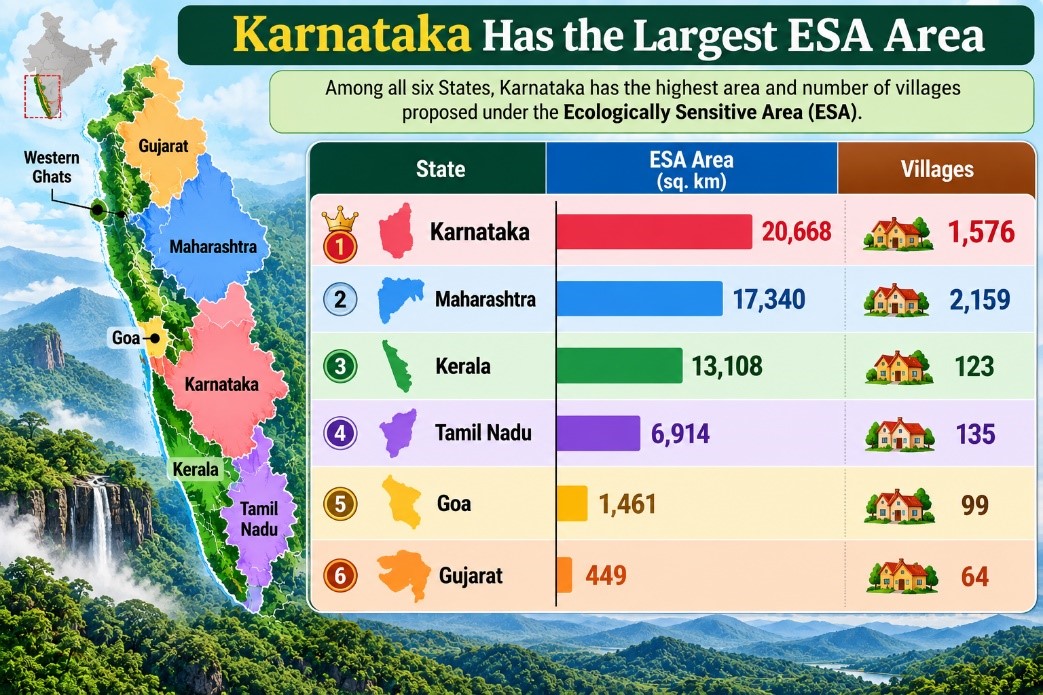
- Karnataka, largest ESA – Of the six Western Ghats States, Karnataka has the largest area to be notified as an ESA, spread across 10 districts.
What is the report?
- About the committee – The High-Level Working Group (HLWG), chaired by K. Kasturirangan, was tasked with reviewing the earlier Western Ghats Ecology Expert Panel (WGEEP), headed by Prof. Madhav Gadgil.
- Objective – To suggest measures to protect the fragile Western Ghats, recognised by UNESCO as one of the world’s ecological hotspots.
- Timeline of reports – The WGEEP submitted its report in 2011. The HLWG was set up in 2012 and submitted its recommendations in 2013.
- Recommendations by HLWG – Of the 1.64 lakh square kilometres of the Western Ghats, it recommended declaring 59,940 sq. km, covering 4,156 villages as ESA across Kerala, Karnataka, Tamil Nadu, Goa, Maharashtra and Gujarat.
- Key proposed changes –
- Currently, the area sought to be notified is 56,825 sq. km, mainly after Keralam undertook a ground survey and brought down its area to 9,993 sq. km.
- Subsequently, the number of villages in Maharashtra and Goa has increased, while the number has come down in Karnataka.
- As per the latest draft, a total of 4,402 villages will be part of the ESA.
- Final recommendation yet to be decided – The actual area is sought to be finalised based on the recommendations of the State governments, the views of stakeholders, and the ESA Expert Committee.
What are the key recommendations?
- Banned activities – Include mining, quarrying, sand extraction, setting up red-category industries, thermal power plants, construction of buildings beyond 20,000 square metres, township and large area development projects.
- Activities with conditions – It has subjected infrastructure and development projects to environmental clearances and allowed hydroelectricity projects with certain conditions.
- Mandatory Environmental clearance – All development projects located within 10 km of the Western Ghats ESA and requiring environmental clearance would be regulated under the provisions of the EIA Notification, 2006.
- It has recommended financial arrangements and incentives for Green Growth in the Western Ghats, and suggested a decision-support and monitoring centre.
How does it differ from the Gadgil report?
- Extent of area – The Gadgil Committee designated the entire Western Ghats as an ESA & estimated it to cover about 1.29 lakh sq. km.
- The Kasturirangan Committee identified 1.64 lakh sq. km as the Western Ghats, of which about 60,000 sq. km were sought to be declared ESA.
- Approach to initiate the conservation exercise – The Gadgil Committee recommended three categories of ESZ — 1, 2 and 3 — with corresponding restrictions and bans on activities.
- The Kasturirangan Committee divided the Western Ghats into natural and cultural landscapes, with the latter being areas that have helped sustain lives but have lost their original character over centuries.
- The prohibition or restriction of activities is sought to be implemented in the ESA.
What is Karnataka’s contention?
- Karnataka’s demand – The State has argued that the ESA should cover only notified forest areas and other forest areas, and should not include plantation areas, agriculture and horticulture fields, or residential and public areas.
- Concern on survey – Pointed out that the areas were demarcated using satellite data and not through a joint survey.
- Classification of land – There is no accurate bifurcation of revenue and forest land, and there is no reference to provide alternatives for livelihood.
- Need to consider pending issues – Like Bagair Hukum, forest rights, deemed forest, land grants, appeals, and legal cases should be considered.
- These issues should be examined by an expert committee through a physical survey.
- Against including entire villages – It has opposed the logic of including entire villages under the ESA because one-fifth of a village’s area may be forest.
- Fear of restriction – Genuine concerns have been expressed about possible restrictions on agriculture, housing and day-to-day activities by zealous forest officials.
- Misinformation about report – Alongside genuine concerns, misinformation has also spread.
- For example, though no restriction has been proposed on house building or renovation activities, ill-informed leaders at the local level are fuelling fears and anxiety that the measures would bring all such activities to a complete halt.
- Concern over land value – There is also concern over a possible loss in the value of agricultural and plantation land due to restrictions, which could result in reduced investment in agriculture.
What has Karnataka done now?
- Reject & demand time – Rejecting the report in its current form, the Karnataka government passed a unanimous resolution seeking one year to conduct a physical survey of the area and demanded that Karnataka’s part should not be finalised till then.
- High-Level Committee – It has announced the setting up of a high-level committee headed by a retired judge and comprising all stakeholders to review the shortcomings of the Kasturirangan report and recommend modifications.
- Following Keralam model – Cutting across party lines, legislators urged the government to follow the ‘Keralam model’, under which such physical verification was conducted and submitted to the Centre.
Reference
The Hindu | What is Karnataka’s objection to the ESA?



